DEFENCE & SECURITY — TURKEY-ORIGIN SOURCING
Defence & Security Procurement Governance from Turkey
Independent buyer-side procurement governance for international buyers engaging in defence and security procurement from Turkey. Structure your procurement before supplier commitment. No trading. No supplier representation. No commissions.
TURKEY’S POSITION IN THIS SECTOR
Why buyers engage in defence and security procurement from Turkey.
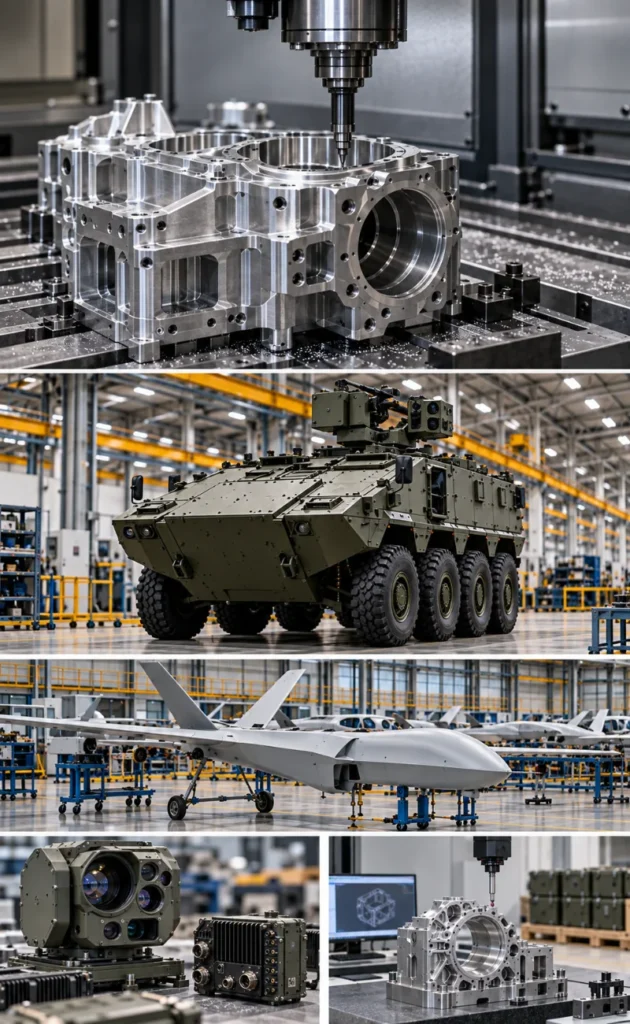
Turkey has an established and growing defence and security manufacturing base with documented export activity to NATO-aligned markets, EU countries, and regional destinations. The sector includes personal protective equipment, communication systems, security technologies, and specialised industrial manufacturing capabilities. Procurement in this category operates under controlled frameworks that require structural validation before any engagement begins.
- Established defence and security manufacturing base with NATO-aligned procurement experience in selected product categories
- State-affiliated entities and private manufacturers with documented export activity
- Capabilities across protective equipment, communication systems, security technologies, and specialised industrial manufacturing
- Geographic positioning supporting EU, Balkans, and MENA logistics routes
- Quality management systems aligned with defence and national standards where applicable
- Export-active manufacturers serving NATO-aligned and regional buyers in specific categories
- Authorised entity status not confirmed before engagement
- Export licence standing assumed without documentation review
- End-user certificate requirements not mapped before sourcing begins
- Controlled procurement documentation requirements not confirmed before supplier contact
- Dual-use classification not assessed before engagement
- QMS alignment with AQAP, ISO 9001, or equivalent standards not verified before RFQ
- Established defence and security manufacturing base with NATO-aligned procurement experience in selected product categories
- State-affiliated entities and private manufacturers with documented export activity
- Capabilities across protective equipment, communication systems, security technologies, and specialised industrial manufacturing
- Geographic positioning supporting EU, Balkans, and MENA logistics routes
- Quality management systems aligned with defence and national standards where applicable
- Export-active manufacturers serving NATO-aligned and regional buyers in specific categories
- Authorised entity status not confirmed before engagement
- Export licence standing assumed without documentation review
- End-user certificate requirements not mapped before sourcing begins
- Controlled procurement documentation requirements not confirmed before supplier contact
- Dual-use classification not assessed before engagement
- QMS alignment with AQAP, ISO 9001, or equivalent standards not verified before RFQ
Structure cannot be improvised on a NATO-aligned procurement project.
Defence and security procurement operates under controlled frameworks that require authorised entity verification, export documentation review, and documentation governance before any sourcing activity begins. Structural gaps that would cause delays in commercial procurement create compliance and supply chain risks that are significantly more consequential in this category.
REQUIREMENTS BY TARGET MARKET
Turkey does not change. Your target market does.
Defence and security procurement requirements vary significantly by destination country, applicable standards framework, product classification, and end-user structure. These requirements must be mapped before supplier engagement begins — improvisation at the execution stage creates programme, compliance, and supply chain risk.
European Union
- EU defence procurement frameworks applicable where EU directives apply
- Export control compliance under applicable EU dual-use regulation
- End-user certificate requirements vary by member state and product category
- Supplier QMS alignment with applicable standards
- Import documentation and customs requirements for controlled goods
- Country-specific national security and defence procurement requirements
United Kingdom
- UK export control licensing requirements where applicable
- MOD procurement framework requirements where applicable
- End-user certificate and assurance documentation
- UK customs and import documentation for controlled goods
- Defence Standards compliance where applicable
- Security vetting and supplier assurance requirements where applicable
NATO-Aligned Procurement
- AQAP standards where applicable
- NATO interoperability requirements for applicable product categories
- STANAG compliance where applicable
- Security classification handling requirements where applicable
- End-user certificate and transfer documentation requirements
- Supplier authorisation and qualification confirmation
Middle East & North Africa
- Country-specific defence import authorisation requirements
- End-user certificate requirements vary significantly by country
- Turkish export documentation review before engagement
- Import documentation and customs clearance for controlled goods
- Offset and industrial participation requirements where applicable
- Government-to-government or authorised channel requirements where applicable
PROCUREMENT TRAPS
The two most common structural failures in Turkey-origin defence procurement.
These are recurring exposure points in defence and security procurement from Turkey. Both can be reduced through structured verification before any commercial commitment is made.
Supplier presents without confirmed authorised entity status
Export licence standing assumed rather than reviewed
A Turkish entity presents itself as a defence supplier with product catalogues, technical documentation, and production capability claims. The entity's authorisation status — whether required authorisations, registrations, or licensing evidence applicable to the product category and destination are in place — has not been confirmed. Engaging with an entity that does not hold the required authorisation evidence creates supply chain, compliance, and programme delivery risk. Authorised entity status should be reviewed before any commercial engagement begins — regardless of how established the supplier appears.
A buyer proceeds with commercial engagement assuming that a Turkish supplier holds an active export licence for the relevant product category and destination. Export documentation and licence standing have not been reviewed against the specific product and market. Export documentation scope may differ by product configuration, destination, or applicable framework. Export standing should be reviewed before commercial engagement progresses — not assumed from past relationships or supplier claims.
WHERE SOURCING FAILS IN THIS CATEGORY
What buyers engaging in defence and security procurement from Turkey actually face.
Defence procurement challenges from Turkey are almost always structural — they emerge when authorisation status, export controls, and documentation governance are assumed rather than reviewed before engagement begins.
Manufacturer identity assumed rather than reviewed
Buyers engage with Turkish defence suppliers based on catalogues, trade fair contacts, or referrals without confirming whether the entity is a manufacturer, authorised supplier, group company, or intermediary. Entity role and counterparty clarity must be reviewed before engagement begins.
Documentation structure not mapped before supplier contact
Buyers initiate supplier contact before mapping documentation requirements such as end-user certificates, export documents, import authorisations, and quality assurance documentation. In controlled procurement environments, documentation structure cannot be defined reactively.
Dual-use classification not assessed before engagement
Some products connected to defence and security procurement may carry dual-use classifications that create export control obligations for both supplier and buyer. Classification risk must be reviewed before procurement structure is defined.
QMS and facility scope not confirmed before RFQ
RFQs are issued before confirming whether the supplier's QMS, certification scope, facility capability, and production responsibility match the procurement requirement. Scope mismatch creates programme schedule and execution risk.
DOCUMENTATION & AUTHORISATION MAP
What defence and security buyers need reviewed before supplier engagement.
The authorisation and documentation requirements below are commonly applicable and frequently left unconfirmed in Turkey-origin defence and security procurement. Requirements vary by product category, destination country, and applicable procurement framework. Each should be reviewed before supplier engagement begins.
What it covers
Review that the Turkish supplier holds the required authorisations, registrations, or licensing evidence applicable to the specific product category and destination country. Includes confirmation that the contracting entity is the actual manufacturer or authorised supplier — not an intermediary presenting without disclosure.
Common gap in Turkey sourcing
Entity presents with catalogue and capability claims without authorisation status being independently reviewed. Status assumed from past supply, referral, or trade fair contact — none of which constitute verified authorisation. Entity classification must be the first step, not an assumption.
What it covers
Review of export documentation and licence evidence covering the specific product, product configuration, and destination country for the procurement where applicable. Turkish export control regulations govern controlled items — licence currency, scope, and destination coverage must be confirmed.
Common gap in Turkey sourcing
Export licence assumed to be in place; licence currency, product scope, and destination country coverage not independently reviewed before commercial engagement. Export documentation structure must be mapped before procurement structure is defined — not assumed at execution stage.
What it covers
Documentation confirming the authorised end-user and intended use of the product in the destination country — required by Turkish export authorities and destination country import procedures where applicable. Format and content requirements vary by product category and country.
Common gap in Turkey sourcing
EUC requirements not mapped before engagement begins. Certificate format and content requirements vary by country and are frequently not confirmed before the sourcing structure is defined — creating delays or compliance exposure at export clearance stage.
What it covers
Assessment of whether the product falls within dual-use export control classifications under Turkish regulations and applicable international frameworks. Dual-use classification creates export control obligations for both supplier and buyer — independent of whether the product is categorised as defence equipment.
Common gap in Turkey sourcing
Dual-use classification not assessed before procurement structure is defined; export control obligations identified only after commercial decisions are made. Classification risk must be reviewed at the specification stage — before supplier engagement begins.
What it covers
NATO Allied Quality Assurance Publication standards applicable to defence procurement — AQAP-2110 for design and development, AQAP-2120 for production. Required for procurement by NATO member armed forces where AQAP compliance is specified in the contract or procurement condition.
Common gap in Turkey sourcing
Quality management system alignment with AQAP standards not confirmed before RFQ is issued; ISO 9001 held but AQAP requirements not separately confirmed. ISO 9001 does not equal AQAP compliance — they are distinct frameworks with different audit and documentation requirements.
What it covers
NATO Standardization Agreements define technical standards for interoperability of equipment, procedures, and systems across NATO member forces. Where a specific STANAG is referenced in procurement documentation, supplier compliance must be confirmed against the exact STANAG version and scope.
Common gap in Turkey sourcing
STANAG compliance claimed without confirmation that the supplier's product or process has been tested or qualified against the specific STANAG version referenced in the procurement. General NATO-supplier claims do not constitute STANAG compliance — specific agreement and version confirmation is required.
What it covers
Quality management system certification covering production process controls, documentation, and continual improvement — baseline requirement for most defence and security procurement. Does not substitute for AQAP compliance where NATO standards are specified.
Common gap in Turkey sourcing
Certificate scope may not cover the specific production facility or product line relevant to the procurement. Facility-level scope and legal entity traceability must be confirmed before any RFQ is issued.
What it covers
Official documentation confirming country of origin for customs clearance, import duty classification, and export control purposes. For defence and security products, origin documentation may also be required as part of the end-user certificate and procurement compliance package.
Common gap in Turkey sourcing
Document type required varies by destination market and product category. For products with components sourced from multiple countries, origin determination under applicable rules of origin must be confirmed before shipment — particularly relevant for controlled items where origin affects export licence applicability.
What it covers
Review that the Turkish supplier holds the required authorisations, registrations, or licensing evidence for the specific product category and destination country. Entity classification must be the first step — not an assumption.
Common gap
Entity presents with catalogue and capability claims without authorisation status being independently reviewed. Status assumed from past supply or referral.
What it covers
Export licence evidence covering the specific product, configuration, and destination country. Licence currency, scope, and destination coverage must be confirmed.
Common gap
Export licence assumed to be in place; currency, product scope, and destination country coverage not independently reviewed before commercial engagement.
What it covers
Confirms the authorised end-user and intended use in the destination country. Required by Turkish export authorities and destination country import procedures where applicable.
Common gap
EUC requirements not mapped before engagement. Format and content requirements vary by country — frequently not confirmed before the sourcing structure is defined.
What it covers
Assessment of whether the product falls within dual-use export control classifications under Turkish regulations and applicable international frameworks.
Common gap
Classification not assessed before procurement structure is defined; export control obligations identified only after commercial decisions are made.
What it covers
NATO quality assurance standards — AQAP-2110 for design and development, AQAP-2120 for production. Required where specified in NATO member procurement contracts.
Common gap
ISO 9001 held but AQAP requirements not separately confirmed. ISO 9001 does not equal AQAP compliance — they are distinct frameworks with different requirements.
What it covers
NATO Standardization Agreements for interoperability of equipment and procedures across NATO member forces. Compliance must be confirmed against the exact STANAG version referenced in procurement documentation.
Common gap
STANAG compliance claimed without confirmation that the product has been tested or qualified against the specific STANAG version. General NATO-supplier claims do not constitute STANAG compliance.
What it covers
Quality management system covering production process controls and documentation — baseline for most defence procurement. Does not substitute for AQAP compliance where NATO standards are specified.
Common gap
Certificate scope may not cover the specific production facility or product line. Facility-level scope must be confirmed before any RFQ is issued.
What it covers
Official documentation confirming country of origin for customs clearance and export control purposes. For defence products, may also form part of the EUC and procurement compliance package.
Common gap
For products with components from multiple countries, origin determination must be confirmed before shipment — particularly relevant for controlled items where origin affects export licence applicability.
KEY VERIFICATION AREAS
What we verify in defence and security procurement.
These are the specific verification points applied in every defence and security procurement engagement. Each area addresses a known structural gap in Turkey-origin defence procurement, and each is confirmed before any supplier advances to commercial engagement.
WHAT YOU RECEIVE
Structured outputs at the end of each engagement stage.
Every defence and security procurement engagement produces documented outputs at each stage. These structured deliverables inform your procurement decisions before any supplier advances to commercial engagement.
SCOPE BOUNDARIES
What this engagement does not cover.
Clarity on scope boundaries is particularly important in defence procurement. The following activities are outside the scope of Hana Solution’s defence and security procurement engagement — regardless of how the request is framed.
HOW HANA SOLUTION WORKS IN THIS SECTOR
Governance applied to defence and security procurement from Turkey.
The same six-stage governance sequence is applied to every engagement. In defence and security procurement, authorised entity review, export documentation review, and documentation structure mapping are the highest-priority steps before any supplier contact begins.
Sourcing Direction & Strategy
Product category, destination country requirements, applicable procurement framework, and documentation structure defined before any supplier contact begins.
Supplier Mapping & Shortlisting
Turkey-origin defence manufacturers and authorised suppliers identified against defined criteria. Entities without confirmed authorisation separated before shortlist formation.
Supplier Verification & Risk Screening
Authorised entity status, export licence standing, QMS alignment, and counterparty risk assessed for each shortlisted supplier.
RFQ Governance & Quotation Analysis
Technical specification and documentation requirements standardised before RFQ is issued. Quotations normalised for scope and delivery conditions before price assessment begins.
Production Monitoring & Factory Visits
Production milestones tracked independently. QMS compliance and specification adherence monitored during active orders.
Shipment Process Management
Export document set reviewed and destination import requirements confirmed before departure.
Sourcing Direction & Strategy
Product category, destination country requirements, applicable procurement framework, and documentation structure defined before any supplier contact begins.
Supplier Mapping & Shortlisting
Turkey-origin defence manufacturers and authorised suppliers identified. Entities without confirmed authorisation separated before shortlist formation.
Supplier Verification & Risk Screening
Authorised entity status, export licence standing, QMS alignment, and counterparty risk assessed for each shortlisted supplier.
RFQ Governance & Quotation Analysis
Technical specification and documentation requirements standardised before RFQ is issued. Quotations normalised for scope and delivery conditions before price assessment begins.
Production Monitoring & Factory Visits
Production milestones tracked independently. QMS compliance and specification adherence monitored during active orders.
Shipment Process Management
Export document set reviewed and destination import requirements confirmed before departure.
RELATED SOLUTIONS
Each service is available as a standalone engagement.
You do not need to engage the full governance sequence. Start where your defence and security procurement situation requires.
Sourcing Direction & Strategy
Define product category, documentation structure, dual-use considerations, and procurement framework before any supplier contact begins.
View Service → Step 02Supplier Mapping & Shortlisting
Identify authorised Turkey-origin defence suppliers. Entities without confirmed authorisation status separated before shortlist formation.
View Service → Step 03Supplier Verification & Risk Screening
Authorised entity status confirmation, export licence standing review, QMS alignment assessment, and counterparty risk screening before commercial engagement.
View Service → Step 04RFQ Governance & Quotation Analysis
Technical specification and documentation requirements standardised. Quotations normalised before price comparison begins.
View Service → Step 05Production Monitoring & Factory Visits
Independent milestone tracking, QMS compliance monitoring, and pre-shipment coordination for active defence procurement orders.
View Service → Step 06Shipment Process Management
Export licence documentation, end-user certificate, and conformity documents confirmed in shipment set before departure.
View Service →Define product category, documentation structure, dual-use considerations, and procurement framework before any supplier contact begins.
View Service →Identify authorised Turkey-origin defence suppliers. Entities without confirmed authorisation status separated before shortlist formation.
View Service →Authorised entity status confirmation, export licence standing review, QMS alignment assessment, and counterparty risk screening before commercial engagement.
View Service →Technical specification and documentation requirements standardised. Quotations normalised before price comparison begins.
View Service →Independent milestone tracking, QMS compliance monitoring, and pre-shipment coordination for active defence procurement orders.
View Service →Export licence documentation, end-user certificate, and conformity documents confirmed in shipment set before departure.
View Service →FREQUENTLY ASKED QUESTIONS
What buyers ask before defence and security procurement from Turkey.
What does "authorised entity" mean in the context of Turkish defence procurement?
Why must export licence standing be confirmed before commercial engagement?
What is a dual-use product and why does it matter for procurement from Turkey?
Can Hana Solution verify a Turkish defence supplier we have already been working with?
Does Hana Solution represent or recommend specific defence suppliers?
What does "authorised entity" mean in the context of Turkish defence procurement?
START HERE
Start defence and security procurement with structure before engagement.
Submit your procurement requirements and destination market. We establish the procurement structure, map authorisation and documentation requirements, and confirm whether a controlled engagement is the right next step — before supplier contact begins.