
SOURCING FROM TURKEY BY INDUSTRY
Sourcing From Turkey? Find the Right Industry for Your Product.
Supplier capability, certification, MOQ, production risk and shipment readiness vary by product category. Choose the industry closest to your requirement to see what international buyers should assess before moving forward with a Turkish manufacturer.
Hana Solution LLC supports international buyers sourcing from Turkey with supplier search, verification and on-the-ground support across these manufacturing sectors.
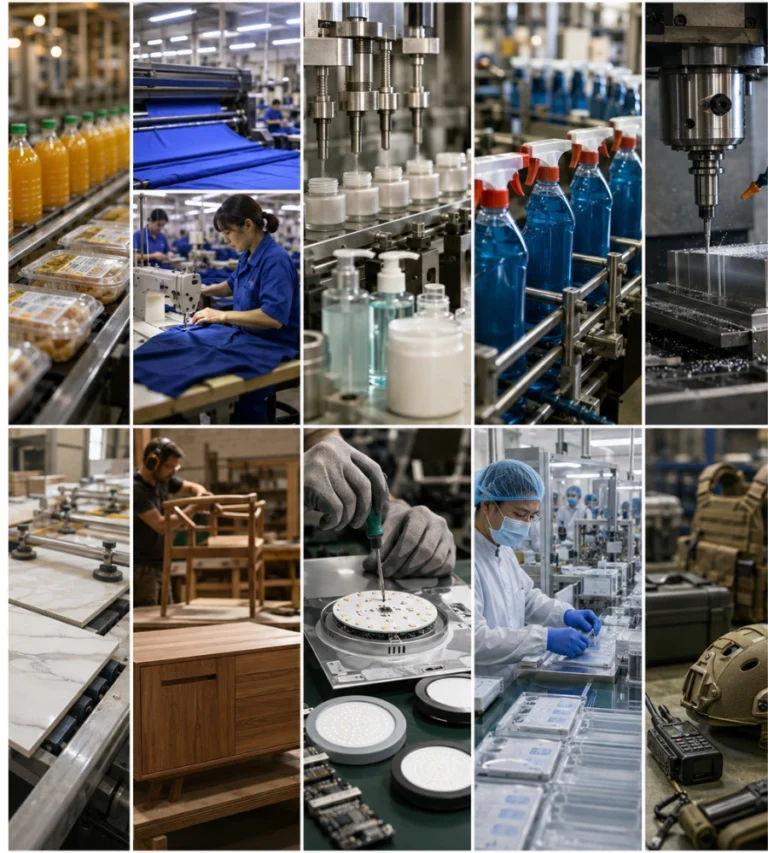
EXPLORE BY INDUSTRY
What Are You Sourcing From Turkey?
Choose the category closest to your product. Each industry page covers relevant product groups, supplier risks, compliance requirements and buying issues to assess before proceeding with a Turkish manufacturer.
Showing industries 1–4 of 10
-
Food & FMCG
Need suppliers or manufacturers that can meet your product, private-label, packaging and destination-market requirements — and be verified before you commit?
Product examples Packaged and private-label foods, nuts and dried fruits, ingredients, beverages and food-service products
Explore Food & FMCG Sourcing in Turkey → -
Textile & Apparel
A manufacturer may offer the right product category but still fall short on fabric specifications, certification scope, MOQ or production consistency.
Product examples Underwear, sleepwear, workwear, apparel and home textiles
Explore Textile Sourcing in Turkey → -
Cosmetics & Personal Care
Supplier suitability depends on formulation capability, documentation, packaging compatibility, private-label options and production conditions.
Product examples Skincare, haircare, personal hygiene and private-label cosmetics
Explore Cosmetics Sourcing in Turkey → -
Cleaning Products
Looking for a supplier that can align formulation, safety documentation, labelling, packaging and private-label requirements?
Product examples Household cleaners, professional cleaning products and detergents
Explore Cleaning Product Sourcing in Turkey → -
Machinery & Industrial Equipment
Supplier suitability depends on whether drawings, materials, tolerances, testing capability and after-sales requirements can actually be met.
Product examples Industrial machinery, fabricated equipment, components and production systems
Explore Machinery Sourcing in Turkey → -
Construction Materials
A product may appear commercially suitable while technical standards, dimensions, test reports, finishes or project lead times remain unresolved.
Product examples Building materials, architectural products, fixtures and project components
Explore Construction Material Sourcing in Turkey → -
Furniture & Interior Products
Need a manufacturer that can control materials, finishes, dimensions, customisation, production consistency and export packaging?
Product examples Residential furniture, hospitality furniture, joinery and interior products
Explore Furniture Sourcing in Turkey → -
Electrical & Lighting
Product suitability depends on technical specifications, component quality, testing, safety documentation and destination-market compatibility.
Product examples Lighting products, electrical components, fixtures and control equipment
Explore Electrical & Lighting Sourcing in Turkey → -
Medical Products
A supplier may operate in the medical sector without having the regulatory status, quality systems, documentation or traceability required for the product.
Product examples Medical consumables, healthcare products, equipment and related supplies
Explore Medical Product Sourcing in Turkey → -
Defence & Security
Need to clarify manufacturer eligibility, controlled specifications, documentation, end-use conditions or institutional purchasing requirements?
Product examples Protective equipment, field systems, security technologies and institutional supplies
Explore Defence & Security Sourcing in Turkey →
WHAT CHANGES BY INDUSTRY
What Changes by Industry When Sourcing From Turkey?
The evidence a buyer needs changes with the product. A textile manufacturer, machinery producer and medical supplier cannot be assessed against the same manufacturing, documentation or shipment criteria.
Capability must match the actual product, not only the supplier’s catalogue. In textiles, this may mean fabric composition, stitching and production consistency; in machinery, it may mean material grades, tolerances and testing capability.
Required evidence depends on the product and destination market. Food and cosmetics may require formulation, labelling and shelf-life documentation, while electrical and medical products may require technical, safety or regulatory records. Defence and security procurement may also involve manufacturer eligibility, controlled specifications and end-use documentation.
Order suitability changes with MOQ, tooling, sampling, customisation, capacity and lead time. Private-label cosmetics and cleaning products may depend on formulation and packaging minimums, while machinery, furniture and construction material orders may depend on drawings, project quantities and production capacity.
Readiness must be judged against product-specific checks. Furniture may require finish consistency and export packaging, while food, medical and electrical products may require labelling, traceability, test records or specific packing conditions before dispatch.
REAL BUYER-SIDE PROJECTS
Selected Findings From Buyer-Side Projects.
These examples show what changed when supplier claims, documents and order status were checked against the buyer’s actual requirement. Only selected findings are shown; full project context is available in the linked case studies.
-
TEXTILE & APPAREL
2 of 4 Certificates Covered Only Yarn.
Four Turkish garment quotations were reviewed for an EU/UK buyer. Two OEKO-TEX certificates covered yarn rather than the finished garments being quoted.
View the Textile Quotation Case →BUYER IMPACT
The buyer did not advance those two offers. The remaining two were compared on one common delivery, payment and documentation basis.
-
MACHINERY & INDUSTRIAL EQUIPMENT
1 Trader Excluded Before RFQ.
Three Turkish packaging machinery candidates were checked before RFQ. One operated as a trading company, and another submitted an expired CE-related certificate.
View the Machinery Verification Case →BUYER IMPACT
The buyer excluded the trader and advanced two manufacturers to RFQ, one of them conditionally.
-
MACHINERY & INDUSTRIAL EQUIPMENT
610 Units Ordered, None Shipment-Ready.
After missed loading dates, the supplier reported the goods as ready and asked for a further advance. A factory visit found about 490 units on site, unpacked and without quality-control evidence.
View the Factory Visit Case →BUYER IMPACT
The buyer did not release the further payment and moved to a formal recovery decision based on the verified order position.
Project 1 of 3
INDUSTRY SOURCING INSIGHTS
What Should You Verify Before Sourcing From Turkey?
These selected guides answer product- and market-specific questions that can change whether a Turkish supplier is suitable, what the order will cost or whether the product can enter the destination market. Choose the issue closest to your product or market.
-
TEXTILE & APPAREL
Does the OEKO-TEX Certificate Cover the Finished Product?
A valid certificate may cover yarn or fabric rather than the finished garment. Check the product scope, class, certificate number and expiry date before accepting the supplier’s compliance claim.
Read the OEKO-TEX Verification Guide → -
COSMETICS & PERSONAL CARE
Is the Turkish Cosmetics Manufacturer Ready for the US Market?
FDA facility registration does not confirm that the whole order is compliant. Check the FEI number, registration status, US Agent, Responsible Person and product-listing responsibility before placing a US-bound order.
Read the FDA Registration Checklist → -
MACHINERY & INDUSTRIAL EQUIPMENT
How Do US Tariffs Affect Machinery Sourced From Turkey?
US import duties can depend on HTS classification, material content and active trade measures. Confirm the current tariff treatment before treating a Turkish supplier quotation as the final landed cost.
Read the US Machinery Tariff Guide → -
CONSTRUCTION MATERIALS
Is the Supplier a Manufacturer or a Trading Company?
A polished website, catalogue or showroom does not prove manufacturing capability. Check the production site, capacity, document trail and contracting company before requesting quotations or placing an order.
Read the Construction Supplier Verification Guide → -
ELECTRICAL & LIGHTING
Does the Lighting Product Have the EPREL Registration Required for the EU?
CE marking does not replace EPREL registration. Match the quoted model to its EPREL record, product information sheet and QR code before ordering lighting products for the EU market.
Read the EPREL Market Access Guide → -
MEDICAL PRODUCTS
Does the ISO 13485 Certificate Cover the Medical Product You Are Buying?
A genuine ISO 13485 certificate may cover a different product, process, legal entity or manufacturing site. Check the scope and location, then confirm any separate EU MDR requirements before choosing the supplier.
Read the ISO 13485 Scope Guide →
6 industry insights available
OTHER PRODUCT CATEGORIES
Is Your Product Outside the Listed Industries?
The 10 categories above represent our primary working scope. If your product does not clearly fall into one of these categories or is difficult to classify, send us the product details, target market, required quantity and current sourcing stage. We will review whether the requirement is suitable for supplier search, verification or on-the-ground support in Turkey before any work begins.
INDUSTRY SOURCING FAQ
Questions Buyers Ask Before Sourcing From Turkey by Industry.
The product category changes what a buyer should confirm about the manufacturer, documentation, certification, production capability and destination-market requirements.
INDUSTRY-SPECIFIC BUYER QUESTIONS
Sourcing From Turkey by Industry
Open the question that best matches the supplier or product issue you need to evaluate.
01 Do supplier requirements change by industry? +
Yes. A textile supplier may need to confirm fabric composition, stitching capability and OEKO-TEX scope, while a machinery producer may need to provide technical drawings, traceable material certificates and independent testing records.
The correct evidence depends on the product, its intended use and the destination market.
02 Does Hana Solution LLC work across all ten industries listed above? +
Yes. Each of the ten industries has a dedicated page covering relevant product groups, supplier risks and verification points.
We review the exact requirement first and proceed only when the project fits our buyer-side sourcing or on-the-ground support scope in Turkey.
03 Is a valid certificate enough to approve a Turkish supplier? +
No. A certificate must match the correct legal entity, product, model, manufacturing site, process and validity period.
Buyers should also confirm whether separate destination-market registrations, test reports, labelling records or product documentation are required.
04 Can a supplier be suitable for one market but not another? +
Yes. The same product may face different safety, labelling, registration, testing or documentation requirements in the EU, UK, US or another destination market.
Supplier suitability should therefore be checked against the market where the product will actually be sold or used.
05 What if my product does not clearly fit one of the listed industries? +
You can still submit the requirement through the project brief.
Send the product details, target market, expected quantity and current sourcing stage. We will review whether the requirement is suitable before any work begins.
06 What information should I provide before supplier search or verification begins? +
Provide the product specifications or drawings, target market, required quantity, certification or testing needs, packaging requirements, expected timeline and any current supplier information.
Clear input helps determine which Turkish manufacturers and product-specific checks are relevant from the start.
START YOUR TURKEY SOURCING PROJECT
Share Your Product and Target-Market Requirements.
If you are sourcing from Turkey, tell us what product you need, the required quantity, where it will be sold and your current sourcing stage. We will review the requirement and confirm the appropriate next step before any work begins.
- Buyer-Side Only
- No Commissions
- No Trading