
ELECTRICAL LIGHTING SOURCING TURKEY
Electrical & Lighting Sourcing in Turkey for International Buyers
Hana Solution LLC helps international buyers find, assess and verify Turkish electrical equipment and lighting manufacturers against defined product, technical specification, quantity and destination-market requirements.
Already have a supplier, quotation, sample or active electrical or lighting order in Turkey? We can verify the supplier, compare offers and provide buyer-side visibility through production, testing status, documentation and shipment readiness.
- 20+ Years Procurement & Logistics
- Fixed-Fee, Phase-Based
- No Supplier Commissions or Mark-Ups
- No Trading
Where Are You in Your Electrical & Lighting Sourcing Process?
Start with the situation closest to your current buying stage—whether you are assessing Turkey, looking for manufacturers, checking an existing supplier, comparing technical quotations, following production or preparing an order for shipment.
Not Sure Whether Turkey Fits Your Electrical or Lighting Requirement?
Your product type, technical specification, voltage or rating, application, quantity, customisation, target cost or destination-market requirements may need clarification before manufacturer search begins.
Service: Turkey Manufacturing Fit Assessment
Assess Manufacturing Fit →Need Electrical or Lighting Manufacturers in Turkey?
Identify and shortlist Turkish manufacturers against the actual product, technical specification, manufacturing capability, quantity, customisation and destination-market requirements—not simply against a general catalogue or product category.
Service: Supplier Mapping & Shortlisting
Find Suitable Manufacturers →Already Have a Turkish Electrical or Lighting Supplier?
Check the named supplier’s legal identity, manufacturer versus trader status, actual production facility, relevant manufacturing capability, supplier-provided technical documents and claimed certification or testing scope before further commitment.
Service: Supplier Verification & Risk Screening
Verify Your Supplier →Preparing an RFQ or Comparing Technical Quotations?
Compare supplier offers against the same product configuration, technical ratings, components, materials, performance, testing, documentation, packaging, quantity, Incoterms, payment terms and lead time.
Service: RFQ & Quote Comparison
Compare Supplier Quotations →Is Your Electrical or Lighting Order Already in Production?
Establish independent visibility over approved configuration, component status, production progress, completed quantities, testing, open technical issues, delays and unresolved points.
Service: Production Monitoring & Factory Visits
Monitor Your Active Order →Has the Supplier Reported the Order Ready for Shipment?
Confirm finished quantities, product identification, available test or technical documents, labelling, accessories, packing, open issues and actual collection readiness before the goods move.
Service: Shipment Readiness & Coordination
Check Shipment Readiness →What Should Buyers Check Before Choosing a Turkish Electrical or Lighting Manufacturer?
A supplier may offer the right general product and still be the wrong manufacturing fit. Buyers need to understand whether the technical specification, components, production capability, testing evidence, documentation and commercial scope match the actual requirement.
Can the Manufacturer Meet the Actual Electrical or Lighting Requirement?
Product selection should begin with the actual technical requirement, not with a visually similar catalogue model.
View technical criteria
Depending on the product, relevant factors may include voltage, frequency, power, dimensions, materials, electrical ratings, protection level, intended environment and application.
For lighting, this may also include luminous output, efficacy, colour temperature, CRI, optics, dimming or control requirements and housing construction.
A similar-looking product is not necessarily the same technical product.
Who Is Actually Manufacturing the Product?
The company quoting or exporting the product may not be the facility actually producing or assembling it.
View supplier checks
The supplier may be the actual manufacturer, an assembler, brand owner, exporter, distributor or trader using another production facility.
- contracting entity
- actual production site
- assembly responsibility
- outsourced processes
- relevant manufacturing capability
- testing responsibility
- product and document traceability
Use of subcontractors is not automatically a problem. Lack of clarity about who produces and controls the product is.
Can the Factory Produce the Required Configuration Consistently?
Electrical and lighting products can depend heavily on components, subassemblies, testing capability and repeatability.
View production criteria
- LED modules or light sources
- drivers and control gear
- electrical components
- conductors and cabling
- PCB or electronic assemblies where relevant
- metal or plastic housings
- switching or protection components
- assembly capability
- testing capability
- OEM or private-label production
- repeatability across the order
A manufacturer’s general capability does not automatically prove that the required configuration can be produced consistently at the required volume.
Do the Documents Apply to the Actual Product Being Purchased?
Certificates, declarations and test reports should relate to the actual manufacturer, model, configuration and scope being purchased.
View documentation criteria
- Declaration of Conformity
- technical data sheets
- model identification
- test reports
- applicable standards
- CE-related documentation
- LVD or EMC evidence where applicable
- RoHS documentation
- ecodesign or energy-labelling information
- EPREL information where applicable
- destination-specific approval or listing requirements
For EU electrical equipment, LVD applies only to equipment within defined voltage limits, while EMC requirements address equipment that can generate or be affected by electromagnetic disturbance.
For lighting, EU energy-labelling and EPREL obligations concern applicable light sources, not every lighting product in the same way.
Are the Suppliers Quoting the Same Electrical or Lighting Product?
Two products can look similar while differing materially in specification, components, performance and commercial scope.
View comparison criteria
Lighting
- LED source or module
- driver
- wattage and lumen output
- efficacy and CRI
- colour temperature
- optics and dimming
- housing material
- IP rating
- testing basis
- warranty and packaging
Electrical Equipment
- conductor or component specification
- ratings
- protection devices
- enclosure
- accessories and materials
- standards and test basis
- documentation
- commercial exclusions
Quotation comparison should begin with scope alignment—not unit-price ranking.
Does the Finished Order Match the Approved Requirement?
Once production is active, reported completion should be checked against the approved product and actual collection requirements.
View readiness criteria
- approved configuration
- key components
- produced quantities
- test status
- open defects or rework
- model and product identification
- labels
- accessories
- packaging
- outstanding documents
- collection readiness
A supplier stating that production is “complete” does not by itself establish shipment readiness.
TYPICAL ELECTRICAL & LIGHTING SCOPE
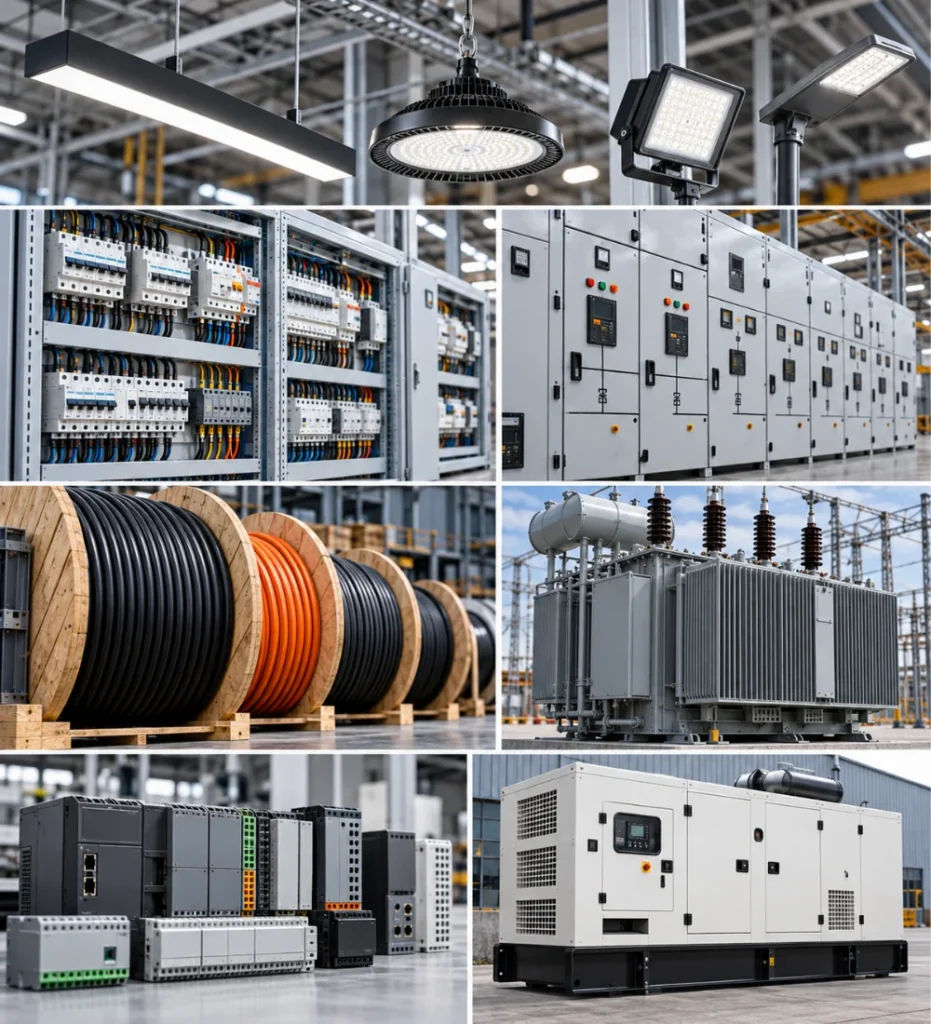
Electrical Products, Lighting and Components We Can Assess
Finished products, project equipment, OEM and private-label
manufacturing, electrical components and lighting products.
Electrical Products, Lighting and Components We Can Assess
Finished products, project equipment, OEM and private-label manufacturing, electrical components and lighting products.
Hana Solution LLC does not work from a fixed electrical product catalogue. Buyer requirements may involve finished products, OEM or private-label manufacturing, project equipment or defined electrical and lighting components.
Depending on the requirement, sourcing may involve Turkish lighting manufacturers, cable manufacturers, switchgear and electrical panel producers, transformer or generator manufacturers, or suppliers of defined automation and electrical components.
This is not an electrical or lighting catalogue or an exhaustive product list. If you need an electrical product, lighting product, component or project-specific manufactured item from Turkey, submit the requirement and Hana Solution LLC will first assess whether it fits our sourcing scope.
TECHNICAL DOCUMENTATION · TESTING · COMPLIANCE
Requirements Depend on the Product and Destination Market
Documentation and testing requirements vary by product,
configuration, technical characteristics, use and destination.
Requirements Depend on the Product and Destination Market
Documentation and testing requirements vary by product, configuration, technical characteristics, use and destination.
Electrical and lighting compliance should not be reduced to a CE mark, certificate file or a single testing claim.
The applicable requirements depend on the exact product, technical characteristics, use and destination market.
Within an agreed assignment, Hana Solution LLC may request and organise supplier-provided declarations, technical documents, test reports and certification records; compare them with the stated model, manufacturer, facility and requirement; identify visible scope or traceability gaps; and coordinate agreed independent inspection or testing where required.
Low Voltage & EMC Requirements
For relevant EU-bound electrical products, requirements can include the Low Voltage Directive and EMC Directive depending on the product and its characteristics.
The European Commission states that LVD 2014/35/EU covers electrical equipment operating within 50–1000 V AC or 75–1500 V DC.
European Commission — Low Voltage Directive ↗Energy Labelling & EPREL
Energy-labelling and EPREL obligations should be checked against the actual lighting product configuration.
Current EU requirements apply to relevant light sources, including certain light sources placed on the market within containing products. Ecodesign requirements can also apply to light sources and separate control gear.
European Commission — Light Sources ↗US, Balkan & MENA Markets
For US, Balkan and MENA destinations, applicable approval, testing, certification or listing requirements should be checked against the actual product and destination.
The buyer’s destination country and product configuration determine what needs to be verified. Hana Solution LLC does not assume that one certification route applies across all electrical or lighting products or markets.
Hana Solution LLC does not issue product certificates, perform laboratory testing, certify products, act as the manufacturer responsible for CE marking, act as a notified body, provide electrical engineering approval or act as a regulatory authority.
Where applicable, Hana Solution LLC can review supplier-provided evidence for visible scope and traceability issues and coordinate qualified independent testing or inspection as agreed.
Why Does Buyer-Side Independence Matter in Electrical & Lighting Sourcing?
Electrical and lighting products can appear commercially similar while differing materially in components, ratings, technical performance, testing evidence and documentation.
Independent buyer-side support keeps the comparison focused on what the buyer actually specified and what the available evidence supports.
Is the Supplier Being Assessed Against Your Actual Requirement?
Hana Solution LLC does not begin with a preferred electrical manufacturer, lighting brand or supplier catalogue.
Supplier assessment begins with the buyer’s actual product, technical specification, quantity, application and destination-market requirements.
Are the Products and Quotations Genuinely Comparable?
Two suppliers may offer visually similar or similarly described products while using different components, electrical ratings, housings, drivers, light sources, protection levels, test bases, warranties or documentation.
Those differences should be visible before price becomes the deciding factor.
Are Supplier Claims Supported by Evidence Relevant to the Product?
Manufacturer status, technical capability, certificate scope, test reports, product performance, production progress and shipment readiness should not automatically be accepted because they appear in a catalogue, quotation or supplier update.
Evidence should relate to the actual supplier, factory, model, configuration and decision being made.
Could Supplier-Side Compensation Influence the Recommendation?
Hana Solution LLC does not manufacture or sell electrical or lighting products, trade, hold inventory, represent suppliers, receive supplier commissions or add supplier mark-ups.
Our professional fee does not increase because a particular manufacturer wins the order or because a higher-priced quotation is selected.
The final supplier, technical and purchasing decision remains with the buyer.
ELECTRICAL LIGHTING SOURCING TURKEY
Electrical Lighting Sourcing Turkey: Practical Buyer Questions
Looking for electrical equipment or lighting manufacturers in Turkey, checking an existing supplier, comparing technical quotations or managing an active order? These practical questions explain where Hana Solution LLC can support your sourcing requirement.
PRACTICAL BUYER QUESTIONS
Electrical Lighting Sourcing Turkey FAQ
Open the question that best matches your current electrical or lighting sourcing stage.
01 Can Hana Solution LLC Find Electrical and Lighting Manufacturers in Turkey? +
Yes. Supplier Mapping & Shortlisting can identify Turkish electrical equipment and lighting manufacturers against the buyer’s actual product, technical specification, quantity, manufacturing capability and destination-market requirements.
The result is a focused requirement-based shortlist rather than a directory of electrical companies or lighting catalogues.
Shortlisting does not mean that a supplier has already been independently verified or technically approved.
Find Suitable Manufacturers →02 What Types of Electrical and Lighting Products Can Hana Solution LLC Source From Turkey? +
Requirements may involve lighting products, LED light sources and control gear, cables and conductors, switchgear, electrical panels and distribution equipment, wiring accessories, transformers, generators, automation and control equipment, and other defined electrical components.
Depending on the requirement, sourcing may involve Turkish lighting manufacturers, cable manufacturers, switchgear and electrical panel producers, transformer or generator manufacturers, or suppliers of defined automation and electrical components.
Hana Solution LLC does not work from a fixed catalogue. Supplier suitability depends on the specific product, technical requirement, production model, quantity and destination market.
03 Can You Verify a Turkish Electrical or Lighting Supplier We Already Found? +
Yes.
Verification can focus on the named legal entity, actual production facility, manufacturer versus trader status, relevant manufacturing capability, supplier-provided technical documents, test reports and agreed verification points.
Verification is evidence-based and scope-specific. Hana Solution LLC does not certify suppliers or guarantee future performance.
Verify Your Supplier →04 Can You Compare Technical Quotations From Turkish Electrical or Lighting Manufacturers? +
Yes.
Supplier quotations can be compared against a common technical and commercial basis, including product configuration, ratings, components, materials, performance, testing, documentation, accessories, packaging, quantity, lead time, Incoterms, payment terms and exclusions.
Where suppliers are not quoting the same technical scope, those differences should be identified before price ranking continues.
Compare Supplier Quotations →05 Can Hana Solution LLC Review CE, LVD, EMC, RoHS, EPREL or Other Product Documentation? +
Where these requirements are relevant to the product, destination market and agreed assignment, Hana Solution LLC can review supplier-provided records for scope, model traceability, manufacturer consistency and visible documentation gaps.
The applicable framework depends on the product. For example, EU LVD applies only within its defined voltage range, while energy-labelling and EPREL requirements for lighting concern applicable light sources rather than every lighting product indiscriminately.
Hana Solution LLC does not issue certificates, perform regulatory approval or replace qualified laboratories, notified bodies, engineering specialists or regulatory advisers where those are required.
European Commission — Electrical & Electronic Engineering Industries ↗
06 Can Hana Solution LLC Visit a Factory or Check an Active Electrical or Lighting Order in Turkey? +
Yes.
Production Monitoring & Factory Visits can provide independent visibility into approved configuration, components, production progress, finished quantities, testing status, defects, rework, delays and unresolved issues.
Where physical evidence is required, an agreed factory visit can compare reported status with the actual order.
Shipment Readiness & Coordination can then address finished quantities, product identification, packing, accessories, documentation and collection readiness.
START WITH YOUR REQUIREMENT
Tell Us What You Need to Source or Check in Turkey
Share the electrical or lighting product, destination country, approximate quantity, key technical specification and current sourcing stage.
You can also send details of an existing Turkish supplier, quotation, sample or active order.
Submitting a brief does not start paid work. Hana Solution LLC reviews the requirement first and confirms the appropriate scope, deliverables, fixed fee and timeline before work begins.