
FURNITURE SOURCING TURKEY
Furniture Sourcing in Turkey for International Buyers
Hana Solution LLC helps international buyers find, assess and verify Turkish furniture manufacturers against defined product, material, finish, quantity and destination-market requirements.
Already have a supplier, quotation, sample or active furniture order in Turkey? We can verify the supplier, compare offers and provide buyer-side visibility through sampling, production and shipment readiness.
- 20+ Years Procurement & Logistics
- Fixed-Fee, Phase-Based
- No Supplier Commissions or Mark-Ups
- No Trading
Where Are You in Your Furniture Sourcing Process?
Start with the situation closest to your current buying stage—whether you are assessing Turkey, looking for furniture manufacturers, checking an existing supplier, comparing quotations or samples, following production or preparing for shipment.
Not Sure Whether Turkey Fits Your Furniture Requirement?
Your product type, materials, construction method, finishes, quantity, customisation, target cost or destination-market requirements may need clarification before manufacturer search begins.
Service: Turkey Manufacturing Fit Assessment
Assess Manufacturing Fit →Need Furniture Manufacturers in Turkey?
Identify and shortlist Turkish manufacturers against the actual product, materials, construction, finish, dimensions, production capability, quantity and destination market—not simply against catalogue style or a broad furniture category.
Service: Supplier Mapping & Shortlisting
Find Suitable Turkish Furniture Manufacturers →Already Have a Turkish Furniture Supplier?
Check the named supplier’s legal identity, manufacturer versus trader status, actual production facility, relevant manufacturing capability, subcontracting structure and supplier-provided documentation before further commitment.
Service: Supplier Verification & Risk Screening
Verify Your Furniture Supplier →Preparing an RFQ or Comparing Furniture Quotations?
Compare supplier offers against the same product specification, materials, dimensions, finish, upholstery, hardware, packaging, testing, MOQ, Incoterms, lead time and exclusions.
Service: RFQ & Quote Comparison
Compare Furniture Quotations →Is Your Furniture Order Already in Sampling or Production?
Establish independent visibility over sample approval, materials, finishes, produced quantities, open quality points, delays and unresolved issues through structured follow-up and factory visits where required.
Service: Production Monitoring & Factory Visits
Monitor Your Furniture Order →Has the Supplier Reported the Order Ready for Shipment?
Confirm finished quantities, approved configuration, packing, labelling, available documents, unresolved issues and collection readiness before the furniture leaves the supplier.
Service: Shipment Readiness & Coordination
Check Shipment Readiness →What Should Buyers Check Before Choosing a Turkish Furniture Manufacturer?
A supplier may show the right furniture style and still be the wrong production fit. Buyers need to establish whether the proposed materials, construction, finishes, factory capability, order structure, documentation and commercial scope match the actual requirement.
Can the Manufacturer Build the Product You Actually Specified?
Furniture sourcing should distinguish visual similarity from the actual materials, construction and finish being purchased.
View assessment details
Relevant factors may include wood or panel type, veneer or laminate, metal components, foam and filling, upholstery, hardware, dimensions, joinery, finish, colour and intended use.
A visually similar catalogue image or sample does not establish that the proposed production specification is the same.
Who Is Actually Producing the Furniture?
The company quoting or exporting the furniture may not be the facility actually producing it.
View assessment details
The supplier may be the manufacturer, assembler, contract producer, brand owner, exporter or trader using another production facility.
The buyer should understand the contracting entity, actual production location, outsourced operations and responsibility for materials, assembly, finishing, quality and packing.
Subcontracting is not automatically a problem. Undisclosed production structure is.
Can the Factory Reproduce the Approved Product at Order Scale?
A good prototype or sample does not automatically establish consistent production capability.
View assessment details
Relevant factors may include custom dimensions, drawings, sample development, machining, upholstery, metalwork, finishing, colour matching, assembly, batch consistency and project or container volume.
The sample stage should make clear what has actually been approved before volume production begins.
Do the Materials and Documents Match the Furniture Being Purchased?
Supplier evidence should relate to the actual materials, product, manufacturer and destination-market requirement.
View assessment details
Relevant evidence may involve wood and panel specifications, upholstery, foam, coatings, adhesives, hardware, test reports, material declarations, certification claims, traceability, packing and labelling.
For US-bound furniture containing regulated composite wood, TSCA Title VI can apply to hardwood plywood, MDF, particleboard and finished goods containing those products.
US EPA — Composite Wood Formaldehyde Standards ↗Are the Suppliers Quoting the Same Furniture?
Visually similar furniture can hide substantial differences in material, construction, specification and commercial scope.
View assessment details
Differences may involve timber species, panel grade, veneer, foam, upholstery, hardware, metal sections, coating system, dimensions, packaging, MOQ, testing, lead time, Incoterms and exclusions.
Furniture quotation comparison should begin with scope alignment—not unit-price ranking.
Where useful, a product specification or simplified BOM can make those differences visible.
Does the Finished Order Match What Was Approved?
Production completion should be assessed against the approved product and actual collection requirements.
View assessment details
Buyers may need visibility over approved materials and finishes, sample-to-production alignment, produced quantities, defects or rework, accessories, assembly, packing, labelling and collection readiness.
Furniture reported as “finished” is not necessarily ready to collect or ship.
TYPICAL FURNITURE & INTERIOR SCOPE
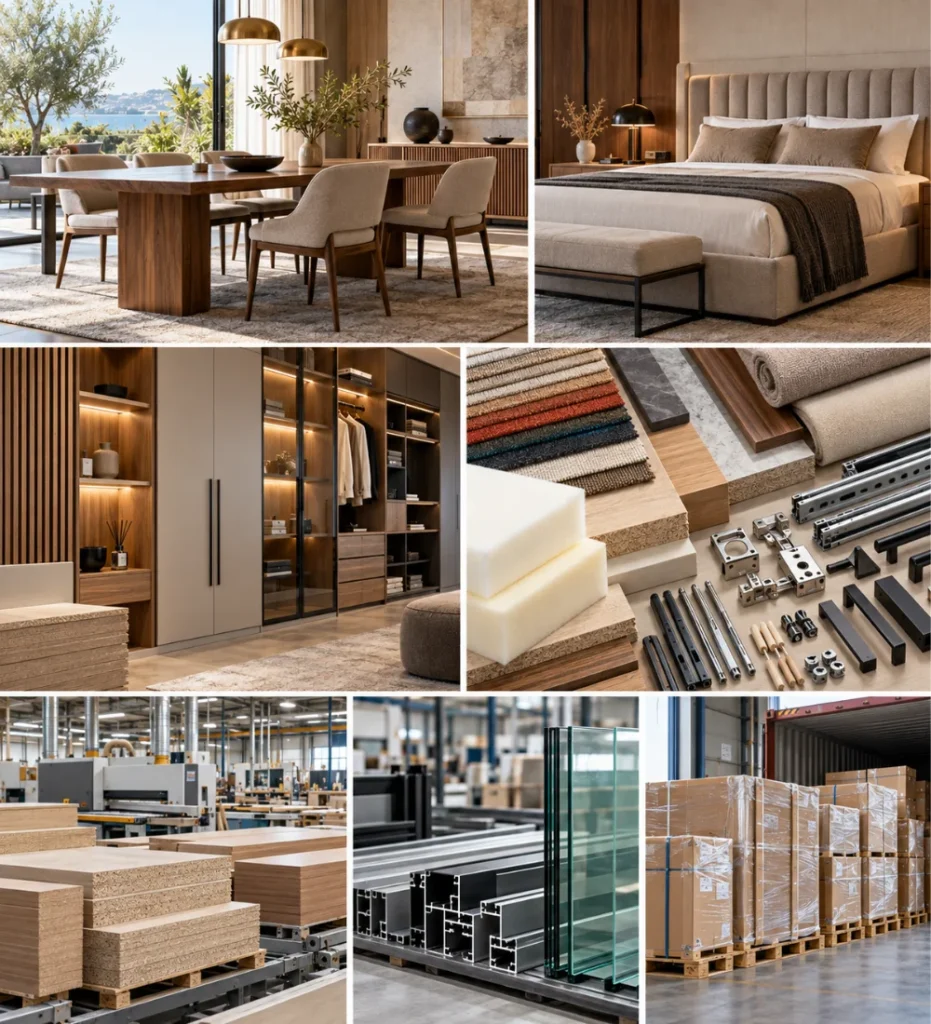
Furniture, Components and Production Materials We Can Assess
Finished furniture, contract products, interior elements,
components and selected furniture-production materials.
Furniture, Components and Production Materials We Can Assess
Finished furniture, contract products, interior elements, components and selected furniture-production materials.
Hana Solution LLC does not work from a fixed supplier catalogue. Buyer requirements may involve:
This is not a furniture catalogue or an exhaustive product list. If you need a finished furniture product, component, interior product or furniture-production material from Turkey, Hana Solution LLC first assesses whether the requirement fits our sourcing scope.
TECHNICAL DOCUMENTATION · MATERIAL CLAIMS · COMPLIANCE
Requirements Depend on the Product, Material and Destination Market
Timber, composite wood, upholstery, coatings and other materials may
create different documentation requirements by market.
Requirements Depend on the Product, Material and Destination Market
Timber, composite wood, upholstery, coatings and other materials may create different documentation requirements by market.
Furniture compliance should not be reduced to a single certificate. Requirements can vary according to the finished product, material composition, intended use, buyer specification and destination market.
Within an agreed assignment, Hana Solution LLC may request and organise supplier-provided documents, material declarations, test reports and certification records; compare them with the stated product, manufacturer and requirement; and identify visible gaps or scope mismatches.
EUDR Requirements
Where furniture or furniture materials fall within the EUDR product scope, the applicable requirements should be checked against the actual product and operator position.
As of October 2026, the European Commission states that EUDR applies from 30 December 2026 for large and medium operators, from 30 June 2027 for most micro and small operators, and from 30 December 2026 for micro and small operators already covered by the former EU Timber Regulation.
European Commission — Regulation on Deforestation-Free Products ↗EPA TSCA Title VI
For US-bound furniture containing regulated composite wood products, EPA TSCA Title VI requirements can apply to hardwood plywood, particleboard, MDF and finished goods containing these materials, including relevant certification, labelling and recordkeeping requirements.
US EPA — Formaldehyde Emission Standards for Composite Wood Products ↗Hana Solution LLC does not issue certificates, perform laboratory testing, certify FSC or PEFC supply chains, certify EUDR compliance or act as a regulatory, engineering or product-safety approval authority.
Where formal regulatory, laboratory, engineering or legal approval is required, responsibility remains with the buyer and its appointed qualified specialists.
Why Does Buyer-Side Independence Matter in Furniture Sourcing?
Furniture is highly visual, but buying decisions often depend on details that are not visible in a catalogue image—materials, internal construction, subcontracting, finish, hardware, packing and repeatability.
Independent buyer-side support keeps the comparison focused on the buyer’s actual requirement and available evidence.
Is the Supplier Being Assessed Against Your Furniture Requirement?
Hana Solution LLC does not begin with a preferred furniture factory, catalogue or supplier promotion.
Supplier assessment starts with the buyer’s product, materials, construction, dimensions, finish, quantity, destination market and commercial requirements.
Are the Furniture Offers Genuinely Comparable?
Two suppliers may show nearly identical furniture while quoting different internal construction, panel grades, timber, foam, upholstery, hardware, finish, packaging or commercial scope.
Those differences should be visible before price becomes the deciding factor.
Are Supplier Claims Supported by Evidence Relevant to the Order?
Manufacturer status, production capability, material claims, certificates, sample approval, production progress and shipment readiness should not automatically be accepted because they appear in a catalogue, showroom presentation or supplier update.
Evidence should relate to the actual supplier, product and order.
Could Supplier-Side Compensation Influence the Recommendation?
Hana Solution LLC does not manufacture or sell furniture, trade, hold inventory, represent furniture factories, receive supplier commissions or add supplier mark-ups.
Our professional fee does not increase because a particular manufacturer wins the order or because a higher-priced quotation is selected.
The final supplier, product and purchasing decision remains with the buyer.
FURNITURE SOURCING TURKEY
Furniture Sourcing Turkey: Practical Buyer Questions
Looking for furniture manufacturers in Turkey, sourcing furniture components or production materials, checking an existing supplier, comparing quotations or managing an active order? These practical questions explain where Hana Solution LLC can support your buying process.
PRACTICAL BUYER QUESTIONS
Furniture Sourcing Turkey FAQ
Open the question that best matches your current furniture sourcing stage.
01 Can Hana Solution LLC Find Furniture Manufacturers in Turkey? +
Yes. Supplier Mapping & Shortlisting can identify Turkish furniture manufacturers against the buyer’s product type, materials, construction, dimensions, finish, quantity, customisation and destination-market requirements.
The result is a focused requirement-based shortlist rather than a furniture company directory or collection of catalogue links.
Shortlisting does not mean that a supplier has already been independently verified, technically approved or commercially selected.
Find Suitable Turkish Furniture Manufacturers →02 Can Hana Solution LLC Source Furniture Materials and Components as Well as Finished Furniture? +
Yes, where the requirement fits our sourcing scope.
Projects may involve finished furniture as well as specified materials or components such as wood-based panels, veneers, upholstery materials, foam, metal components, hardware, mechanisms or other defined furniture-production inputs.
The requirement should identify what is being purchased, the key specification, quantity, intended use and destination market before supplier comparison begins.
03 Can You Verify a Turkish Furniture Supplier We Already Found? +
Yes. Verification can focus on the named legal entity, actual manufacturing facility, manufacturer versus trader status, subcontracting structure, production capability, material claims, supplier-provided documentation and other agreed verification points.
Verification is evidence-based and scope-specific. Hana Solution LLC does not certify suppliers or guarantee future supplier performance.
Verify Your Furniture Supplier →04 Can You Compare Furniture Quotations and Samples From Different Turkish Manufacturers? +
Yes. Furniture quotations can be compared against a common technical and commercial basis including materials, construction, dimensions, finish, upholstery, foam, hardware, packaging, MOQ, testing, tooling where relevant, lead time, Incoterms, payment terms and exclusions.
Samples can also reveal specification differences that are not obvious from quotations alone.
Where suppliers are not quoting the same product or commercial scope, those differences should be identified before price comparison continues.
Compare Furniture Quotations →05 Can Hana Solution LLC Review FSC, EUDR, TSCA or Other Furniture Documentation? +
Where these requirements are relevant to the product, destination market and agreed assignment, Hana Solution LLC can review supplier-provided documentation for scope, consistency and relevance to the stated supplier, product and material.
The applicable framework depends on the actual product and market. FSC or PEFC claims, EUDR requirements, US composite-wood requirements, material declarations and test reports should therefore be assessed only where relevant.
Hana Solution LLC does not issue certificates, certify chain of custody, perform laboratory approval or replace the buyer’s appointed regulatory or legal specialists.
European Commission — Regulation on Deforestation-Free Products ↗
US EPA — Formaldehyde Emission Standards for Composite Wood Products ↗
06 Can Hana Solution LLC Visit a Furniture Factory or Check an Active Order in Turkey? +
Yes. Production Monitoring & Factory Visits can provide independent visibility into sample approval, materials, finishes, produced quantities, open quality issues, rework, delays and unresolved points.
Where physical evidence is required, an agreed factory visit can compare reported status with the actual order.
Shipment Readiness & Coordination can then address finished quantities, packing, labels, hardware and accessories, documents and collection readiness before the goods move.
START WITH YOUR REQUIREMENT
Tell Us What You Need to Source or Check in Turkey
Share the furniture product, component, interior product or production material, destination country, approximate quantity, key specification and current sourcing stage.
You can also send details of an existing Turkish supplier, quotation, sample or active furniture order.
Submitting a brief does not start paid work. Hana Solution LLC reviews the requirement first and confirms the appropriate scope, deliverables, fixed fee and timeline before work begins.