
Canned Meat Manufacturers in Turkey: What Buyers Should Confirm Before Ordering
Turkish manufacturers produce canned meat for international buyers, including chicken luncheon meat, canned chicken, canned beef and corned beef, often with private-label options. If you need shelf-stable chicken in a pouch or tray, confirm that the plant can make your exact product in that pack. Finding a manufacturer is the easy part. The real question is whether a plant can make your product, in your pack, with the evidence your order needs.
By Deniz Niyazi Yildiz · Last reviewed: November 2026 · Sources: Codex Alimentarius, Ministry of Agriculture and Forestry of Türkiye, Halal Accreditation Agency (HAK)
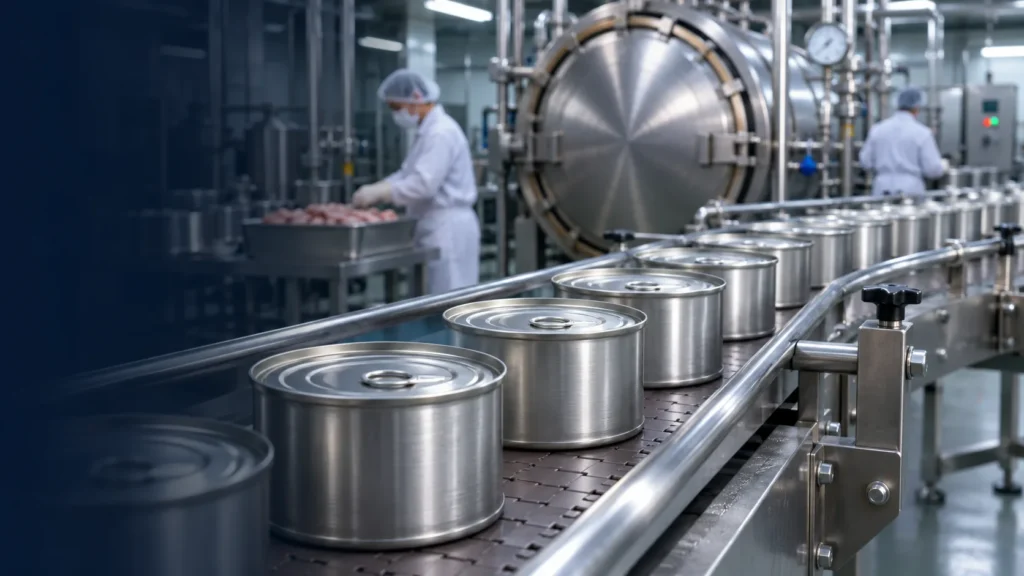
01 · Define the Product and the Pack
Most delays start before the first quotation, when the buyer and the plant are picturing different products. Define what you will order and how it is packed.
Reference standards: Codex Standard for Luncheon Meat (CXS 89-1981) and Standard for Corned Beef (CXS 88-1981).
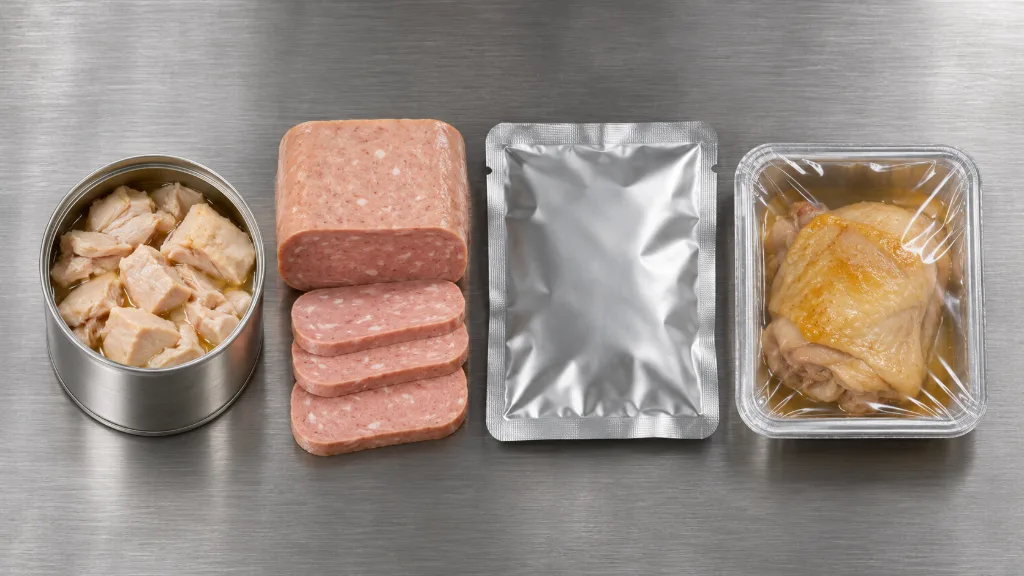
| Product | What it is | What to define |
|---|---|---|
| Canned chicken pieces or chunks | Cooked chicken meat in a sealed can | Cut (breast, thigh, mixed), fill and drained weight, liquid, can size |
| Chicken luncheon meat | Comminuted, cured chicken product, which may be smoked, packed in a sealed container | Meat content, binders, flavour, slice quality, can size |
| Canned beef | Cooked beef pieces in a sealed can | Cut, fill, liquid, can size |
| Corned beef | Chopped, cured, boneless beef, heat-treated after sealing | Recipe, can format, labelling as corned beef |
| Chicken in retort pouches or trays | Ready-to-eat chicken sterilised in its sealed flexible or rigid pack | Pouch or tray type, portion, whole-muscle or pieces, storage claim |
02 · Who Makes Canned Meat in Turkey
Several kinds of company offer canned meat from Turkey, and one plant may run several lines. What matters is the line that would make your product.
- Canned meat plants: lines for luncheon meat, canned chicken, canned beef and corned beef, often with private-label programmes.
- Integrated poultry producers: slaughter plus further processing; some run cooked or sterilised lines.
- Ready-meal and ration producers: may run retort lines for pouches or trays; confirm this product by product.
- Exporters and traders: sell products made at other plants, sometimes under their own label.
Your label on an existing product
The plant already makes the product. The project is about label, pack size, quantity and documents.
A new recipe, portion or pack
A different project: it needs trials, process validation and more time. Relabelling is not product development.
Plant role unverified: if the company quoting cannot show its link to the production site and the line that makes your product, keep the plant role open until it is explained. Turkish Manufacturer vs Trader →
03 · Evidence: What to Ask Before Quotation and Before Order
Ask for evidence in two steps. Asking for everything at the first contact can stop a development project too early; asking too late leaves you committed without proof.
Before you request quotations
| Check | What to ask for |
|---|---|
| Production line | The line that makes this format, with experience of a similar product and pack |
| Process evidence | Existing process evidence for a similar product, or a validation plan for a new one |
| Storage claim | The storage condition stated in the specification and on the label |
| Halal (where required) | Valid certificate with scope and annexes, the issuing body’s accreditation, and whether the importing country accepts it |
| Food safety certification | Certificate, scope, site and the certification body’s accreditation |
| Plant approval in Türkiye | Establishment approval or registration and its scope of activity |
| Export route (initial check) | Whether this product from this plant can be exported to your destination market, and which approval or listing applies |
Before you commit to an order
| Check | What to ask for |
|---|---|
| Process validation | Validation for the final product and pack: the formula, the pack type and the size |
| Seal integrity | Closure and seal checks for the chosen can, pouch or tray |
| Shelf-life basis | Shelf-life study or test results for this product and pack |
| Market eligibility | Where your market requires it, the plant’s listing or approval for that market and product category |
| Export health certificate model | The veterinary health certificate model for your market and product, and confirmation that the plant can meet its conditions |
| Composition and label | Ingredient list and meat content; the label must state what the product is |
At shipment: check the official certificate issued for the actual consignment. A lab report is not process validation. An analysis shows the result for one sample. Validation shows the process reliably achieves it.
- Shelf-stable canned and retort products: Codex Code of Hygienic Practice for Low and Acidified Low Acid Canned Foods (CXC 23-1979). It covers low-acid foods in hermetically sealed containers, not refrigerated products.
- Halal certification bodies accredited in Türkiye: Halal Accreditation Agency (HAK).
- Approved establishments for export markets: Ministry of Agriculture and Forestry.
- In official export controls, the Ministry applies the importing country’s requirements; see its export controls page.
We review the evidence; we do not certify products.
Already holding a supplier’s documents? Tell us what the supplier sent →
04 · When the Reference Product Says “Keep Refrigerated”
Buyers often brief a plant with a product they have seen on a shelf. Check its label first. If it says “Keep refrigerated”, it is a chilled product, even if it is ready to eat.
A room-temperature version is a different product: different process, pack, transport and storage.
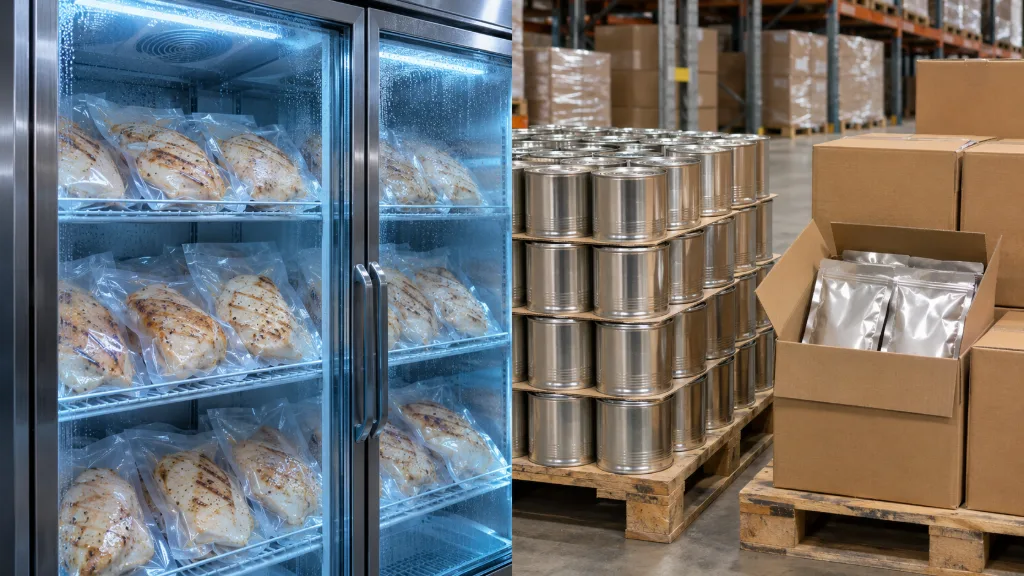
| Chilled ready-to-eat chicken | Shelf-stable chicken (can, pouch, tray) | |
|---|---|---|
| Ready to eat | Yes | Yes |
| Storage before opening | As stated on the label, under refrigeration | Ambient, when commercial sterility is proven for that product and pack |
| Process | Cooking or pasteurisation, often sous-vide | Validated sterilisation in the sealed pack |
| What to check | Label storage condition, validated shelf life, cold chain end to end | Process validation, seal integrity, shelf-life basis |
| Transport | Chilled throughout | Ambient, for a qualifying product |
Three mistakes to avoid
- Treating “we have a retort” as proof for your product and pack.
- Using pressure cooking, sterilisation and high-pressure processing as if they meant the same thing. Ask which process is used and get it documented.
- Taking a shelf-life figure from another product, pack or plant.
05 · Private Label and Commercial Fit
Once the product and the plant are confirmed, check whether the project works commercially.
| Question | What to clarify |
|---|---|
| Recipe and portion | Existing product or new development; portion; flavour |
| Development and printing costs | Trial and development costs; plate or print costs for your label |
| Label | Languages, mandatory information, who designs and who approves |
| Minimum order | Product MOQ and packaging MOQ, which can differ |
| Samples | Which production the sample represents; how it ships |
| Lead time | First order versus repeat orders |
| Price inclusions | What the price includes: packing, palletising, documents, inspection |
| Quotation validity | How long the price holds |
| Delivery terms | Incoterm with the named place |
| Payment | Payment stages, any documents required for payment, and the relationship between the contracting party, invoice issuer and payment beneficiary |
| Shelf life at delivery | Minimum remaining shelf life required on arrival |
Your Decision: Proceed, Clarify or Hold
- When it applies
- The line, the process evidence and the approvals match your product, and the mandatory requirements of your market are covered.
- When it applies
- Capability is likely, but a document, scope or specification point is still open.
- When it applies
- The plant relationship cannot be explained, a process or storage claim cannot be verified, or a mandatory market requirement cannot be met.
A Hold is not a verdict on the company. It pauses the decision until the evidence matches the project; see how Hana Solution LLC runs supplier verification.
Warning Signs
- The plant role is unverified: the company quoting cannot show its link to the production site.
- “We have retort machines” is offered instead of process evidence for your product and pack.
- Certificates name a different company or site, with no explanation of the relationship.
- Shelf life is claimed without a basis for your product and pack.
- The label and the ingredient list describe different meats.
- For a custom recipe or pack, nobody can say which production the sample represents. For an existing catalogue product, a retail sample can still help a first assessment.
These signs warrant clarification; none proves a problem on its own.
Facing a similar decision? Choose yours and send a short brief:
Related Guides
Questions About Canned Meat Manufacturers in Turkey
Halal, product formats, private label, storage, certificates, quotations and shelf life.
Related: Food & FMCG → Supplier Verification → Supplier Mapping → Sourcing toolkit →
Related guides: Sunflower oil manufacturers in Turkey → How to verify a Turkish manufacturer → Manufacturer or trader? →
See it in practice: Case study: 29 Organisations Mapped, 2 Recommended →
This guide explains product, process, approval and commercial checks for canned meat sourced from Türkiye. It is not legal, customs or regulatory advice. Official sources: Codex – Luncheon Meat (CXS 89-1981) · Codex – Corned Beef (CXS 88-1981) · Codex – Low-acid canned foods (CXC 23-1979) · Ministry of Agriculture and Forestry – Export · Halal Accreditation Agency (HAK) – Accredited bodies.
Can Turkish manufacturers produce halal canned chicken for export?
Yes. Turkish plants produce canned chicken and chicken luncheon meat for international buyers. Where halal is required, check the certificate’s scope and the issuing body’s accreditation, then confirm that the importing country accepts that certificate. Separately, confirm the plant’s approval in Türkiye, the export route for your market and the health certificate model your shipment needs.
What is the difference between canned chicken and chicken luncheon meat?
Canned chicken is cooked chicken meat in pieces or chunks. Chicken luncheon meat is a comminuted, cured product that may be smoked and may contain binders. A plant may run both on separate lines, so confirm the line for your product.
Can Turkish manufacturers make private-label canned meat?
Many offer private label. Check whether the offer is relabelling an existing product or developing a new one, and who pays for development and label printing.
What is the difference between shelf-stable and refrigerated ready-to-eat chicken?
Shelf-stable chicken is sterilised in its sealed pack and stored at ambient temperature when commercial sterility is proven for that product and pack. Refrigerated ready-to-eat chicken must be kept chilled as stated on its label. Check the reference product’s label before you brief a plant.
How can I check a Turkish halal certificate?
Ask for the certificate with its scope and annexes. Check that it is valid, that the issuing body is accredited, and that the scope covers the site, the activity and the product category. Then confirm that the importing country accepts certificates from that body.
What should I check before requesting quotations?
Define the product and the pack. Then confirm the line, process evidence for a similar product or a validation plan, the storage claim, the plant’s approval in Türkiye, an initial check of the export route for your market and, where required, halal scope.
How long does canned meat from Turkey last?
It depends on the product, the pack and the validated process. Ask for the shelf-life basis for your product, and agree the minimum remaining shelf life at delivery.

Tell Us What You Need to Source or Check
Share your product, pack, storage need, quantity and market. Start with what you have, such as a reference product, a specification or a supplier’s quotation.
