
Hana Solution LLC – Insights
The Difference Between a Turkish Manufacturer and a Trader
Turkish Manufacturer vs Trader distinction determines MOQ reality, pricing transparency, lead time reliability, compliance traceability, and documentation integrity. Traders and manufacturers look identical at the initial engagement stage — same directories, same trade fairs, same product catalogues. Buyers who do not verify supplier type before commercial engagement consistently encounter the consequences of this confusion.
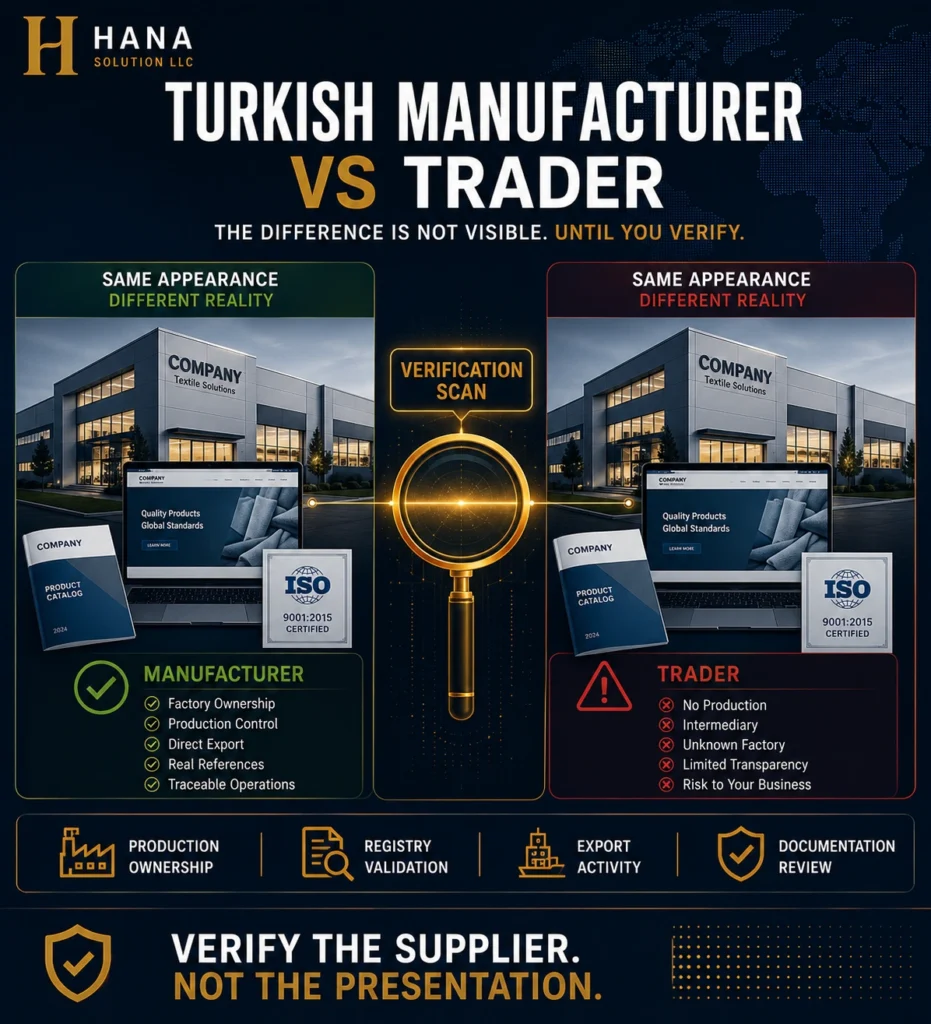
Turkish Manufacturer vs Trader: Why the Distinction Is Harder Than It Appears
In buyer-side supplier verification engagements across multiple sectors, one of the most frequently encountered issues is supplier type misidentification. A company presents a product catalogue, references export activity, and communicates in the language of manufacturing. The buyer assumes they are engaging a manufacturer. They are not.
Turkish trading companies operate with significant sophistication. Many hold ISO certifications — issued at the company level, not the factory level. Some maintain showrooms and sample inventories. Some have been in operation for decades. None of this confirms manufacturer status. What confirms manufacturer status is registry validation, production facility evidence, and export documentation traceability to a specific production address.
A company that holds an ISO certificate, exports regularly, and presents a product catalogue is not necessarily a manufacturer. These signals confirm business activity — not production capability.
What a Trader Actually Is
A trader — also referred to as a trading company, intermediary, or sourcing agent — purchases products from manufacturers and resells them to international buyers. They do not own production facilities. They do not control production schedules, quality processes, or compliance documentation at the factory level.
This is not inherently problematic in all contexts. For buyers who understand they are engaging a trader and have priced in the additional margin and risk layer accordingly, the arrangement can function. The problem arises when a buyer believes they are engaging a manufacturer — and the commercial terms, compliance commitments, and documentation expectations are set accordingly.
In sourcing engagements where supplier type was validated before RFQ issuance, the most common finding was that between 30 and 50 percent of initially shortlisted suppliers were traders presenting as manufacturers. This rate varies by sector — it is higher in FMCG and textile, lower in heavy machinery — but the pattern is consistent.
When a trader accepts an RFQ on behalf of a manufacturer they do not control, every commitment in that RFQ — lead time, MOQ, quality specification, certification — carries an additional layer of execution risk the buyer cannot see.
Manufacturer vs Trader — The Practical Differences
| Parameter | Manufacturer | Trader |
|---|---|---|
| Production control | Direct — owns or operates facility | None — sources from third party |
| MOQ flexibility | Negotiable at production level | Fixed by manufacturer — marked up |
| Pricing transparency | Ex-factory price — traceable | Margin embedded — not disclosed |
| Certification scope | Covers production facility | Company-level only — factory not covered |
| Lead time reliability | Controlled — production schedule direct | Dependent on manufacturer availability |
| Documentation traceability | Full — production address on records | Partial — intermediary layer present |
| Compliance verification | Verifiable at factory level | Factory compliance unconfirmed |
How to Identify the Difference
Supplier type cannot be determined from a catalogue, a website, or a trade fair conversation. It requires registry validation and documentation review. The following signals, when cross-referenced, provide a reliable basis for supplier type determination.
Why This Matters Before RFQ
The supplier type question must be resolved before the RFQ is issued — not after. An RFQ sent to a trader produces a response based on what that trader can source, not what a manufacturer can produce. The pricing, lead time, MOQ, and compliance commitments in that response carry an embedded layer of uncertainty the buyer cannot price or manage.
In engagements where supplier type was confirmed before RFQ issuance, the RFQ responses were structurally comparable — same production basis, same compliance traceability, same documentation standard. In engagements where supplier type was not confirmed in advance, RFQ responses consistently varied in ways that made structural comparison impossible.
The RFQ governance step is only meaningful when the suppliers receiving the RFQ have been verified as manufacturers. Without that verification, the RFQ process produces noise — not a comparable shortlist.
Supplier type verification is not a due diligence checkbox. It is the prerequisite that determines whether every subsequent step — RFQ, negotiation, contract, production — has a reliable foundation.
Frequently Asked Questions
Registry validation is the primary method. A manufacturer will have a production facility registered in the Turkish trade registry (MERSIS) at a specific address. The address on their ISO certificate or export documentation should correspond to a production facility, not a commercial office. Trading companies typically have commercial addresses with no registered production activity. Cross-referencing export records with product category and production address provides reliable confirmation.
Not always — but the buyer must know they are engaging a trader and price the arrangement accordingly. The risk arises when a buyer believes they are engaging a manufacturer, sets commercial terms and compliance expectations at manufacturer level, and then discovers mid-engagement that production control, documentation traceability, and compliance verification are not available at the assumed level.
Commercial incentive. Buyers prefer direct manufacturer engagement — perceived lower cost, higher control, better compliance traceability. Traders who present as manufacturers access a larger pool of buyers and command higher margins. The presentation is rarely explicit misrepresentation — it is more often omission. The supplier does not volunteer their trading status, and the buyer does not ask the right verification questions.
Before the RFQ is issued. Supplier type verification is part of the supplier mapping and shortlisting phase — after initial identification but before any commercial document is exchanged. Verifying supplier type after an RFQ has been issued, or after a commercial relationship has begun, significantly increases the cost of correcting the error.
Yes. Supplier type determination — manufacturer vs trader — is a core component of both the Supplier Mapping & Shortlisting and Supplier Verification & Risk Screening services. Registry validation, export activity review, and documentation cross-referencing are conducted before any supplier is advanced to the RFQ stage.
Submit a project brief. We confirm manufacturer status, validate registry records, and deliver a verification report before your RFQ is issued.