
Hana Solution LLC – Insights
Animal Supplement Manufacturers in Turkey
Animal Supplement Manufacturers in Turkey may offer pet, equine and feed-support products, but finding a supplier is not the same as qualifying the right production partner. This Insight explains how international buyers can compare supplier structures, verify product-specific capabilities and identify regulatory, certification and market-entry risks before engagement.
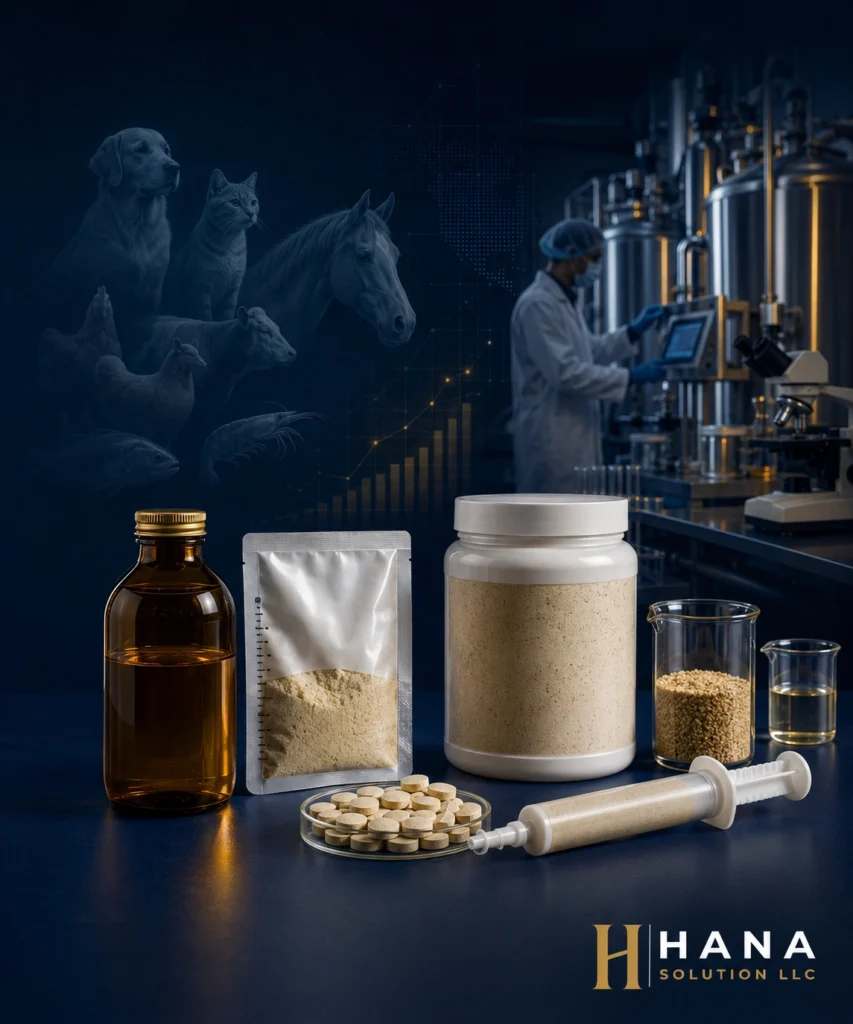
Animal Supplement Manufacturers in Turkey: One Category, Four Supplier Structures
Based on Hana Solution's structure-first assessment, companies marketed as animal supplement manufacturers in Turkey typically resolve into four commercial and production structures: an integrated manufacturer, a contract manufacturer, a brand or formulation owner using a third-party facility, or a trader and export coordinator. The buyer risk changes with each structure.
The category spans pet, equine, livestock, poultry and aquaculture products in formats including pastes, liquids, tablets, soft chews, powders, oils, electrolytes, feed additives and premixes. This breadth creates sourcing opportunity, but it does not make the visible suppliers interchangeable.
The first qualification decision is therefore not whether a company offers the product. It is which legal entity controls the formula, relevant production stages, quality evidence and destination-market route—and whether that structure fits the buyer's intended transaction.
A supplier search can identify companies. A sourcing decision requires a manufacturer profile built around species, formulation, dosage form, claims, destination market and commercial scale.
Why This Matters Now
Turkey's broader pet-nutrition and animal-feed ecosystem has expanded materially. A 2024 USDA Foreign Agricultural Service report recorded Turkish dog and cat food sales of approximately USD 127 million in 2022 and projected the market to exceed USD 300 million by the end of 2027. The same report stated that around two-thirds of domestic pet-food consumption was produced in Turkey (USDA FAS, Pet Food Sales in Turkiye Are Expected to Double by 2027).
Investment activity provides another signal of manufacturing depth. In September 2025, the European Bank for Reconstruction and Development acquired a minority stake in a Turkish pet-food producer with an export footprint across 55 countries, alongside Turkven and the International Finance Corporation, to support capacity and technology expansion (EBRD, investment announcement of 22 September 2025).
These indicators relate to the wider pet-food and animal-nutrition ecosystem; they are not a measurement of Turkey's animal-supplement market and do not establish the capability of any individual supplier. Their buyer-side relevance is narrower: Turkey has a commercially meaningful production base, but supplier suitability still has to be established product by product and facility by facility.
Market growth establishes category relevance. It does not establish supplier-level product fit.
Why the Market Must Be Segmented Before Suppliers Are Compared
Turkey's national framework for veterinary services, plant health, food and feed is established under Law No. 5996 on Veterinary Services, Plant Health, Food and Feed. The applicable registration, approval and product route depends on the activity and product involved.
Turkey's official feed-business structure already shows why the commercial phrase "animal supplement" is too broad for supplier qualification. The Ministry of Agriculture and Forestry publishes separate establishment categories for compound feed, feed additives, premixes, cat and dog food, animal by-products, dog chews and other feed activities (Ministry of Agriculture and Forestry, Feed Establishment Lists).
These lists are valuable official inputs. They do not create a ready-made shortlist of animal supplement manufacturers for a particular buyer. A listed establishment still has to be matched to the required species, product format, formula, process, packaging, destination market and transaction structure.
The same distinction exists internationally. The European Commission separates feed materials, feed additives and compound feed, including pet food, and applies different rules to their authorisation, marketing and use (European Commission, Animal Feed). A buyer's general use of the word "supplement" does not remove those underlying product distinctions.
| Supplier structure | What it controls | Buyer-side question |
|---|---|---|
| Integrated manufacturer | Operates the relevant facility and may also control formulas, brands and export operations | Does its actual production scope match the required species, dosage form, formula and scale? |
| Contract or toll manufacturer | Manufactures for third-party brands or formulation owners | Which responsibilities, evidence rights and audit access sit with the production facility? |
| Brand or formulation owner | Controls the brand, specification or formula while production occurs at a third-party facility | Who holds approvals, releases batches and protects continuity if the manufacturing relationship changes? |
| Trader or export coordinator | Coordinates products and export activity across one or more manufacturers | Is the production site disclosed, stable and directly verifiable? |
No structure is automatically qualified or disqualified by its label. An integrated factory can lack product fit; a transparent contract-manufacturing model can be workable. The decision depends on whether control, evidence, accountability and continuity are visible and compatible with the requirement.
An official establishment record can confirm that a business exists within a defined activity. It does not prove that the facility is qualified for the buyer's exact product.
"Animal Supplement" Is Not One Manufacturing Requirement
The supplier profile changes first by species and use case, then again by dosage form and destination market.
| Commercial product group | Typical formats | Manufacturer distinction that matters |
|---|---|---|
| Cat and dog supplements | Malt and oral pastes, liquids, syrups, tablets, soft chews, powders, sachets, oils and probiotics | Pet-specific formulation, palatability, consumer packaging, dosage control and market-appropriate claims |
| Equine supplements | Electrolytes, powders, pellets, liquids, oral pastes and syringes for joints, digestion, hoof, coat, recovery or calming | Equine formulation experience, batch traceability and additional contamination controls where competition horses are involved |
| Livestock and poultry products | Vitamin-mineral mixtures, premixes, liquid supplements, feed additives, water-soluble powders, blocks and licks | Species and production-stage suitability, feed-chain controls, dosing route and scale economics |
| Aquaculture products | Premixes, water-dispersible products, feed additives and functional ingredients | Aquatic-species application, stability, dispersion and feed-process compatibility |
| Medicated or therapeutic products | Products whose composition, intended use or claims move beyond ordinary feed positioning | A different regulatory and manufacturing route that should not be assumed from a general supplement catalogue |
A legitimate pet-supplement manufacturer is not automatically an equine-supplement manufacturer. A capable premix producer is not automatically suitable for a finished private-label consumer product.
Product Form Changes the Manufacturer Requirement
Buyers often begin with an intended function such as joint support, digestion, immunity, coat care, electrolytes or vitamin supplementation. Function alone does not define the production requirement. The same commercial concept can require a different facility, process and evidence package when delivered as a paste, tablet, chew, liquid, powder or oil.
| Product format | Capability questions | What a catalogue image does not prove |
|---|---|---|
| Malt or oral paste | Mixing control, viscosity, homogeneity, tube or syringe filling, seal integrity and dose delivery | Stable commercial batches and controlled filling at the required pack size |
| Liquid or syrup | Solubility, suspension control, preservation, filling accuracy, container compatibility and leakage control | Shelf-life performance and repeatability across production lots |
| Tablet | Blending, compression, weight variation, hardness, friability, disintegration and coating where applicable | That the relevant tablet process is controlled by the quoting entity |
| Soft chew | Dough or mass preparation, palatability, active distribution, texture, moisture control and packaging barrier | Consistent active content and physical stability over the intended shelf life |
| Powder or sachet | Particle distribution, blend uniformity, segregation risk, moisture control and sachet weight accuracy | Homogeneity at both laboratory and commercial batch scale |
| Oil-based product | Oxidation management, raw-material quality, antioxidant system, light and oxygen protection and filling control | Whether sensory and analytical specifications remain stable through shelf life |
| Premix | Carrier selection, micro-ingredient distribution, cross-contamination control, inclusion rate and feed-chain application | Suitability for direct consumer feeding or finished retail presentation |
For this reason, a supplier should be assessed against the required dosage form and process—not merely against a similar product name.
Private Label Can Describe Four Different Commercial Models
The phrase "private label animal supplements" is frequently used as if it defines one production model. In practice, it can describe materially different relationships.
| Private-label model | What the supplier provides | Buyer-side issue to resolve |
|---|---|---|
| Existing formula and new brand | A standard supplier formula placed in buyer-branded packaging | Formula rights, market eligibility, differentiation and access to supporting documentation |
| Modified standard formula | An existing base formula adjusted for ingredient, flavour, strength, format or packaging | Who controls the revised specification and whether changes require new validation or regulatory work |
| Custom formulation | Development against a buyer brief | Development fees, ownership, confidentiality, validation, minimum scale and change control |
| Contract packing | Filling or packaging of formula or bulk product supplied or sourced elsewhere | Responsibility for ingredients, release, traceability, non-conformity and product claims |
A supplier saying "we offer private label" does not establish which of these models is available, who owns the formula, which entity manufactures the product, or who remains responsible for the finished specification.
Private label is a commercial label. The underlying ownership, production and accountability model still has to be defined.
Search Results Show Products—Not Production Reality
Websites, directories, exhibition lists and online marketplaces can support supplier discovery. They cannot establish manufacturer suitability on their own.
- A broad catalogue does not show which products are made in-house, outsourced or traded.
- Factory images do not connect the quoting legal entity to the required production line.
- Certificate logos do not establish holder, site, scope, validity or product relevance.
- A successful sample does not prove commercial-batch repeatability, traceability or reorder continuity.
The online question is "Who offers this product?" The procurement question is "Who controls the required product and can support the intended transaction?"
The Hana Solution Buyer-Side Decision Architecture
Hana Solution does not treat public information as a finished sourcing decision. Official registers, supplier websites, certificates and product files are inputs. They become commercially useful only when assessed against a defined buyer requirement and combined with supplier-specific evidence.
Our buyer-side model separates the assessment into four decision layers. Together they convert discovery information into a controlled commercial conclusion.
Supplier names, evidence combinations, scoring thresholds, capability gaps, pricing intelligence and engagement-specific findings are not published. They form part of Hana Solution's scoped buyer-side work.
1. Identity and Regulatory Validation
The process begins with the required commercial outcome—not with available catalogues. Species, life stage, intended function, dosage form, ingredient constraints, target active levels, pack size, branding model, destination market, order volume and timeline establish the manufacturer profile. This definition stage is the focus of Sourcing Direction & Strategy.
Without this structure, a search may return genuine manufacturers that remain irrelevant to the required product.
A supplier cannot be qualified against an undefined formula, format and market requirement.
The word "supplement" does not create a universal regulatory category. Product composition, intended use, claims, species and destination market can change how the product is treated.
This is especially clear in the United States. The FDA states that there is no separate dietary-supplement regulatory classification for animal products; products described commercially as animal supplements may be regulated as animal food or as new animal drugs depending on intended use (US FDA, Animal Foods & Feeds).
The buyer therefore needs to define the intended claims and destination route before assuming that a formula or label used in one market can be transferred to another. Hana Solution can structure the sourcing and evidence questions; final legal classification and product approval remain matters for the relevant authority and qualified regulatory counsel.
2. Product and Production Capability
"Animal supplement manufacturer" is too broad to function as a capability conclusion. Tablet compression, soft-chew production, paste filling, liquid suspension, oil filling and micro-ingredient premixing require different equipment, process controls and technical experience.
Capability should be matched to the exact process, species and batch scale. It should also distinguish between laboratory development, pilot production and repeat commercial production.
Manufacturer legitimacy does not equal dosage-form capability. Dosage-form capability does not equal suitability for the buyer's formula and market.
A product name such as "joint support" or "multivitamin" does not define the commercial product. Two suppliers can quote products with similar names while offering different ingredients, active levels, carriers, flavours, serving sizes, daily dosages and shelf-life assumptions.
The sourcing structure should identify:
- formula version and specification ownership;
- ingredient identity, grade and approved source;
- active-content basis and tolerance;
- species and life-stage limitations;
- allergen, animal-origin and restricted-ingredient considerations;
- palatability or administration requirements;
- substitution and change-notification controls;
- support for the intended product claims.
This is where a visually similar product can prove commercially non-comparable.
3. Evidence and Destination-Market Readiness
A certificate, sample or generic certificate of analysis should not be treated as a complete quality conclusion. Evidence must be linked to the correct entity, site, process, product and batch—the core purpose of Supplier Verification & Risk Screening.
Depending on the product, relevant controls may include:
- raw-material identity and supplier qualification;
- blend or active-content uniformity;
- microbiological and chemical specifications;
- contaminant and cross-contamination controls;
- fill weight, tablet weight or dose-delivery accuracy;
- stability and shelf-life basis;
- packaging compatibility and seal integrity;
- lot coding, retained samples and release records;
- complaint, withdrawal and recall traceability.
The evidence package should be proportionate to the product and market. More documents do not automatically produce a stronger decision; relevance and traceability matter.
A product legally made and sold in Turkey is not automatically ready for another jurisdiction. Ingredient status, additive authorisation, label language, mandatory statements, claims, importer obligations, animal-origin documentation and registration pathways can differ.
Where a formulation contains animal-origin materials and falls within the applicable animal-by-product route, EU entry may depend on country and product eligibility, the listing of the relevant establishment and the required health or official certification. The European Commission's non-EU establishment framework includes a specific animal-by-product section for pet-food plants, including facilities manufacturing dog chews and flavouring innards (European Commission, Non-EU Countries Authorised Establishments).
This is not a blanket requirement for every mineral, botanical or plant-based animal supplement. The applicable entry route must be established from the exact formulation, product use and destination-market rules rather than inferred from the general term "animal supplement".
The buyer should therefore separate three questions:
- Can the facility manufacture the product?
- Can the finished formula and label be placed on the target market?
- Can the supplier provide the evidence and export documentation needed for that route?
A positive answer to the first question does not resolve the other two.
4. Commercial Comparability and Continuity
Animal supplement quotations can appear comparable while being based on different formula strengths, daily doses, ingredient grades, testing scopes, packaging specifications, MOQs, tooling, payment terms, Incoterms and lead-time assumptions.
This is where RFQ Governance becomes separate from supplier verification. Verification determines whether a supplier should remain under consideration. RFQ governance determines whether competing offers describe the same controlled requirement and allocate risk transparently.
Certification Must Match the Entity, Site, Process and Product
Certification can be relevant evidence, but only within its actual scope. A logo on a website should never be converted into a universal statement that every product and process is covered.
- Establishment records should match the legal name, facility address, activity and current status.
- Quality certificates should be checked for holder, site, scope, validity and exclusions—not only the standard logo.
- Certificates of analysis should connect the correct product and batch to the specification, method, result and release decision.
- Product approvals should be read against the jurisdiction, formula, label, species, holder and current product version.
FAMI-QS, for example, defines its scope around specialty feed ingredients and covered feed-chain activities. Its own scheme documents require operators to address the legal requirements of both the country of origin and the destination market (FAMI-QS, Scheme Documents and Scope). This makes scope verification more important—not less.
The correct question is not "Does the supplier have certificates?" It is "What exactly does each certificate cover, and does that scope support this decision?"
Equine Supplements Add a Competition-Risk Layer
Equine sourcing should not be treated as an extension of ordinary pet supplementation when the product may be used for competition horses. Ingredient identity, cross-contamination, batch traceability and use records can carry consequences beyond normal product acceptance.
The Fédération Equestre Internationale warns about supplement use, including herbal products and products with unknown ingredients, and addresses supplement records and contamination prevention within its Clean Sport guidance (FEI, Contamination Prevention; FEI, Prohibited Substances List).
For a buyer targeting the competition-horse segment, additional supplier questions may include:
- whether raw materials are screened against an appropriate risk model;
- how shared-equipment and cross-contamination risks are controlled;
- whether full ingredient disclosure is available;
- how every commercial lot is identified and released;
- whether retained samples and batch records are maintained;
- how formula, ingredient-source and process changes are communicated;
- what evidence can be provided for the exact lot supplied.
An equine label does not establish competition suitability. That conclusion requires a defined use case and a supplier-specific contamination and traceability assessment.
Different Products Require Different Manufacturer Profiles
| Target product | Relevant manufacturer profile | Common sourcing error |
|---|---|---|
| Cat malt or oral paste | Pet-formulation experience, paste processing, palatability and controlled tube filling | Selecting a general liquid or food producer without paste-specific capability |
| Dog joint tablet | Tablet blending and compression, active-content control, pet dosage and appropriate packaging | Comparing price per tablet without normalising strength, serving and specification |
| Fish-oil product | Oil sourcing, oxidation controls, analytical specification and oxygen/light-protective filling | Comparing only declared oil quantity rather than composition, quality and shelf-life controls |
| Equine electrolyte | Equine-use experience, mineral specification, blend uniformity, administration format and batch traceability | Assuming a livestock mineral mixer is automatically suitable for a branded equine product |
| Livestock vitamin premix | Micro-ingredient dosing, feed-chain quality controls, species-stage formulation and commercial-scale mixing | Selecting based on retail supplement presentation rather than premix process capability |
| Water-soluble poultry product | Solubility, dosing-system compatibility, stability and scale-appropriate packaging | Assuming any powder formula will perform consistently in water application |
The manufacturer profile should therefore be built from the product architecture outward—not from a generic supplier category inward.
What a Decision-Ready Outcome Looks Like
Hana Solution's objective is not to publish or sell the longest list of animal supplement companies. It is to determine which suppliers, if any, justify controlled commercial engagement under the buyer's defined requirement.
| Outcome | Commercial meaning |
|---|---|
| Actionable | The supplier's identity, regulatory position, production capability and available evidence align sufficiently to justify the next controlled stage |
| Conditional | Potential fit exists, but a material formula, process, evidence, regulatory, capacity or commercial condition remains unresolved |
| Restricted | The supplier structure or evidence does not support further buyer exposure under the defined requirement and current conditions |
These are buyer-side decision outcomes—not public rankings. The underlying evidence, thresholds and supplier-specific conclusions remain confidential to the engagement.
Two Buyer Situations Require Different Starting Points
I Need Animal Supplement Manufacturers in Turkey
A buyer without a credible supplier universe should begin by defining the product and the correct manufacturer profile. Searching before this definition tends to combine pet-product brands, contract manufacturers, premix producers, exporters and intermediaries in the same list.
The appropriate sequence is: Sourcing Direction → Supplier Mapping → Supplier Verification → RFQ Governance.
Start with Sourcing Direction when the species, formula route, dosage form, destination market or supplier type has not yet been structured. Use Supplier Mapping & Shortlisting once the target manufacturer profile is defined.
I Already Have Turkish Animal Supplement Suppliers
A buyer with company names, catalogues, samples, quotations or ongoing discussions does not need another generic list. The appropriate starting point is Supplier Verification & Risk Screening.
The objective is to establish:
- what each supplier and legal entity actually represents;
- which facility controls the relevant manufacturing stages;
- whether the production scope matches the required dosage form;
- whether formula, quality and market claims are supported by relevant evidence;
- what remains conditional before samples, deposits or production;
- which suppliers should proceed to a controlled and comparable RFQ.
The two buyer situations should not be combined into the same engagement scope.
Frequently Asked Questions
Begin by defining the target species, intended function, dosage form, formula model, destination market, packaging, order volume and timeline. These inputs determine the correct manufacturer profile. Official establishment lists, directories and exhibitions can support discovery, but the resulting companies should be segmented and verified before they are treated as a commercial shortlist.
Turkey's national food, feed and veterinary framework is established under Law No. 5996. The phrase "animal supplement" does not define one regulatory route. Depending on the formulation, intended use, claims, species and activity, the relevant structure may involve compound feed, complementary feed, a feed additive, a premix or a separate veterinary-product pathway. The applicable establishment status and product requirements should therefore be confirmed for the exact product rather than assumed from its commercial name.
Yes. Some Turkish companies offer private-label cat and dog products in formats such as pastes, liquids, tablets, powders, oils and other dosage forms. Availability does not establish suitability. Buyers should confirm the private-label model, actual production site, formula rights, MOQ, documentation, quality controls and destination-market route for the exact product.
Yes. Turkish suppliers offer equine products including powders, liquids, pastes, electrolytes and vitamin-mineral formulations. A buyer should verify equine-specific formulation and production experience. Products intended for competition horses require additional attention to ingredient disclosure, contamination risk, batch traceability and change control.
The terms describe different commercial or regulatory positions depending on formula, intended use, claims, species and jurisdiction. A premix, feed additive, complementary feed, finished pet product and veterinary medicinal product should not be treated as interchangeable. The applicable classification should be established for the intended destination before supplier selection and label development are finalised.
There is no single certificate that qualifies every manufacturer for every product. Relevant evidence depends on the activity, facility, dosage form, ingredients, species and target market. Certificate validity, legal holder, site address, scope and product relevance should be checked instead of relying on logos or a generic document request.
No. A sample shows that a product was produced at least once under a particular set of conditions. It does not by itself prove commercial-batch uniformity, shelf life, process control, documentation readiness, capacity, formula continuity or accountability for future deviations.
Some suppliers may cover several species and formats, but this should not be assumed from a broad catalogue. The buyer should verify which products are produced at which facility, whether processes and quality controls match each dosage form, and whether the species-specific formulation and documentation experience is relevant.
Supplier mapping can be performed after the target manufacturer profile is defined. Hana Solution does not publish generic supplier lists or sell introductions. Shortlisting and verification are conducted within an agreed buyer-side scope based on the product, market and commercial requirement.
No. Hana Solution does not trade animal supplements, represent manufacturers for commission or earn supplier-side margins. The firm works on the buyer side through sourcing direction, supplier mapping, verification, RFQ governance and related procurement-control services.
The starting brief should identify the species, product function, dosage form, preferred formula model, destination market, estimated order volume, packaging, timeline and current sourcing stage. Buyers with existing suppliers should also explain whether they already have catalogues, formulas, quotations, samples or commercial discussions.
Key Takeaways
- Animal Supplement Manufacturers in Turkey do not form one uniform supplier category.
- Law No. 5996 provides Turkey's national food, feed and veterinary framework, but the applicable route still depends on the exact product and activity.
- Pet supplements, equine products, livestock premixes and feed additives require different manufacturer profiles.
- Dosage form changes the relevant equipment, process controls, evidence and commercial scale.
- Private label may mean a standard formula, modified formula, custom development or contract packing.
- Official listings and certificates are evidence inputs; their entity, site, activity and product scope must match the decision.
- Product classification, claims and market access depend on the destination jurisdiction.
- Animal-origin formulations can create additional establishment-listing and certification questions for EU entry.
- Competition-horse products require an additional contamination and batch-traceability assessment.
- Finding new suppliers and validating existing suppliers require different procurement workflows.
Before You Commit to an Animal Supplement Manufacturer in Turkey
A manufacturer should not be treated as decision-ready until the following areas are structurally aligned:
- species, function, dosage form and commercial requirement are defined;
- the intended regulatory and claims route is understood for the destination market;
- the legal entity, facility and production roles are clear;
- manufacturing capability matches the exact product format and batch scale;
- formula ownership, ingredient specifications and change control are established;
- quality evidence is relevant to the product, process and commercial lot;
- certificates and official records match the correct entity, site and scope;
- packaging, shelf-life and traceability requirements are supported;
- destination-market documentation responsibilities are allocated;
- quotations are based on comparable formula, testing and commercial assumptions;
- unresolved conditions are documented before samples, deposits, tooling or production commitments.
The objective is not to reproduce public supplier information. It is to convert a defined product requirement and verified evidence into a controlled buyer decision.
Hana Solution supports international buyers evaluating Animal Supplement Manufacturers in Turkey through independent sourcing direction, supplier mapping, supplier verification and RFQ governance—without trading, commission or supplier affiliation.
Last reviewed: July 17, 2026
This Insight provides buyer-side sourcing and supplier-governance analysis. It does not constitute veterinary, medical, formulation, legal or regulatory advice. Product classification, ingredients, claims, labelling, registration and import requirements vary by species and destination market and should be confirmed for the specific product and transaction.
Submit the target species, product function, dosage form, destination market, expected volume, packaging, timeline and current supplier status. Hana Solution will confirm the appropriate engagement entry point before work begins. Already have suppliers? Start with Supplier Verification.