
Hana Solution LLC – Insights
Turkey Market Entry Sourcing Structure: Why Buyer Contact Comes Last
Turkish manufacturers approaching international markets and international buyers approaching Turkish manufacturers share one structural failure point: both sides initiate contact before the procurement architecture is defined. The result is the same — wasted outreach, wrong counterparties, and commercial exposure that was avoidable. Market entry is not a contact problem. It is a structure problem.
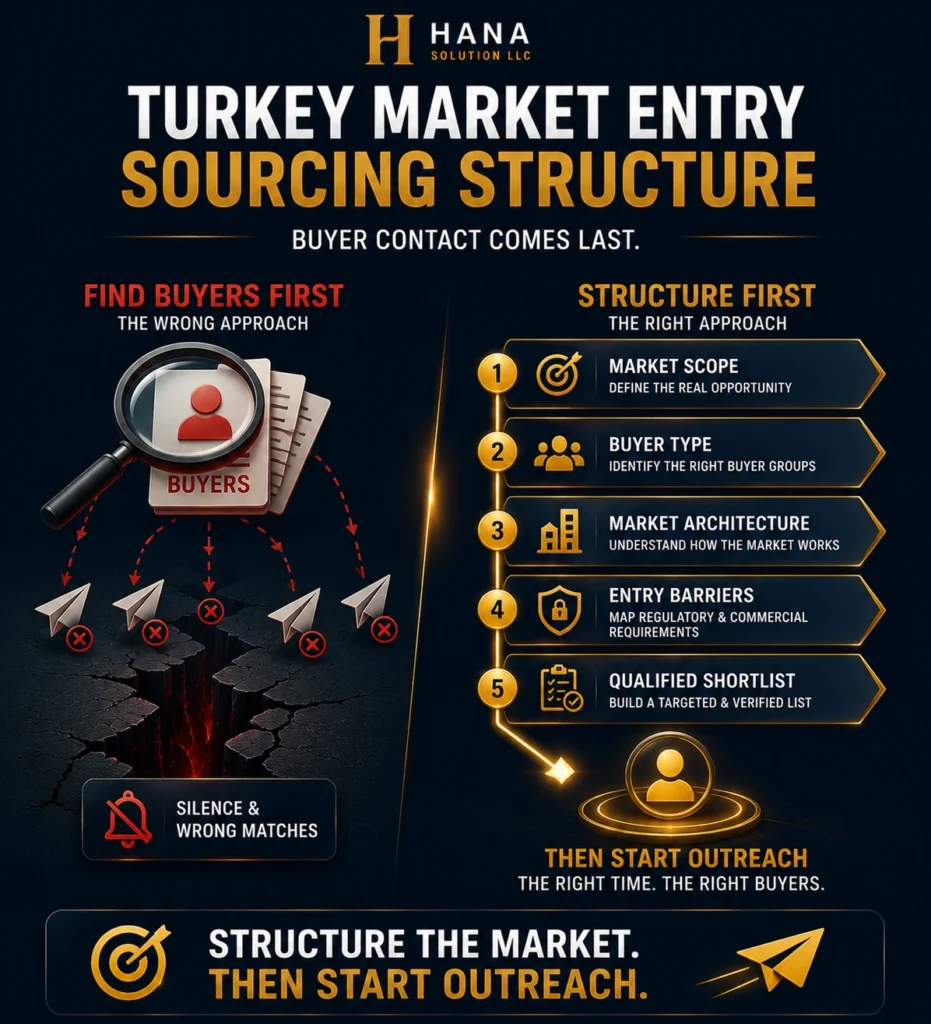
Turkey market entry sourcing structure is the step most manufacturers and buyers skip entirely — and it is the step that determines whether any commercial engagement is worth beginning. Both sides initiate contact before the procurement architecture is defined. The result is the same: wasted outreach, wrong counterparties, and avoidable commercial exposure. Market entry is not a contact problem. It is a structure problem.
The Request That Skips the Sourcing Structure
A Turkish manufacturer decides to expand into the EU, Balkans, or UK market. The immediate response is operational: find buyers. Contact distributors. Send catalogues. Attend trade fairs.
This sequence appears logical. It is not. The reason it fails consistently is not execution — it is sequencing. Buyer contact has been initiated before the market architecture has been defined.
Which buyers are structurally relevant? Which product categories are compliant with destination-market regulations? What documentation will an EU importer require before commercial engagement begins? What is the realistic MOQ range a Balkan distributor can absorb? None of these questions are answered before the first contact is made.
"Finding buyers" is treated as the starting point. In a structured market entry process, it is the outcome — not the beginning.
From the buyer side, an unstructured approach is immediately visible. A supplier who cannot define their compliance documentation, product classification, target channel, or realistic minimum order quantity is not a qualified counterparty. The contact is made. The response is silence — or a polite refusal. The manufacturer concludes the market is difficult. The real conclusion is that the turkey market entry sourcing structure was missing before contact began.
What Both Sides Miss Before the First Contact
The distinction is not cosmetic. A buyer receiving an unstructured approach from a Turkish manufacturer is evaluating whether that manufacturer can be a reliable supply chain partner — not just whether the product is interesting. Structural gaps signal execution risk before any commercial discussion begins.
Four Points Where Unstructured Market Entry Fails
Regardless of sector or target market, the absence of a defined turkey market entry sourcing structure consistently produces failure at the same four points. They are not random — they follow a sequence.
Distributor, importer, retailer, and private label buyer have different requirements. Contacting all of them with the same approach produces no qualified response.
EU, UK, and Balkan markets carry different regulatory requirements by product category. Entering without compliance documentation mapped to destination market results in immediate disqualification.
Production minimums that work for established export relationships frequently exceed what a new distributor in a smaller market can absorb. MOQ reality must be assessed before outreach begins.
Import volume is publicly visible. Procurement architecture is not. Who controls buying decisions, how the distribution channel is structured, and whether independent entry is possible — none of this is visible from directories or trade platforms.
What a Correct Turkey Market Entry Sourcing Structure Looks Like
Market entry structured from the buyer side follows a defined sequence. Each step produces an output that determines whether the next step is viable — and prevents resources from being committed to the wrong channel, wrong buyer type, or wrong market before that is known.
-
1Market and product scoping
Which product categories are viable for the target market? Which are excluded by regulation, pricing structure, or channel incompatibility? This step narrows the scope before any other work begins.
-
2Buyer type definition
Distributor, importer, retailer, private label manufacturer — each requires a different approach, different documentation, and different commercial structure. The type must be defined before the list is built.
-
3Market architecture mapping
Who are the actual procurement decision-makers in the target market? How is the distribution structure organised? Are there consolidated buying groups that control the majority of relevant volume? This is structural mapping — not a directory search.
-
4Entry barrier assessment
Regulatory requirements, labelling obligations, documentation standards, minimum order feasibility, and pricing realism are assessed before any outreach is initiated. Entry barriers that cannot be cleared are identified before resources are committed.
-
5Buyer shortlisting — not lead generation
The output is a structured list of qualified, structurally relevant buyers — not a mass contact list. Each entry is assessed for product fit, buying capacity, regulatory alignment, and decision-maker access before it reaches the list.
The result of this sequence is not a guarantee of commercial engagement. It is the condition under which commercial engagement is worth beginning.
How an EU or UK Buyer Evaluates an Approach from a Turkish Manufacturer
International buyers receiving approaches from Turkish manufacturers apply a qualification filter before any commercial discussion begins. The questions are structural, not relational.
Can the supplier demonstrate compliance documentation for the specific destination market? Is the product category correctly classified? Does the MOQ match the buyer's realistic intake capacity? Is the supplier a manufacturer or a trading intermediary? Is there independent verification of production capability?
A manufacturer who cannot answer these questions structurally — not just affirmatively — does not advance past the initial filter. The approach is not rejected on the basis of the product. It is filtered out on the basis of a missing turkey market entry sourcing structure.
This is why market entry preparation is not a sales function. It is a procurement governance function — applied from the buyer side, but determining whether the seller's approach is qualified to proceed.
Import volume is publicly visible. Procurement architecture is not. The gap between the two is where unstructured market entry fails.
Frequently Asked Questions
A defined target buyer type, destination-market compliance documentation mapped to the specific product category, realistic MOQ assessed against market capacity, and a structural understanding of who controls procurement decisions in the target market. Without these, outreach produces no qualified response regardless of product quality.
Because buyer contact is the outcome of a structured process — not the starting point. Without a defined buyer type, compliance profile, and market architecture assessment, the outreach reaches the wrong entities under the wrong assumptions. The result is disqualification at first contact.
Lead generation is a contact activity. Market access is a structural assessment. Market access determines whether the conditions for commercial engagement exist — the right product, the right compliance documentation, the right buyer type, and the right channel — before any contact is made. Lead generation without market access produces volume. Market access without lead generation produces no contacts. Both are required, in that order.
Buyer-side governance defines the structural requirements that a supplier must meet before commercial engagement begins. Applying this framework to market entry means evaluating whether a manufacturer's product, compliance documentation, and operational structure meet the requirements of the target buyer — before outreach is initiated. The governance framework protects both sides from entering a commercial relationship that was structurally unviable from the start.
Hana Solution applies buyer-side procurement governance to turkey market entry sourcing structure assessments through the Sourcing Direction service. This covers market and product scoping, buyer type definition, market architecture mapping, entry barrier assessment, and qualified buyer shortlisting — structured before any commercial contact is initiated.
Submit a project brief. We define the governance structure, confirm scope, and respond within 24 hours. No trading. No commissions. Buyer-side only.