
Hana Solution LLC – Insights
Section 232 Turkey Tariff Machinery: What Buyers Must Know in 2026
Section 232 Turkey tariff machinery rules changed twice in 2026 — and most buyers are still pricing quotes against the old version. Section 122 is a temporary global surcharge, not a Turkey-specific tariff; Section 232 is the one that actually targets steel- and aluminum-heavy machinery, and it does not stack with Section 122 on the same HTS line. Confirming which regime governs your specific HTS classification before supplier commitment determines your actual landed cost.
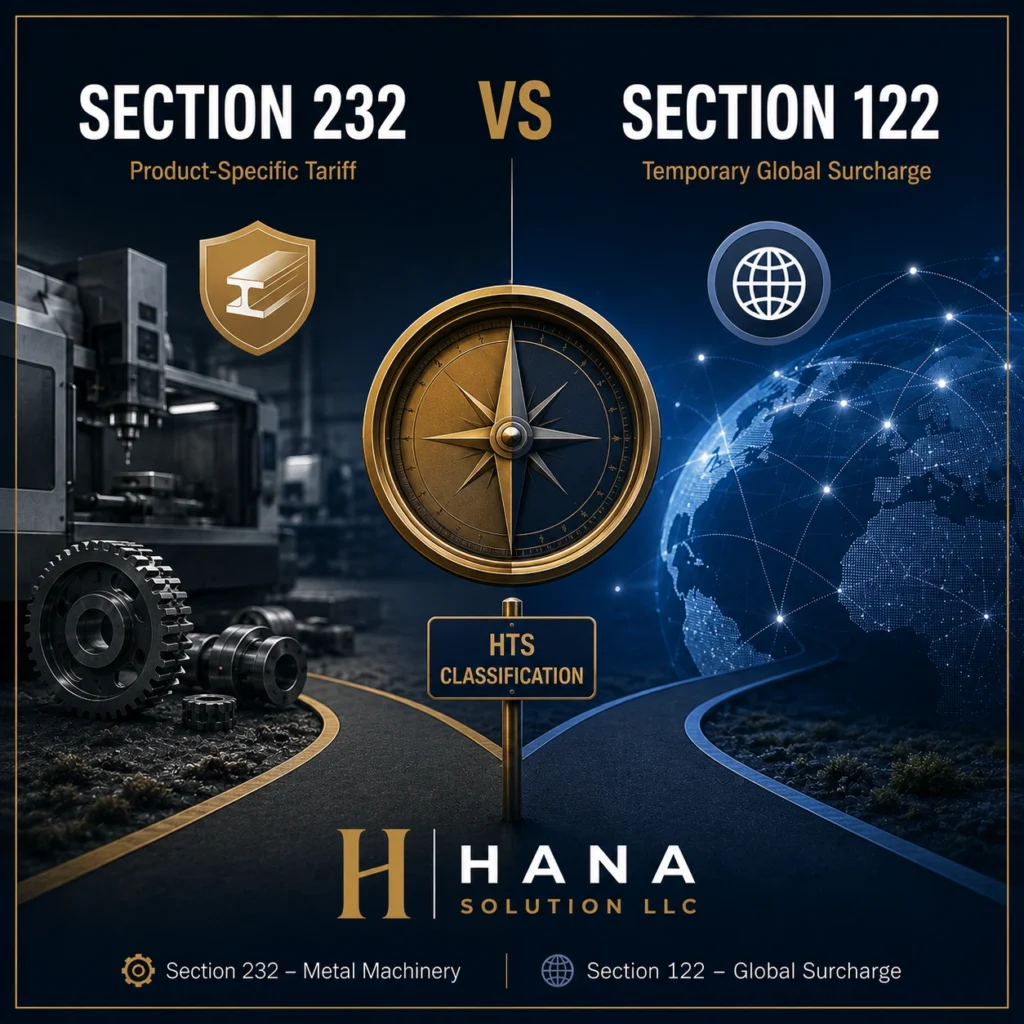
Section 232 Turkey Tariff Machinery: What Actually Governs Your Shipment in 2026
If you're pricing a machinery quote from a Turkish manufacturer for delivery into the United States in 2026, there is a good chance your landed-cost estimate is wrong — and not in the direction most buyers assume. The most common mistake is treating Section 122 as "the Turkey tariff" and Section 232 as a separate, optional add-on for metal content. In most cases, only one of the two actually applies to a given shipment, and it usually isn't the one buyers price for first. Getting this backwards can materially change landed cost on the same HTS line — enough, in some cases, to flip a competitive quote into a loss.
The mechanics, briefly: Section 122 is a temporary, global 10% surcharge applied to imports from all countries — not a Turkey-specific measure — and it is scheduled to expire by operation of law on July 24, 2026 (Federal Register 2026-03824). Section 232 is a standing, product-specific regime covering steel, aluminum, and copper derivative articles, including machinery classified under covered HTS lines in Chapters 84 and 85, and since April 2026 it is assessed on the full customs value of a covered article in most cases, not just its metal-content share (Proclamation 11021; CBP CSMS #68855869). Goods already covered by Section 232 are generally excluded from the Section 122 surcharge. The real question for a Turkey-origin machine is not "do both apply" — it is which regime governs the specific HTS line.
The practical question is not whether both tariffs apply — it is which one governs your specific HTS classification.
Why This Matters Now
During machinery sourcing engagements for international buyers, we regularly see landed-cost models built on a tariff assumption that was accurate two or three months earlier and has since changed. That has been the most consistently observed structural risk in Turkey-origin machinery sourcing in 2026 — not supplier capability or CE documentation, both of which are addressed separately in machinery supplier verification. It has been tariff misclassification driven by outdated assumptions: buyers and freight forwarders working from a prior month's tariff summary, or assuming a country-specific rate that Section 122 replaced with a global baseline in February 2026. Both Section 122 and Section 232 have been amended multiple times within 2026 alone — the classification that applied in April is not necessarily the classification that applies today.
Two Different Mechanisms — Not Two Stacking Tariffs
The table below reflects the structure of both regimes as confirmed against the Federal Register and CBP guidance (CSMS #68855869) as of mid-July 2026. This is a structural comparison, not customs advice for a specific shipment — HTS classification should always be confirmed with a licensed customs broker or directly against the U.S. Harmonized Tariff Schedule before a shipment moves.
| Section 122 | Section 232 | |
|---|---|---|
| Applies to | All countries of origin — a temporary global baseline surcharge, not a Turkey-specific measure | Steel, aluminum, and copper articles and derivatives, across all countries of origin, where the HTS line is on the covered annex |
| Rate | 10% ad valorem | Up to 50% (varies by metal and product category) — since April 2026, generally assessed on the full customs value of the covered article, not just metal content, subject to a de minimis exception where qualifying metal content is under 15% of product weight |
| Legal basis | Section 122 of the Trade Act of 1974 — Presidential Proclamation, Feb 24, 2026 (Federal Register 2026-03824) | Section 232 of the Trade Expansion Act of 1962 — Proclamation 11021 (effective Apr 6, 2026), further revised by CBP CSMS #68855869 (effective Jun 8, 2026) |
| Status (13 Jul 2026) | Statutorily capped at 150 days — scheduled to expire 12:01am EDT, July 24, 2026, absent Congressional extension. Under active litigation: CIT ruled it invalid May 7, 2026; Federal Circuit stayed that ruling pending appeal, so CBP continues to collect it for now. | Not subject to the same 150-day statutory cap. Coverage and rates have been revised twice in 2026 (April and June) — some machinery rates were reduced in June while coverage was simultaneously expanded to additional derivative articles. |
| Do both apply to one shipment? | Generally no, for lines already covered by Section 232 — the Section 122 proclamation excludes goods already subject to Section 232 duties (steel, aluminum, copper, derivatives, lumber, autos) to the extent that tariff applies | Governs first where the HTS line is on the covered annex — Section 122's global baseline applies instead where it is not |
Buyers researching "does Section 232 apply to Turkey" frequently find guidance describing Section 122 as a Turkey-specific tariff — that description was accurate under the pre-February 2026 IEEPA framework, but Section 122 replaced country-specific rates with a single global baseline. The practical exposure question for a Turkey-origin machine is which of the two regimes governs its specific HTS classification — not whether Turkey faces a unique rate.
HTS Classification: What Actually Determines Exposure
Section 232 exposure on covered machinery is generally assessed against the full customs value of the classified article as of the April and June 2026 revisions — not a metal-content share, except where the de minimis exception applies. This is where most classification errors occur before a shipment ever reaches customs.
- Confirm the current HTS classification for the specific machine or component with the supplier or freight forwarder — Chapter 84 (machinery) and Chapter 85 (electrical equipment) carry the bulk of Section 232 derivative-article coverage, and the covered-product annex was expanded again in June 2026.
- Confirm whether the classified line is on the current Section 232 covered-derivatives annex — if it is, Section 232 duty generally governs and Section 122 does not additionally apply to that line.
- Where Section 232 does not apply to the specific line, confirm current Section 122 status before shipment — it is a temporary measure under active litigation and scheduled to expire July 24, 2026; a status confirmed in one month is not guaranteed current the next.
- Request the qualifying metal-content share only where the sub-15%-by-weight de minimis exception is being claimed — for machinery classified under covered HTS lines, this exception will typically not apply, and full customs value should be assumed until confirmed otherwise.
- Reconcile the applicable regime into landed cost before commercial commitment — a cost estimate built on a prior classification cycle (pre-April, or pre-June 2026) is very likely to be out of date.
- Document the classification basis in writing, dated — informal assurances from a supplier or forwarder about "which tariff applies" are not a substitute for a documented, dated HTS classification.
A Worked Example: One CNC Machine, Two Possible Outcomes
Take a Turkish-made CNC machining center quoted at $180,000 FOB İzmir, classified under HTS Chapter 84. Two outcomes are possible depending on classification — and they produce very different landed costs.
Scenario A — the HTS line is on the Section 232 covered-derivatives annex
Section 232 governs. Duty is assessed on the full customs value in most cases (not just metal content, per the April 2026 revision) — at a rate that depends on the specific product category, up to 50%. Section 122 does not additionally apply to this line. The buyer's landed-cost model needs one number: the applicable Section 232 rate for this HTS classification.
Scenario B — the HTS line is not on the Section 232 covered-derivatives annex
Section 122 governs instead: a 10% global surcharge, provided it has not yet expired or been struck down on appeal at the time of entry. If July 24, 2026 has passed and no extension or reversal has occurred, this line may clear with no surcharge from either regime — a materially better outcome than Scenario A.
The two scenarios can produce a materially different landed cost on the same $180,000 machine, depending purely on which HTS line and which regime applies. This is why classification — not negotiation — is usually the highest-leverage step in the buyer's cost model.
Illustrative example only. Actual duty depends on the applicable HTS classification and current CBP guidance.
Decision Tree — Which Regime Applies to This Shipment?
| Step | Outcome |
|---|---|
| 1. Confirm HTS classification | Proceed to Step 2 |
| 2. Is this HTS line on the current Section 232 covered-derivatives annex? | |
| → YES | Section 232 applies — full customs value in most cases, up to 50%, subject to the 15%-by-weight de minimis exception. Section 122 does not additionally apply. |
| → NO | Proceed to Step 3 — Section 122 is the applicable regime, subject to its current status. |
| 3. Has Section 122 expired, or been struck down on appeal, as of the entry date? | |
| → YES | No Section 122 surcharge applies — confirm the current date against CBP guidance before relying on this. |
| → NO | 10% global surcharge applies under Section 122. |
Where This Intersects With Machinery Supplier Verification
Tariff exposure is a separate question from supplier and CE verification, but the two are frequently confused in early-stage machinery sourcing conversations.
A supplier holding valid CE documentation and confirmed production capacity — the focus of machinery supplier verification — carries no tariff exemption. Section 232 and Section 122 are both assessed at the customs entry stage, independent of supplier compliance status. Buyers who have already mapped CE technical file ownership and entity classification for a Turkey-origin machinery supplier still need tariff classification confirmed as a distinct, additional step during RFQ governance — before landed cost is final.
This is also where sourcing direction and shipment process management connect: tariff exposure should be mapped as part of the sourcing structure defined before supplier contact, and confirmed again in the shipment document set before goods move — not discovered for the first time at the port.
Frequently Asked Questions
Where the machinery's HTS classification is on the current Section 232 covered-derivatives annex, yes — Turkey is not exempt, and coverage was expanded again in June 2026. Duty is generally assessed on the full customs value of the covered article, not only its metal content, subject to a narrow de minimis exception.
Section 122 is a temporary 10% global import surcharge that applies to imports from all countries, not Turkey specifically — it replaced country-specific rates in February 2026. It applies to Turkey-origin machinery only where the specific HTS line is not already covered by Section 232.
It is scheduled to expire by operation of law at 12:01am EDT on July 24, 2026 — 150 days after taking effect, under the statutory cap in Section 122 of the Trade Act of 1974. The measure is also under active litigation; a court held it invalid in May 2026, but an appellate stay has kept it in effect for now. Confirm current status directly against CBP guidance before scheduling a shipment.
Generally no, for the portion of a shipment already covered by Section 232 — the Section 122 proclamation excludes goods already subject to Section 232 duties. A shipment with mixed HTS lines, some covered by Section 232 and some not, can see the two regimes apply to different parts of the same entry.
No. CE marking, Declaration of Conformity, and ISO 9001 certification address product safety and quality compliance — they have no bearing on tariff classification or rate. A fully CE-compliant machine carries the same Section 232 or Section 122 exposure as one without it.
No. Supplier verification confirms manufacturer status, export activity, and certification traceability. HTS classification and tariff exposure are a separate determination, made against the specific product and current CBP guidance — typically by a licensed customs broker.
Incoterms determine which party is responsible for import clearance and duty payment — not which tariff applies. Under DDP, the seller typically bears the duty; under FOB or EXW, the buyer typically does. Either way, the underlying HTS classification and applicable regime are unchanged by the Incoterm selected.
No. Hana Solution's buyer-side sourcing direction and RFQ governance work maps compliance and cost-exposure requirements before supplier engagement, and flags where tariff classification needs independent confirmation — but HTS classification, customs entry filing, and tariff determination require a licensed customs broker or the buyer's own customs counsel.
Before You Request Quotations From Turkish Machinery Suppliers
Landed-cost assumptions built before these five points are confirmed are, in most cases, incomplete:
- HTS classification for the specific machine or component — current as of this month, not a prior cycle
- Which regime governs that classification — Section 232 covered-derivatives annex, or the Section 122 global baseline
- Supplier and CE documentation status — a separate verification, not a tariff exemption
- RFQ structure — Incoterms, documentation scope, and commercial terms standardised across suppliers before quotations are compared
- Landed-cost model — rebuilt against current tariff status, not a prior quarter's estimate
If you need an independent buyer-side assessment before supplier commitment, Hana Solution supports sourcing direction, supplier verification, and RFQ governance for Turkey-origin machinery buyers — without trading, commission, or supplier affiliation. We do not determine customs duties. We help buyers identify where independent customs classification is required before supplier commitment.
Last reviewed: July 13, 2026
This Insight does not constitute customs, trade, or legal advice, and it does not substitute for a licensed customs broker's classification of a specific shipment. Tariff rates, chapter coverage, litigation status, and expiration dates referenced here reflect publicly available guidance as of July 13, 2026, and are subject to change — always confirm current status before a shipment is committed.
Submit a project brief. We map tariff, compliance, and supplier-risk exposure before your RFQ is issued — without trading, commission, or supplier affiliation.