
Hana Solution LLC – Insights
Turkey Sourcing Without Structure
Turkey Sourcing Structure determines whether buyers retain control or lose it at predictable failure points. International buyers approaching Turkey-origin sourcing without a defined governance structure consistently encounter the same four failures: wrong supplier type, unverified compliance claims, unstructured RFQ, and commercial engagement before counterparty clarity.
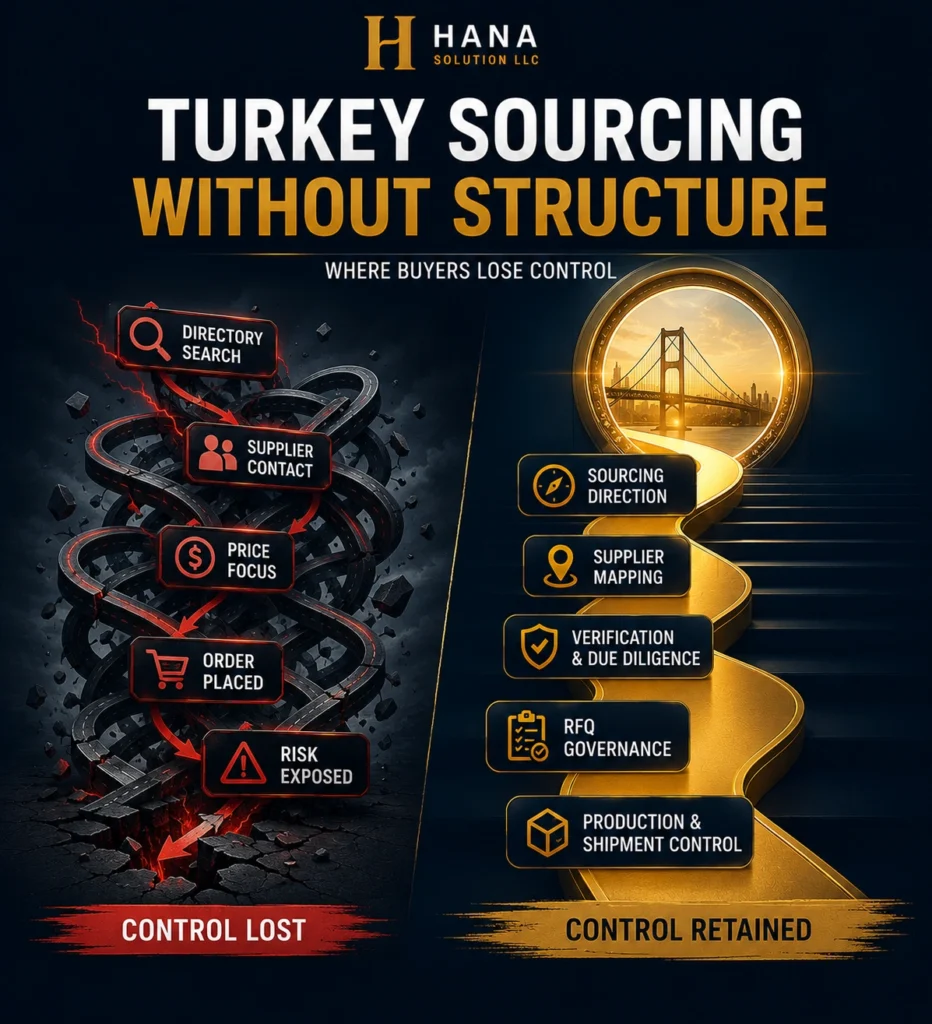
Turkey Sourcing Structure: The Pattern Is Always the Same
A buyer identifies a product requirement. They search directories, attend trade fairs, or receive referrals. They contact several Turkish companies. Prices arrive. A supplier is selected. An order is placed.
At some point in this sequence, something goes wrong. The supplier turns out to be a trader, not a manufacturer. The certificate claimed during negotiation does not cover the specific product. The RFQ responses are incomparable — different terms, different documentation, different scopes. A production deviation goes undetected until shipment.
These are not exceptional cases. They are the standard outcome of unstructured sourcing. The failure is not Turkey-specific — it is structure-specific. Buyers who lose control in Turkey-origin sourcing lose it for the same reasons buyers lose control anywhere: no governance framework before commercial engagement begins.
The failure is not Turkey-specific. It is structure-specific. Buyers who approach sourcing without a governance framework consistently encounter the same four failure points — regardless of the country of origin.
The Four Failure Points
After mapping engagements across multiple sectors and buyer markets, the same four failure points appear in unstructured sourcing projects. They are not random. They follow a sequence.
Why These Failures Are Predictable
None of these failure points are discovered mid-process by accident. They are the predictable consequence of skipping the governance phase. When sourcing begins with supplier contact rather than with sourcing direction and supplier mapping, the buyer has already lost structural control before any conversation has taken place.
The governance phase is not a due diligence checklist applied after a supplier is selected. It is the structure that determines which suppliers are contacted, under what parameters, with what compliance requirements defined in advance.
Structure before supplier contact. Governance before negotiation. These are not procedural preferences — they are the conditions under which buyer-side control is maintained throughout a sourcing engagement.
What Structured Sourcing Looks Like
Step 1 — Sourcing Direction Before Supplier Contact
Before any supplier is contacted, the sourcing objective is defined. What supplier type is required — manufacturer, OEM, private label? What compliance requirements apply to the target market? What is the realistic MOQ range? What are the timeline constraints? What is the acceptable counterparty profile?
This step eliminates entire categories of risk before they have the opportunity to materialise. A buyer who defines these parameters in advance does not waste engagement cycles on traders, incompatible suppliers, or entities whose compliance profile does not match the market requirement.
Step 2 — Supplier Mapping and Shortlisting
Structured mapping identifies manufacturers — not traders — against the defined parameters. Export activity is confirmed. Registry status is checked. Capacity is assessed against the stated requirement. The output is a shortlist of verified manufacturers, not a list of companies that appeared in a directory search.
Step 3 — Supplier Verification Before Commercial Engagement
Each shortlisted supplier is screened before commercial contact. Legal status, export history, certification scope, and counterparty clarity are confirmed. Red flags are identified and documented. The governance decision — Retained or Not Advanced — is made before any commercial discussion begins.
Step 4 — RFQ Governance Before Price Comparison
The RFQ is structured before it is sent. Parameters are standardised — payment terms, lead time definitions, documentation requirements, quality commitments. Responses are benchmarked against the same structural framework. Price comparison follows structural comparison — not the other way around.
Step 5 — Production and Shipment Control
Once a supplier is engaged, oversight does not stop. Production milestones are tracked. Deviations are detected early. Pre-shipment inspection confirms compliance before goods leave the facility. Shipment documentation is verified before customs clearance.
Each step in this framework is a governance gate. A buyer who passes through each gate retains control. A buyer who skips any gate loses it — and rarely recovers it within the same engagement.
The Turkey-Specific Context
Turkey is a significant manufacturing base across multiple sectors — textile, FMCG, machinery, furniture, construction materials, medical products, cosmetics, and defence. The manufacturing infrastructure is well-developed. Export activity is high. Certified manufacturers exist across all relevant compliance frameworks.
The challenge for international buyers is not the absence of qualified suppliers. It is the difficulty of distinguishing qualified manufacturers from traders, agents, and intermediaries who operate in the same market and present similarly at the initial engagement stage.
Turkey's export ecosystem includes a significant proportion of trading companies — entities that source from manufacturers and resell to international buyers. These companies are not manufacturers. They do not control production, cannot guarantee compliance documentation at the factory level, and introduce an additional layer of commercial exposure. Without a structured mapping and verification process, buyers frequently engage traders believing they are engaging manufacturers.
Frequently Asked Questions
Buyer-side governance means the sourcing structure — supplier mapping, verification, RFQ design, and commercial engagement — is managed exclusively in the buyer's interest, with no commission, mark-up, or supplier-side relationship. The governance framework determines which suppliers are contacted, under what parameters, and under what conditions commercial engagement begins.
Buyers lose control for the same reason they lose control in any sourcing context: governance is skipped and supplier contact precedes structural definition. Turkey's high proportion of trading companies operating alongside manufacturers makes the supplier identification step particularly high-risk without a structured mapping and verification process.
A sourcing agent typically operates on commission paid by the supplier or charges mark-ups on product pricing — creating a conflict of interest. A buyer-side procurement advisor operates exclusively for the buyer, with no supplier commission, no product mark-up, and no trading activity. The governance framework and commercial recommendations are aligned solely with the buyer's interests.
Before. Governance structure must be defined before any supplier is contacted. The sourcing direction, compliance requirements, counterparty profile, and RFQ parameters determine which suppliers are appropriate. Defining these after supplier contact begins means the buyer is already operating without structural control.
No. Hana Solution is an independent buyer-side procurement advisory. We do not source products, supply goods, act as a trading intermediary, or receive commission from suppliers. Our engagement covers governance structure, supplier verification, RFQ governance, and production oversight — exclusively on the buyer's behalf.
Submit a project brief. We define the governance structure, confirm scope, and respond within 24 hours. No trading. No commissions. Buyer-side only.