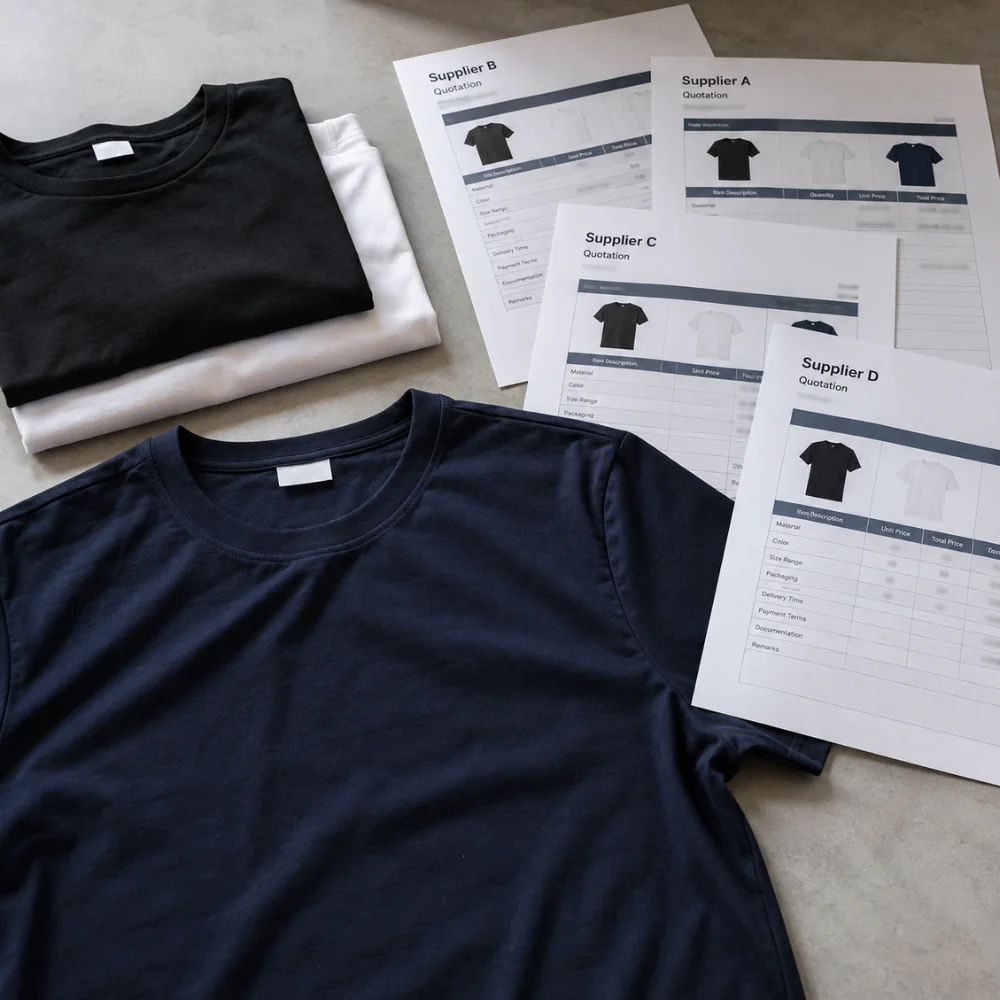
Four Turkish Garment Offers, Four OEKO-TEX References: Which Could the Buyer Actually Compare?
An EU/UK buyer had received four quotations from Turkish ready-made garment suppliers and was about to compare them mainly on unit price. All four offers referred to OEKO-TEX STANDARD 100 documentation. Nobody had yet checked what each certificate actually covered, or whether the offers were priced on the same commercial terms.
The buyer needed finished garments with matching product documentation. A lower unit price was only useful if it bought the same scope: the same certified product, the same delivery responsibilities and the same payment and document conditions.
Hana Solution LLC supported the assignment through RFQ & Quote Comparison, with certificate checks under a separately scoped Supplier Verification & Risk Screening. The buyer already had the quotations; no manufacturer search was needed.
What Needed Checking Before the Price Column Meant Anything
Certificate Owner, Validity and Product Scope
Each certificate number was checked in the OEKO-TEX Label Check. Three questions were treated separately: is the certificate valid, which company holds it, and does the certified article match the finished garment being quoted?
Delivery Responsibilities
The offers used different delivery assumptions. Suppliers A and B were asked to quote on one common delivery basis, so that each price covered the same handover point and the same split of shipment costs and risk.
Payment and Required Documents
Payment structure and RFQ document requirements were aligned. The revised RFQ specified finished-garment certification scope, packing-list and origin-document requirements for every retained supplier.
Production Lead-Time Definition
The retained offers quoted 45 and 50 days from deposit. Recording the starting point made the five-day difference comparable instead of leaving it hidden behind the unit price.
The RFQ comparison framework covers commercial inclusions, terms and clarification points. Supplier and certificate checks follow the separately agreed verification evidence scope.
Four Valid Certificates, Only Two Covering the Garment Being Bought
All four certificates were valid. Suppliers A and B submitted certificates covering finished garments. Suppliers C and D submitted certificates covering yarn, which did not establish certification of the finished garments the buyer intended to source.
| Supplier | Certified Article | Review Finding | Buyer Decision |
|---|---|---|---|
| Supplier A | Finished garments; Product Class II. | Valid certificate matching the finished-garment requirement. | Continued on the revised RFQ basis. |
| Supplier B | Finished garments; Product Class II. | Valid certificate matching the finished-garment requirement. | Continued on the revised RFQ basis. |
| Supplier C | Yarn. | Valid certificate, but the certified article was yarn, not the finished garment. | Not advanced on the submitted evidence. |
| Supplier D | Yarn. | Valid certificate, but the certified article was yarn, not the finished garment. | Not advanced on the submitted evidence. |
Why a valid OEKO-TEX certificate can still be the wrong certificate. A STANDARD 100 certificate applies to the article and the company named on it. A yarn certificate shows that the yarn was tested; it does not certify the finished garment and its other components, such as sewing thread, labels and trims.
Product Class II means the article is intended for direct skin contact. It sets the testing level; it does not tell you whether the certified article is yarn, fabric or a garment. Certificates are issued for one year, so validity must be checked at the time of ordering.
In Turkish garment sourcing, makers sometimes forward certificates held by their yarn or fabric suppliers. Before relying on any certificate, check three fields in the Label Check: certificate owner, type of certified article and validity. See the official STANDARD 100 overview.
Aligning the Remaining Garment Offers Before Comparing Prices
The RFQ was reissued to Suppliers A and B with common delivery, payment and documentation requirements. This separated the certificate question from the commercial question: how did the retained offers compare once they were priced on the same terms?
| Decision Area | Before Review | After Review | Value to the Buyer |
|---|---|---|---|
| Offers progressing | Four quotations under consideration. | A and B continued. C and D were not advanced on the submitted evidence. | Negotiation focused on the two offers backed by finished-garment certification. |
| Certificate relevance | All four offers referenced valid OEKO-TEX documents. | Finished-garment certificates were separated from yarn-only certificates. | A valid certificate was no longer treated as proof that the quoted garment was covered. |
| Delivery basis | Offers used different delivery assumptions. | A and B quoted on one common delivery basis. | Prices covered the same delivery responsibilities. |
| Payment and documents | Payment and document conditions were not aligned. | Payment structure and certification, packing-list and origin-document requirements were aligned. | Price could be assessed against one shared set of commercial requirements. |
| Production timing | Lead-time starting conditions needed to be made explicit. | A: 45 days from deposit. B: 50 days from deposit. | The five-day difference stayed visible in the decision. |
The commercial result: four apparently comparable prices became two offers on a shared RFQ basis. Had the buyer selected on unit price alone, it could have chosen a supplier whose certificate did not cover the garment being ordered.
What the Buyer Could Use for the Next Decision
- Supplier-level certificate findings: for each offer, the certificate owner, certified article and validity, separating finished-garment certificates from yarn certificates.
- A revised RFQ basis: consistent delivery, payment and document requirements for the two retained suppliers.
- A side-by-side view of the retained terms: the shared comparison basis and remaining differences, including production timing.
- Decision support before negotiation: which offers should proceed and which points still needed clarification.
Download the Textile Quotation Case Summary
The editable workbook contains six sheets: Case Summary, Supplier Review, Commercial Comparison, RFQ Checklist, Data Basis and Illustrative Procurement Model. Use the RFQ Checklist as a starting point for your own garment quotation request.
Download Textile Quotation Summary (.xlsx) →Publication summary of the case findings. Product specifications, quantities and prices in the separately labelled Illustrative Procurement Model are example inputs, not historical client order data.
For your own assignment, see the RFQ & Quote Comparison deliverables and our buyer deliverable structure.
Two Offers Advanced With the Certification and Terms Visible
The buyer did not advance Suppliers C and D on the submitted certification evidence. Suppliers A and B proceeded on the revised RFQ basis, so price negotiation continued with the certificate findings and commercial conditions on the table.
Hana Solution LLC provided the review and comparison findings. The buyer retained the supplier-selection and purchasing decision. The reported outcome is progression to negotiation.
Comparing Turkish Apparel Quotations for EU and UK Buyers
In a garment quotation, product detail matters as much as the price. Finished-garment, fabric-only and cut-and-sew (CMT) prices represent different purchasing scopes, and two quotes for "the same T-shirt" can differ in fabric weight, trims or packing.
Before you compare Turkish garment quotes, make sure every supplier has priced:
- the same fabric composition and GSM;
- the same quantities by style, size and colour, with MOQ and quantity tolerance;
- the same labels, hangtags, polybags and carton packing;
- the same sampling and testing charges;
- the same currency, quotation validity, delivery basis and payment milestones;
- a production lead time with a defined start: deposit, pre-production sample approval, fabric approval or all approvals completed.
Delivery terms should match the actual transport mode and handover point, and payment milestones should name the document that releases each payment. Our Textile & Apparel sourcing framework explains the product and production questions that establish supplier fit in Turkey.
The destination market also shapes the brief. Official EU textile labelling guidance and Great Britain textile labelling guidance cover fibre-composition labelling. Certification, labelling and import documentation are separate requirements.
Already Have Turkish Supplier Quotations?
Start with the offers you have. Align inclusions, quantities, delivery, payment and lead times before selecting a supplier.
Need Supplier or Certificate Claims Checked?
Check company identity, manufacturer status, and whether submitted certificates are authentic and cover the product you are buying.
Still defining the product or looking for manufacturers? Review the service starting points for textile and apparel sourcing in Turkey.
Questions About Comparing Turkish Garment Quotations
Does an OEKO-TEX yarn certificate cover the finished garment?
No. A yarn certificate covers the yarn. Check that the certificate is valid, covers the finished garment being purchased, and can be traced to the relevant manufacturer and supply arrangement. In this case, that distinction removed two of four offers.
If a Turkish garment maker uses OEKO-TEX certified fabric, is the garment certified?
Not automatically. Certified fabric alone does not establish certification of the finished garment. Request a valid STANDARD 100 certificate covering the finished article, confirm how it applies to the product being supplied, and check the number in the OEKO-TEX Label Check.
Can you compare quotations from Turkish suppliers I have already found?
Yes. RFQ & Quote Comparison can start with your existing Turkish supplier offers. We agree the product, quantity, destination, comparison fields and clarification points before starting. Certificate and supplier checks are scoped separately where needed.
What will I receive, and who makes the purchasing decision?
The agreed scope defines the comparison matrix, clarification points and supporting findings. You keep the supplier-selection and purchasing decision; Hana Solution LLC has no commission or stake in which supplier you choose.
Holding Several Turkish Garment Quotes and About to Choose?
Tell us what you are buying, the destination market, the approximate order quantity and how many offers you have. Note the differences you need resolved: product scope, price inclusions, MOQ, certification, payment, delivery or production timing. A short outline is enough to start.
Hana Solution LLC confirms the review scope, deliverables, fixed fee and timeline in writing before any paid work begins.
Independent buyer-side support. No supplier commissions, trading or product mark-ups. Submitting a brief does not start paid work or authorise supplier contact.
Buyer-side contact: Deniz Niyazi Yildiz
Founder, Hana Solution LLC · 20+ years in procurement and logistics · About us · LinkedIn
Scope and confidentiality. This case covers submitted certificate evidence and pre-selection quotation alignment; the reported result is progression to negotiation, not completed production, shipment or realised savings. Certificate findings do not establish overall destination-market compliance. Client, supplier and commercially sensitive details are withheld. See our Case Studies for the wider approach. Case published June 2026 · last reviewed October 2026.