
Hana Solution LLC – Insights
OEKO-TEX Scope Mismatch: What Textile Buyers Need to Know
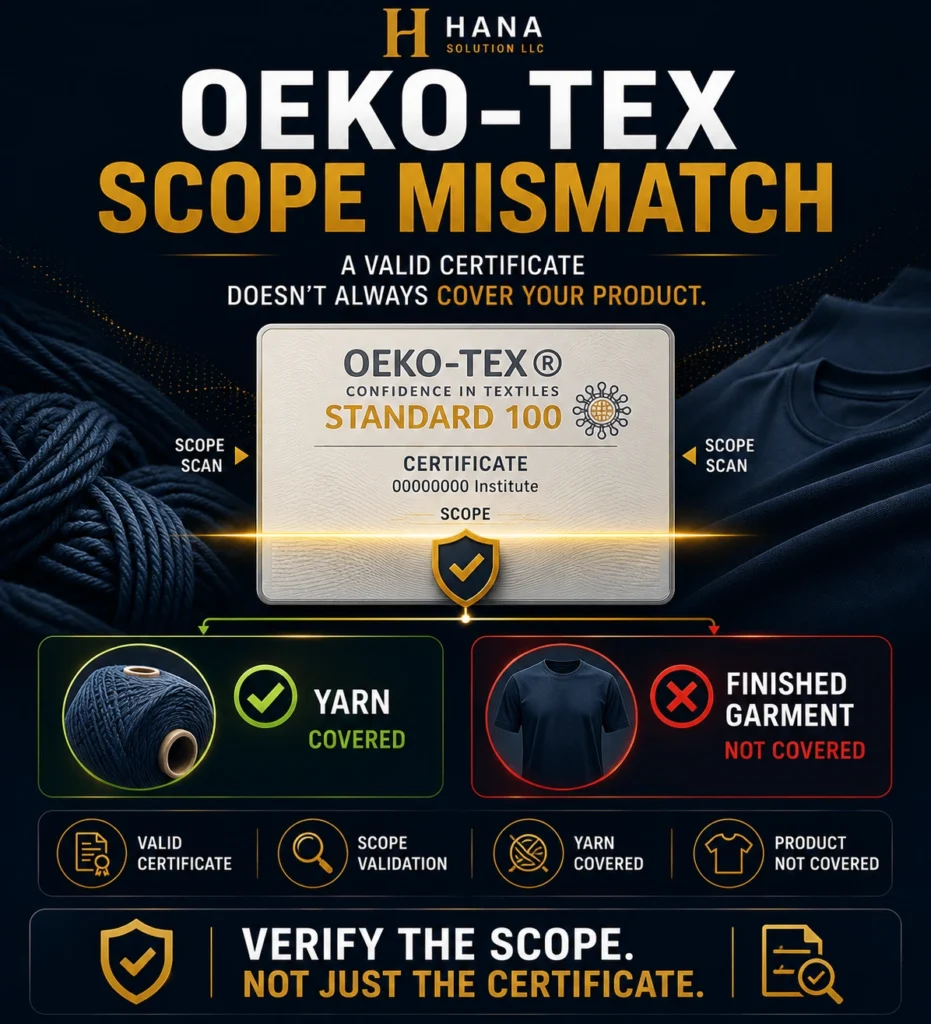
OEKO-TEX Scope Mismatch is the most common certification failure in Turkey-origin textile sourcing. A certificate displayed on a supplier’s website or catalogue is not proof of compliance for your specific product — certification scope is defined at the product stage, and a certificate issued for one stage does not cover another. Buyers who do not validate scope before commercial engagement routinely discover this at the documentation or customs stage.
OEKO-TEX Scope Mismatch: What OEKO-TEX Certification Actually Covers
OEKO-TEX is a family of standards — the most widely referenced being OEKO-TEX Standard 100 — that certifies textile products against harmful substance limits. Certification is issued at the product level, not the company level. A manufacturer can hold OEKO-TEX Standard 100 certification for a specific product category — yarn, greige fabric, finished fabric, or finished garment — while other product categories in their range remain uncertified.
In supplier verification engagements across Turkish textile manufacturers, OEKO-TEX scope mismatch was one of the most frequently encountered compliance failures. A supplier presents an OEKO-TEX certificate as evidence of compliance. The buyer accepts this as confirmation that their specific product — a finished garment, for example — is covered. The certificate covers yarn. The finished garment is not certified.
An OEKO-TEX certificate that covers yarn does not certify finished garments — even if those garments are made from the same yarn. Each product stage requires separate certification. A supplier holding yarn certification cannot claim finished garment compliance on that basis.
The Four OEKO-TEX Standard 100 Product Classes
OEKO-TEX Standard 100 divides textile products into four product classes based on their intended use and contact with the human body. Each class has different testing requirements and limit values. A certificate issued for one product class does not cover products in a different class — even within the same manufacturer's range.
How Scope Mismatch Happens in Practice
Scope mismatch typically occurs in one of three ways in Turkey-origin textile sourcing engagements.
Stage Mismatch
The supplier holds OEKO-TEX certification for yarn or greige fabric — an upstream production stage. The buyer is sourcing finished garments. The certificate covers the input material, not the finished product. The buyer accepts the certificate as garment compliance evidence without checking the scope.
Product Class Mismatch
The supplier holds OEKO-TEX Standard 100 certification for Class III or IV products — outer garments or furnishing textiles. The buyer is sourcing Class II products — direct skin contact garments. The certificate is genuine, but it does not cover the product class being purchased.
Certificate Currency
OEKO-TEX Standard 100 certificates have a validity period. An expired certificate is not evidence of current compliance. In supplier verification engagements, expired certificates presented as current compliance evidence were identified in a significant proportion of initial supplier submissions — particularly from suppliers who had not recently exported to EU markets.
OEKO-TEX certificate validation requires checking three things: the certificate number in the OEKO-TEX database, the scope — which product stages and classes are covered — and the validity date. A certificate that passes only two of these three checks is not a valid compliance basis.
How to Validate OEKO-TEX Certification Before Commercial Engagement
OEKO-TEX maintains a public database — the OEKO-TEX Label Check — where certificates can be validated by certificate number. Validation confirms the certificate holder, the certified products, the product class, and the validity date. This check takes less than two minutes and eliminates scope mismatch risk before any commercial engagement begins.
In buyer-side verification engagements where OEKO-TEX validation was conducted before supplier shortlisting, scope mismatches were identified and resolved before any RFQ was issued. In engagements where validation was not conducted, scope mismatches were discovered at the documentation review stage — after commercial commitments had been made.
Frequently Asked Questions
OEKO-TEX scope mismatch occurs when a supplier presents an OEKO-TEX certificate as compliance evidence for a product that is not covered by that certificate's scope. This happens when the certificate covers a different production stage — yarn rather than finished garment — or a different product class than the product being purchased. The certificate is genuine; it simply does not cover the specific product the buyer is sourcing.
OEKO-TEX provides a public Label Check database at oeko-tex.com where certificates can be validated by entering the certificate number. The database shows the certified products, the applicable product class, and the certificate validity date. For any supplier claiming OEKO-TEX compliance, this check should be completed before the supplier is advanced to the RFQ stage.
Not necessarily. OEKO-TEX Standard 100 certification for yarn confirms that the yarn meets the standard's substance limits. It does not certify that finished garments made from that yarn are compliant — finished garments require separate certification covering the complete product, including all components, accessories, and finishing treatments. Yarn certification is not transferable to finished garment compliance.
Before the supplier is advanced to the RFQ stage. OEKO-TEX validation is part of the supplier verification phase — after initial identification but before any commercial document is exchanged. Conducting validation at this stage ensures that only suppliers with confirmed, in-scope, current certification are included in the RFQ process.
Yes. OEKO-TEX scope validation — including database verification, product class confirmation, and currency check — is conducted as part of the Supplier Verification & Risk Screening service for textile sector engagements. Certification validation is completed before any supplier is advanced to the RFQ stage, eliminating scope mismatch risk before commercial engagement begins.
Submit a project brief. We validate OEKO-TEX scope, confirm certification currency, and ensure your supplier's compliance profile matches your target market requirements.