
Hana Solution LLC – Insights
Why Supplier Qualification Fails Before RFQ
Supplier Qualification Before RFQ engagements close three structural gaps — supplier type, compliance filter, and counterparty screen — before commercial contact begins. Without these gates in place, the RFQ is sent to the wrong entities under the wrong assumptions. The consequences appear later, but the cause is always earlier.
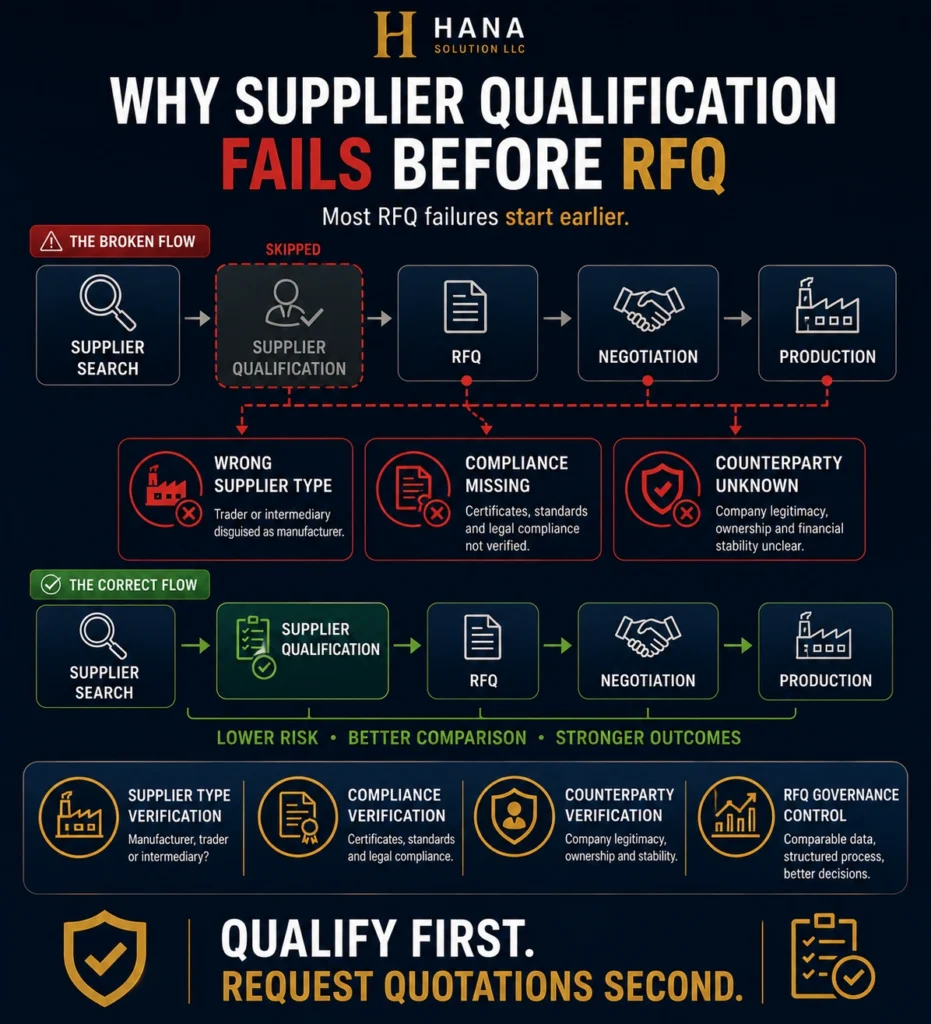
Supplier Qualification Before RFQ: The Phase That Is Skipped — Not Failed
In buyer-side sourcing engagements across textile, machinery, FMCG, and construction sectors, a consistent pattern emerges: supplier qualification is not attempted and then failed — it is skipped entirely. Buyers move from supplier identification directly to RFQ issuance, treating qualification as something that will happen implicitly during the commercial process.
It does not. The commercial process surfaces qualification failures — it does not resolve them. By the time a qualification problem becomes visible in a commercial engagement, the buyer has already committed time, documentation, and frequently advance payment to a supplier who should never have reached the RFQ stage.
Qualification is not a step that happens during the RFQ process. It is the step that determines whether an RFQ should be issued to a given supplier at all.
The Four Qualification Gaps
Across sourcing engagements where supplier qualification was conducted before RFQ issuance, the same four gaps appeared in the pre-qualification stage when it was absent. Each gap creates a specific category of downstream failure.
What Qualification Actually Requires
Supplier Type Definition
Before any supplier is contacted, the required supplier profile must be defined. What production capability is required? What is the minimum acceptable export history? What ownership structure is acceptable? What geographic production region is preferred? These parameters determine which suppliers belong in the pool — and which do not.
Compliance Requirement Mapping
The compliance framework for the target market must be defined before supplier contact. For EU buyers, this means identifying the applicable directives, certifications, and documentation requirements before the first supplier conversation. In projects where compliance requirements were defined in advance, the supplier shortlist was reduced by an average of 40 percent before a single RFQ was issued.
Counterparty Validation
Registry validation, export activity confirmation, and ownership structure review must be completed before commercial engagement begins. This is not a post-RFQ due diligence step — it is a pre-RFQ gate. A supplier who does not pass counterparty validation does not receive an RFQ.
In engagements where all four qualification gates were applied before RFQ issuance, the RFQ process produced structurally comparable responses — and the commercial decision was made on a validated foundation. Where qualification was skipped, the RFQ process produced noise.
The Cost of Skipping Qualification
The cost of skipping supplier qualification is not visible at the point of skipping. It becomes visible when an RFQ response arrives from a trader who presented as a manufacturer. When a compliance claim cannot be evidenced at the documentation review stage. When a counterparty whose ownership structure is unclear requests an advance payment. When production begins with a supplier whose capacity was never independently confirmed.
Each of these outcomes is the downstream consequence of a qualification gap that existed before the RFQ was issued. Addressing them mid-engagement is significantly more costly — in time, commercial exposure, and sourcing cycle delay — than preventing them through qualification before commercial contact begins.
The RFQ is not the beginning of the sourcing process. It is the output of a qualification process that must be completed first. Buyers who treat the RFQ as the starting point consistently encounter qualification failures that were already present before the first supplier conversation took place.
Frequently Asked Questions
Supplier qualification is the process of confirming that a supplier meets the defined parameters — supplier type, compliance requirements, counterparty clarity, and export readiness — before any commercial document is exchanged. In Turkey-origin sourcing, qualification must include manufacturer status confirmation, as the proportion of traders presenting as manufacturers is significant across most sectors.
Because the RFQ is a commercial document. Once it is issued, the buyer has signalled commercial intent to the supplier. Discovering a qualification failure after RFQ issuance — that the supplier is a trader, that their certification is out of scope, that their counterparty structure is unclear — creates a significantly more complex and costly correction than discovering it before the RFQ was sent.
For a shortlist of three to five suppliers, a structured qualification review — covering supplier type, compliance screening, and counterparty validation — typically takes five to ten working days. This timeline varies by sector and market. The investment in qualification time consistently reduces total sourcing cycle time by eliminating suppliers who would otherwise have consumed engagement cycles before being disqualified.
The trader responds with pricing and terms based on what they can source from a manufacturer they do not control. Every commitment in that response — lead time, MOQ, quality specification, certification — carries an additional execution risk layer. If the buyer advances to contract or payment without discovering the supplier's trading status, they are exposed to production delays, compliance gaps, and documentation failures that cannot be traced or managed at the factory level.
Yes. Supplier qualification — covering supplier type determination, compliance requirement mapping, and counterparty validation — is conducted as part of both the Sourcing Direction and Supplier Verification services. Qualification is completed before any RFQ is issued, ensuring that the commercial process begins on a validated foundation.
Submit a project brief. We define the qualification framework, validate the supplier pool, and ensure your RFQ reaches the right entities on a verified foundation.