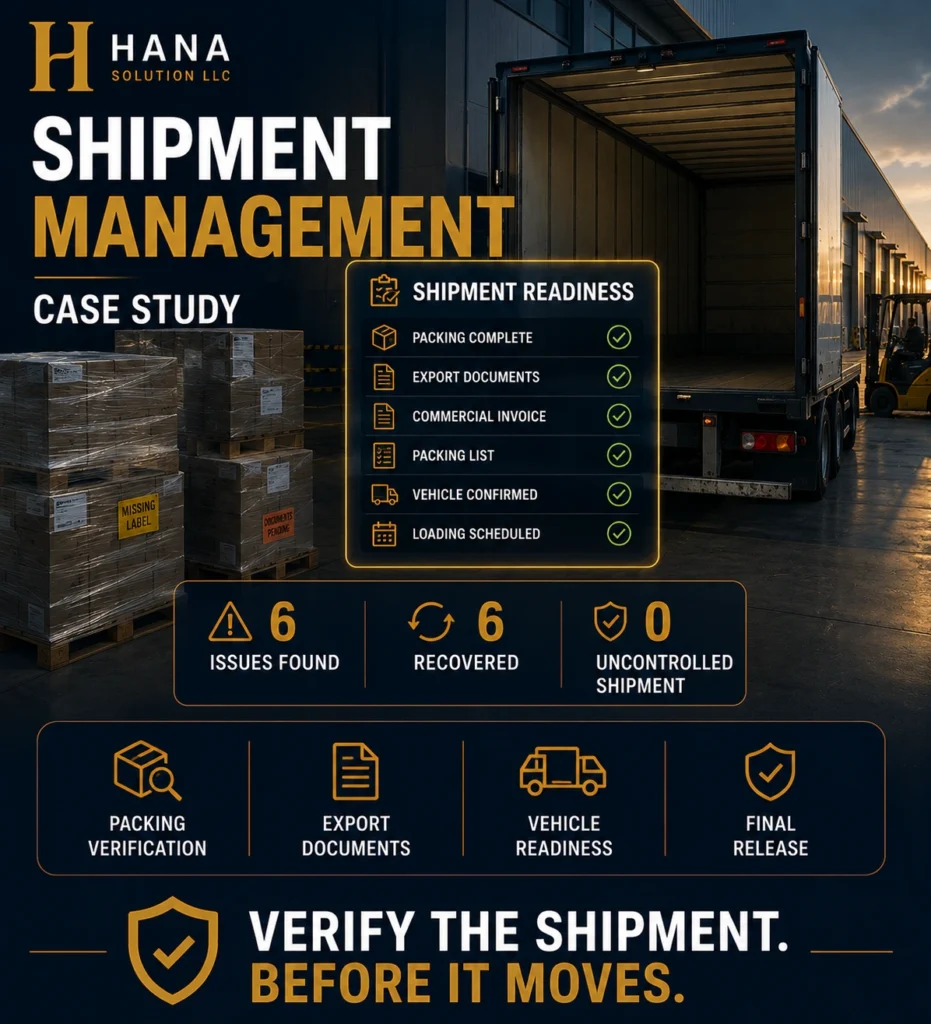
The False Readiness Problem
Shipment Management Turkey to Hungary: The False Readiness Problem
Supplier
Production is complete. Shipment is ready. Loading can begin on the proposed date.
Buyer
Supplier confirmed readiness. Shipment date is set. Goods will depart on schedule.
Reality
Packing incomplete. Quantities unconfirmed. Documentation has gaps. No vehicle allocated. Loading not coordinated.
Decision Tension
The moment buyer-side control changed the outcome
Governance intervention — shipment release withheld
Supplier
"Shipment is ready. Proceed with dispatch."
→
Buyer (pre-control)
"Supplier confirmed. Ready to ship."
→
Buyer-Side Control
"Verification required. Release withheld. 6 failures active."
Shipment was not released based on supplier declaration alone. Independent verification determined readiness — not the proposed date.
Situation & Gap
What the buyer assumed — and what shipment preparation actually revealed
Buyer's Assumption
Production had been confirmed complete. A shipment date had been proposed and accepted. The buyer assumed the shipment was operationally ready — that packing, documentation, vehicle allocation, and loading coordination had all been completed. No independent verification mechanism existed to challenge this assumption.
What Verification Revealed
When buyer-side control was deployed, the shipment that was "ready" was not ready. Packing was incomplete. Quantities were unconfirmed. Documentation had gaps across multiple export documents. No vehicle had been allocated. Loading had not been coordinated between manufacturer and carrier. The proposed dispatch date did not reflect execution reality.
Governance Actions
Four-phase buyer-side intervention — from false readiness to controlled delivery
Phase 1
Readiness Review & Failure Identification
Independent readiness review across all execution components
6 critical failures identified — packing, quantities, documentation, vehicle, loading, visibility
Shipment release withheld pending resolution
6 Failures Active
Phase 2
Packing, Quantity & Documentation Recovery
Packing completion confirmed independently
Quantities verified against purchase order
Recovery Active
Phase 3
Carrier Coordination & Loading Execution
Vehicle allocated and confirmed
Loading schedule synchronized between manufacturer and carrier
Pickup executed against verified readiness — not supplier declaration
Controlled
Phase 4
Transit Monitoring & Delivery Confirmation
FTL progress tracked independently — Turkey to Hungary
Milestones reported to buyer throughout transit
Delivery confirmed — no further escalation
Delivered
Risk Chain
Six failures — one connected execution breakdown
These were not six separate problems — each failure enabled the next
Packing incomplete
Quantities could not be confirmed. Packing list could not be finalized.
Quantities unconfirmed
Invoice and packing list could not be aligned. Documentation set remained incomplete.
Documentation incomplete
Release without correction would have created significant risk of customs processing delays or holds at destination.
Vehicle unallocated
No confirmed transport capacity. Loading date could not be fixed.
Loading not coordinated
Manufacturer and carrier not aligned. Significant risk of pickup failure — driver arriving at an unready factory.
No buyer visibility
All execution status dependent on supplier self-reporting. Significant risk that problems would surface only after departure — with no recovery path available.
Before & After Control
What each failure looked like — and what buyer-side control established
| Component |
Before Control |
After Control |
| Packing | Incomplete | Completed & verified |
| Quantities | Unconfirmed | Confirmed before release |
| Documentation | Gaps — invoice, packing list, transport docs | Full set aligned & reviewed |
| Vehicle | No allocation | Allocated & scheduled |
| Loading | Not coordinated | Date confirmed, pickup executed |
| Buyer Visibility | Supplier updates only | Independent reporting active |
Packing
BeforeIncomplete
AfterCompleted & verified
Quantities
BeforeUnconfirmed
AfterConfirmed before release
Documentation
BeforeGaps — invoice, packing list, transport docs
AfterFull set aligned & reviewed
Vehicle
BeforeNo allocation
AfterAllocated & scheduled
Loading
BeforeNot coordinated
AfterDate confirmed, pickup executed
Buyer Visibility
BeforeSupplier updates only
AfterIndependent reporting active
Counterfactual
What would have happened without buyer-side control
Without independent shipment governance — significant risks that were present
The shipment would likely have departed later than the proposed date — packing was not complete, loading could not have started on schedule regardless of the date proposed
Significant risk of pickup failure — no vehicle confirmed, no loading coordination; driver arriving at an unready factory with no clear loading date
Significant risk of documentation discrepancies at Hungarian customs — invoice and packing list not aligned with physical shipment at point of departure
All problems would likely have been discovered after departure — with the shipment already in transit, recovery options are limited and costly
Buyer entirely dependent on supplier self-reporting — no independent view of execution status at any stage of the transport cycle
Outcome & Client Gains
What shipment recovery produced for the buyer
6
FailuresIdentified after dispatch preparation began
6
RecoveredAll resolved before loading executed
1
Date ChallengedProposed dispatch date withheld — verified date used instead
0
UncontrolledNo further escalation after control established
What the Client Gained
False readiness exposed before dispatch — supplier confirmation alone would have been accepted; independent control proved it was insufficient
Dispatch date challenged and corrected — shipment released on a verified date, not the date the supplier proposed
Documentation aligned before release — export document set corrected before shipment, eliminating customs processing risk at Hungarian destination
Loading coordinated between all parties — manufacturer, carrier, and buyer aligned on schedule before pickup was attempted
End-to-end visibility established — independent reporting replaced supplier self-reporting from departure through delivery confirmation in Hungary
The shipment was not recovered because transport improved. It was recovered because shipment readiness was independently verified before release.
Governance Principle
"A proposed shipment date is not an execution milestone. It is a supplier expectation — until packing is completed, quantities are verified, documents are aligned, vehicle allocation is confirmed, and loading readiness is independently validated. Supplier confirmation creates expectations. Verification creates control."
Shipment Management
Supplier confirmed ready — but is it verified?
Submit a project brief. We establish independent shipment control, verify readiness, and maintain buyer-side visibility from factory to final delivery.
Submit Your Project Brief →
This case study reflects the governance process, structural findings, and execution outcomes from a real buyer-side engagement. Buyer identity, supplier identity, and commercial figures are withheld per confidentiality obligations.