
Hana Solution LLC – Insights
Governance Before Negotiation: What Buyers Miss Before Supplier Contact
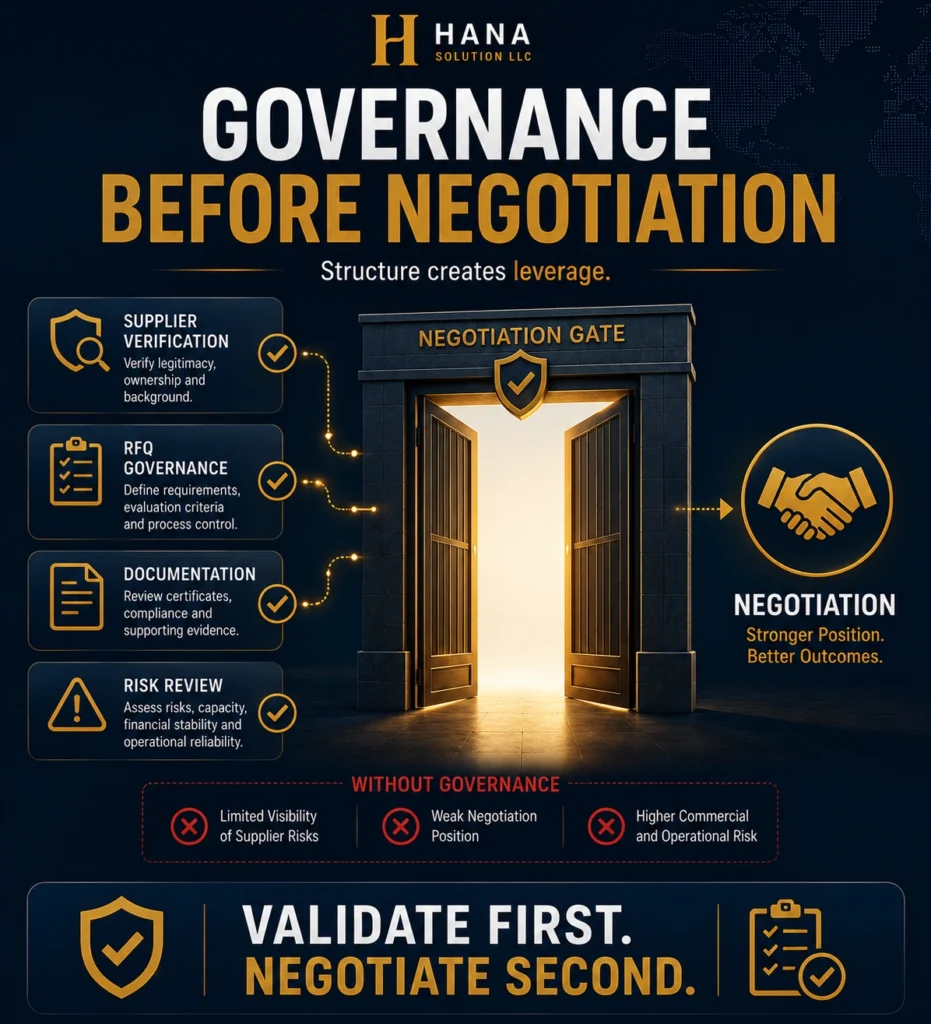
Governance Before Negotiation is the condition under which buyer-side control is maintained — not a procedural preference. Commercial negotiation without prior governance structure produces inconsistent outcomes. What buyers miss in the pre-engagement phase consistently becomes a post-engagement problem.
Governance Before Negotiation: What It Actually Means
Governance before negotiation means that the sourcing framework — supplier type, compliance requirements, counterparty profile, RFQ parameters, and commercial exposure limits — is defined and validated before the first supplier conversation takes place. It is not a document that is produced after negotiation begins. It is the structure that determines whether negotiation should begin at all.
In buyer-side procurement engagements conducted across EU, UK, MENA, and Balkans markets, the most consistently observed source of commercial exposure was not poor negotiation — it was the absence of a governance framework before negotiation started. Buyers who entered supplier negotiations without defined parameters consistently accepted commitments they could not verify and terms they could not enforce.
Governance before negotiation is not about slowing down the sourcing process. It is about ensuring that the commercial commitments made during negotiation have a verified foundation — and that the buyer retains control over what is being agreed.
What Buyers Miss in the Pre-Engagement Phase
The pre-engagement phase — between supplier identification and first commercial contact — is where governance structure is either established or skipped. When it is skipped, four specific gaps consistently appear in the downstream commercial process.
The Governance Framework That Precedes Negotiation
Counterparty Definition
Before any supplier is contacted, the acceptable counterparty profile must be defined. What supplier type is required? What minimum export history is acceptable? What ownership structure is acceptable? What registry status must be confirmed? These parameters are the governance gate through which suppliers must pass before negotiation begins.
Compliance Requirement Mapping
The compliance framework for the target market must be mapped before supplier contact. For EU buyers, this means identifying applicable directives and certification requirements in advance. In engagements where compliance requirements were defined before supplier contact, the supplier pool was reduced by 30 to 50 percent before a single negotiation conversation took place — eliminating compliance exposure before it could be created.
Commercial Exposure Parameters
Maximum acceptable advance payment, payment term structure, and title transfer requirements must be defined before negotiation. A buyer who enters negotiation without defined exposure parameters is in a structurally weak position — any payment term the supplier proposes becomes a reference point rather than a parameter to be evaluated against a defined limit.
Governance Decision Criteria
The criteria for the governance decision — Retained or Not Advanced — must be defined before supplier evaluation begins. What disqualifies a supplier? What conditions must be met before commercial engagement begins? Defining these criteria in advance removes subjectivity from the supplier selection process and ensures that commercial decisions are made against a consistent governance standard.
Governance before negotiation does not prevent commercial engagement — it structures it. Buyers who establish governance parameters before supplier contact consistently achieve more favourable commercial outcomes than those who negotiate without a defined framework.
Why This Is Particularly Relevant for Turkey-Origin Sourcing
Turkey's export ecosystem presents a specific governance challenge: a high proportion of trading companies operating alongside manufacturers, sophisticated presentation of certification claims that have not been validated for scope, and commercial terms that are presented as standard but contain embedded exposure that is not visible without a governance review.
Across buyer-side engagements in Turkey-origin sourcing, the most common pre-negotiation governance gap was the absence of supplier type confirmation. Buyers entered negotiation with entities they believed to be manufacturers — and discovered the trading status only when production-level documentation was requested, at which point commercial commitments had already been made.
Frequently Asked Questions
It means that before any supplier conversation begins, the buyer has defined the acceptable counterparty profile, mapped the compliance requirements for the target market, established commercial exposure parameters, and set the governance decision criteria. These definitions form the framework against which supplier engagement is evaluated — and determine whether negotiation should proceed at all.
Because once negotiation begins, the buyer is already in a reactive position. Governance parameters defined during negotiation are influenced by the supplier's proposals and the commercial pressure of an active engagement. Governance parameters defined before engagement are set without that influence — and provide a stronger foundation for commercial decision-making.
The most consistently observed gap is supplier type confirmation — buyers entering negotiation without confirming whether the counterparty is a manufacturer or trader. This gap creates downstream exposure across pricing, compliance traceability, production control, and documentation integrity. It is the governance gap that produces the widest range of commercial problems.
In practice, it accelerates the sourcing cycle. Engagements where governance was established before supplier contact consistently completed the commercial process faster than those where governance was absent — because qualification failures, compliance gaps, and counterparty clarity issues were resolved before they consumed negotiation cycles. The pre-engagement governance phase replaces the post-engagement correction phase.
The governance framework is established during the Sourcing Direction phase — before any supplier is contacted. Counterparty profile, compliance requirements, commercial exposure parameters, and governance decision criteria are defined and documented. Suppliers are evaluated against these parameters during the Supplier Mapping and Verification phases before any commercial engagement begins.
Submit a project brief. We define the governance framework, validate the supplier pool, and ensure commercial engagement begins on a structured foundation.