
Hana Solution LLC – Insights
Gold Jewelry Manufacturers in Turkey: What International Buyers Must Verify Before Ordering
Gold jewelry manufacturers in Turkey offer 8K–22K production, private label, wholesale and custom manufacturing options. But catalogues, quotations and samples do not prove that a supplier can deliver the required quality, volume and continuity. See what international buyers should verify before shortlisting a manufacturer, approving samples or placing an order.
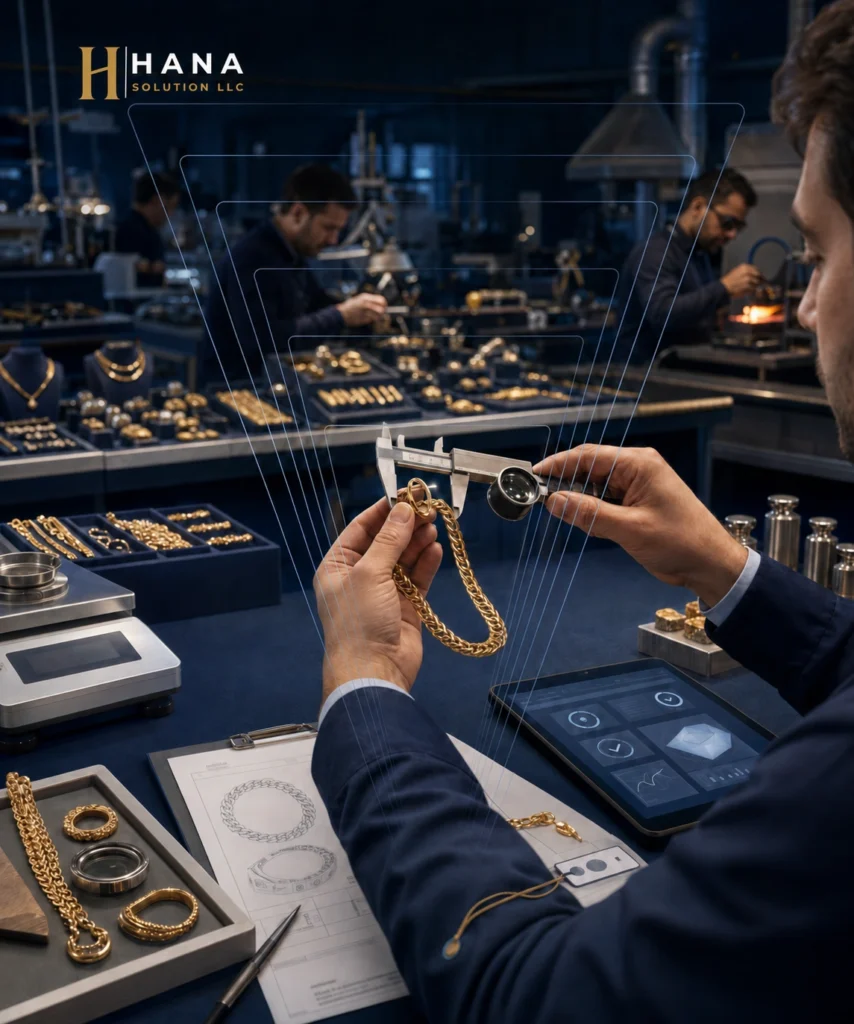
Gold Jewelry Manufacturers in Turkey: A Broad Market Is Not a Qualified Shortlist
Gold jewelry manufacturers in Turkey operate across different product categories, karat ranges and commercial models: collection-based wholesale, private-label production, custom development, OEM/ODM, chain manufacturing, casting, handwork and stone-set jewelry.
That breadth makes Turkey commercially relevant. It does not make every visible supplier relevant to the same buyer.
A manufacturer producing high-volume 22K chains for a regional wholesaler may not be suitable for lightweight 10K private-label pieces intended for North America. A workshop capable of producing an attractive sample may not control the same process at commercial volume. A company presented online as a manufacturer may be an export or trading entity coordinating production through third-party workshops.
The buyer's problem is therefore not simply finding gold jewelry manufacturers in Turkey. It is determining which supplier structure, production capability and commercial model fit the specific product, destination market, volume and continuity requirement.
A supplier search creates names. A controlled sourcing decision requires qualification, verification and commercial comparability.
Why This Matters Now
Türkiye's jewellery sector generated USD 7.9 billion in exports in 2025, the highest annual value recorded in the sector, according to Türkiye Exporters Assembly data (Presidency Directorate of Communications, citing TİM data). This confirms the depth and international relevance of Türkiye's jewellery ecosystem. It does not, however, establish the capability, product fit or supply continuity of any individual gold jewellery manufacturer.
That distinction matters under Türkiye's evolving raw-gold import regime. A monthly quota on unprocessed gold imports has been in place since August 2023 (Ministry of Treasury and Finance, quota announcement). Subsequent Treasury and Borsa İstanbul rules have introduced different allocation structures, exporter-linked mechanisms and operating limits (Borsa İstanbul, announcement of 2 January 2026; current precious-metals import table). These rules do not create a single supplier "quota certificate"; they affect manufacturers differently according to their legal entity, exporter status, material-access model and production structure.
For international buyers, the relevant question is therefore not simply whether Türkiye is a significant jewellery manufacturing market. It is whether a specific manufacturer can secure the required material, maintain the quoted commercial structure and support repeat production under the conditions applicable to its operation.
National export strength and supplier-level continuity are different facts. The first establishes market relevance. The second still requires verification.
8K–22K Is a Product Range, Not a Supplier Qualification
Buyers frequently begin by searching for an 8K, 10K, 14K, 18K, 21K or 22K gold jewelry manufacturer. Karat is important, but it is only one part of the production requirement.
Two suppliers offering the same karat can have entirely different operational compatibility.
| Buyer requirement | What it changes | What a catalogue does not prove |
|---|---|---|
| Karat and alloy | Metal composition, colour, hardness, cost and destination-market suitability | Repeatable alloy control at production scale |
| Product construction | Solid, hollow, stamped, cast, handmade or machine-produced manufacturing route | Whether the relevant process is genuinely controlled in-house |
| Product category | Chains, rings, earrings, bracelets, bridal sets or stone-set jewelry | Scope-matched experience in the required category |
| Weight architecture | Target weight, tolerance and commercial gold exposure per piece | Consistency between sample and commercial batch |
| Design model | Stock collection, modified collection, OEM, ODM or private label | Ownership, confidentiality and repeat-production control |
| Order volume | MOQ, batch planning, labour allocation and raw-material requirement | Capacity at the buyer's actual volume and timeline |
| Destination market | Marking, hallmarking, disclosure and documentation requirements | Whether previous exports match the buyer's jurisdiction |
| Reorder continuity | Collection replenishment and long-term price exposure | Whether the production and material-access model is sustainable |
A statement such as "we produce 14K and 18K jewelry" answers a product-range question. It does not answer whether the supplier can manufacture the buyer's specific construction, weight, finish, volume and target-market requirement consistently.
Search Results Show Suppliers — Not Production Reality
Manufacturer websites, directories, exhibition lists and "top supplier" articles are useful discovery tools. They are not buyer-side verification.
| Visible supplier signal | What remains unresolved |
|---|---|
| Professional website and extensive catalogue | Whether the legal entity controls the production shown |
| "Manufacturer and exporter" description | Whether the business is a factory, workshop, trader or export intermediary |
| Factory images or production videos | Whether they belong to the quoting entity and relevant production line |
| Wide karat range | Whether alloy and assay control are repeatable for the required order |
| Private-label claim | Whether design ownership, tooling, confidentiality and repeat production are controlled |
| Export-market logos | Whether export activity is current and relevant to the buyer's destination |
| Certification logo | Whether the certificate is valid, scope-matched and held by the correct entity |
| Competitive quotation | Whether metal basis, wastage, labour, stones, packaging and commercial assumptions are comparable |
| Successful sample | Whether commercial production will follow the same process and controls |
This is why a long supplier list can create more activity without creating a better decision.
The more similar suppliers appear online, the more important the underlying structural differences become.
The Hana Solution Buyer-Side Architecture for Gold Jewelry Sourcing
Hana Solution does not treat supplier discovery as supplier qualification.
Our buyer-side model separates the decision into distinct layers. Each layer resolves a different commercial question before a supplier is treated as suitable for engagement.
The internal evidence model, scoring thresholds and source combination remain engagement-specific. The purpose here is to show the decision architecture — not to replace a project-specific assessment with a generic online checklist.
1. Procurement Fit Definition
The process begins with the buyer's required commercial outcome, not with available supplier names. The product category, karat range, construction, target weight, finish, stone requirement, design model, destination market, volume and timeline establish what type of manufacturer should qualify. This definition stage is the focus of Sourcing Direction & Strategy.
Without this definition, a search can return legitimate manufacturers that are nevertheless wrong for the order.
A supplier cannot be qualified against an undefined requirement.
2. Entity and Production-Role Clarity
The entity issuing a quotation is not automatically the entity controlling production. A gold jewelry transaction may involve a factory, specialised workshop, subcontracted process, trading company, export company or commercial agent. These structures are not automatically unacceptable, but they create different levels of control, traceability and counterparty exposure — the same structural distinction examined in the difference between a Turkish manufacturer and a trader.
The buyer needs clarity on who:
- accepts the order;
- controls the relevant manufacturing process;
- purchases or provides the gold;
- owns the design and tooling relationship;
- issues the commercial invoice;
- appears on export documentation;
- remains accountable if production deviates from the approved sample.
The decision is not based on what the supplier calls itself. It is based on whether the operational and legal structure fits the intended transaction.
3. Scope-Matched Production Capability
"Gold jewelry manufacturer" is too broad to function as a qualification. Chain manufacturing, lightweight casting, hollow production, stone setting, hand finishing and repeat private-label production require different equipment, workmanship and production controls.
The relevant question is therefore not whether a supplier produces gold jewelry. It is whether the supplier's controlled production scope matches the exact product architecture being sourced. A company may be an authentic and experienced manufacturer while remaining unsuitable for a particular collection.
Legitimacy does not equal product fit.
4. Evidence and Quality-Control Alignment
Sample approval is an important milestone, but it is not the end of supplier qualification. The buyer's commercial exposure begins when a sample is assumed to represent repeat production without confirming how the relevant characteristics will be controlled across the batch — a core focus of Supplier Verification & Risk Screening.
For gold jewelry, those characteristics may include:
- alloy and fineness consistency;
- finished weight and tolerance;
- colour consistency across production lots;
- clasp, soldering and joint integrity;
- stone-setting security;
- plating or surface-finish consistency;
- dimensional repeatability;
- packaging and identification;
- traceability between the approved sample and production order.
The appropriate evidence depends on the product and target market. Hana Solution's role is to determine whether the available evidence supports the required decision — not to treat every document or sample as equally meaningful.
5. Destination-Market Readiness
A supplier can be export-active without being ready for every destination market. Precious-metal marking and disclosure requirements vary by jurisdiction. In the United Kingdom, hallmarking provides an independent guarantee that an article conforms to legal fineness requirements (UK Government, hallmarking compliance guidance). In the United States, the FTC's Jewelry Guides address representations concerning gold content and quality markings, including the identity standing behind a karat mark (US Federal Trade Commission, Jewelry Guides).
Responsible-sourcing claims form a separate layer. The Responsible Jewellery Council's Chain of Custody Standard provides a voluntary framework for traceable and responsibly sourced precious metals; an RJC-related claim should therefore be checked against its actual certification status and scope rather than assumed from general sustainability language (Responsible Jewellery Council, Chain of Custody Standard).
The buyer must distinguish between the supplier's ability to manufacture a karat; the ability to represent and mark it correctly; the ability to document the product for the destination market; and the ability to support the buyer's own compliance and traceability obligations.
"Export ready" is not a universal status. It is a destination-specific conclusion.
6. Supply Continuity and Raw-Material Access
The current Turkish gold environment adds a continuity question that a catalogue or company-registration check cannot answer. The quota regime does not affect every manufacturer in the same way. Manufacturers may operate through different raw-material acquisition, customer-supplied gold, banking, intermediary, export or production models.
For that reason, "Does the supplier have quota?" is too simplistic to function as a buyer-side test. The relevant decision is whether the manufacturer's actual material-access and production model can support the proposed order, pricing structure, timeline and expected reorders under current conditions.
This layer considers whether continuity risk has been identified and commercially allocated before commitment. It does not assume that past production or previous export activity guarantees future availability.
A manufacturer may be legitimate, technically capable and still present an unresolved continuity risk.
7. Commercial Comparability Before Selection
Gold jewelry quotations can look comparable while being built on different assumptions. Quoted prices may differ because suppliers are using different gold-price reference points, karat or alloy assumptions, target weights, wastage treatment, labour and finishing scope, stone specifications, tooling or mould ownership, packaging standards, payment conditions, Incoterms or lead-time assumptions.
A lower quotation is not necessarily a lower commercial cost. It may describe a different product or allocate risk differently.
This is where RFQ Governance becomes separate from supplier verification: verification establishes whether a supplier should remain under consideration; RFQ governance establishes whether competing offers describe the same commercial requirement.
Different Gold Jewelry Products Require Different Manufacturer Profiles
A single "Turkish jewelry manufacturer" search can contain several distinct sourcing requirements.
| Target product | Relevant production distinction | Common qualification error |
|---|---|---|
| Gold chains | Machine type, chain construction, soldering, hollow/solid capability and volume economics | Selecting from general jewelry manufacturers without chain-specific capability |
| Lightweight commercial jewelry | Weight engineering, casting or stamping control and repeatability | Approving a visually correct sample without confirming batch-weight consistency |
| Stone-set fine jewelry | Stone sourcing, setting method, loss control and inspection capability | Treating metalwork experience as evidence of stone-setting capability |
| Bridal and regional collections | Karat preference, design language, set consistency and repeat replenishment | Selecting based on catalogue similarity without confirming market-specific production history |
| Custom and private-label jewelry | CAD development, tooling, ownership, confidentiality and revision control | Assuming "custom production" defines who owns and controls the design |
| Wholesale stock collections | Availability, reorder structure and catalogue continuity | Treating current stock availability as manufacturing capability |
| Branded repeat collections | Batch consistency, design retention and long-term supply control | Selecting on first-order performance without evaluating reorder continuity |
For buyers, this means the manufacturer profile must be built around the product architecture — not around a generic jewelry category.
What a Decision-Ready Outcome Looks Like
Hana Solution's objective is not to produce the longest supplier list. It is to determine which suppliers, if any, justify controlled commercial engagement.
A supplier assessment can resolve into three broad outcomes:
| Outcome | Commercial meaning |
|---|---|
| Suitable for structured engagement | The supplier's role, production scope and available evidence align sufficiently with the defined requirement to justify the next controlled stage |
| Conditional | Potential fit exists, but a material production, documentation, continuity or commercial condition remains unresolved |
| Not suitable at the current stage | The structure or evidence does not support further buyer exposure under the defined requirement |
These are decision outcomes, not public rankings. The detailed evidence thresholds, weighting and supplier-specific findings are not published. They form part of Hana Solution's scoped buyer-side work and remain confidential to the engagement.
Two Buyer Situations Require Different Starting Points
I Need Gold Jewelry Manufacturers in Turkey
A buyer without a credible supplier universe should not begin with verification. The first requirement is to define the correct manufacturer profile and build a structured shortlist.
The appropriate sequence is: Sourcing Direction → Supplier Mapping → Supplier Verification → RFQ Governance.
Start with Sourcing Direction when the product, supplier type, target market or qualification basis has not yet been structured. Use Supplier Mapping & Shortlisting once the required manufacturer profile is defined.
I Already Have Turkish Gold Jewelry Suppliers
A buyer with existing names, quotations, samples or supplier conversations does not need another generic list. The appropriate starting point is Supplier Verification & Risk Screening.
The objective is to determine:
- what each supplier actually represents;
- whether production scope matches the required product;
- whether the available evidence supports the claims;
- what remains conditional before commercial commitment;
- and which suppliers should proceed to a controlled RFQ.
The two buyer situations should not be combined into the same engagement scope.
Frequently Asked Questions
Begin by defining the product category, karat, construction, target market, expected volume, design model and timeline. These requirements determine the correct manufacturer profile. Directories and exhibitions can provide discovery inputs, but the resulting companies should be qualified and verified before they are treated as a commercial shortlist.
Yes. Turkish manufacturers produce gold jewelry across 8K, 10K, 14K, 18K, 21K and 22K ranges, depending on product category and destination market. However, the ability to offer a karat does not establish scope-matched production capability, marking compliance or commercial suitability for a specific order.
Verification should establish the quoting entity's legal and operational role, production-scope match, export readiness, evidence supporting product and quality claims, destination-market suitability and continuity conditions. The evidence required depends on the product and intended transaction; there is no single certificate that resolves the complete supplier decision.
Some Turkish manufacturers support private-label, OEM or ODM production. Suitability depends on design and tooling control, confidentiality, production repeatability, destination-market requirements, volume feasibility and the relationship between the quoting entity and the production facility.
No. A sample demonstrates that one acceptable piece was produced. It does not by itself establish repeatability at commercial volume, batch consistency, raw-material continuity, documentation readiness or accountability if production differs from the approved sample.
It can affect suppliers differently depending on their raw-material and production model. The quota should not be interpreted as proof that a manufacturer cannot supply. It creates a reason to evaluate material access, pricing assumptions and production continuity rather than relying only on historical capability.
Supplier mapping can be performed after the buyer's target manufacturer profile is defined. Hana Solution does not publish generic supplier lists or sell introductions. Shortlisting and verification are conducted within an agreed buyer-side scope.
No. Hana Solution does not trade jewelry, represent manufacturers for commission or earn supplier-side margins. The firm works on the buyer side through sourcing direction, supplier mapping, verification, RFQ governance and related procurement-control services.
The starting brief should identify the product category, intended karat range, target market, estimated order volume, design model, required timeline and current sourcing stage. Buyers with an existing shortlist should also explain whether quotations, samples or commercial discussions have already begun.
Key Takeaways
- Türkiye is a significant gold jewellery manufacturing market, but national export value is not evidence of an individual supplier's capability.
- An advertised 8K–22K production range does not prove process control, target-market suitability or repeat-order consistency.
- Manufacturer status, legal-entity identity and actual production control must be verified separately.
- Hallmarking, marking and product-documentation requirements depend on the destination market.
- Türkiye's evolving raw-material rules make supply continuity a separate verification layer.
- Finding new manufacturers and validating an existing shortlist require different procurement workflows.
Before You Commit to a Gold Jewelry Manufacturer in Turkey
A manufacturer should not be treated as decision-ready until the following areas are structurally aligned:
- the product and commercial requirement are defined;
- the correct supplier type has been established;
- manufacturer or intermediary status is clear;
- production capability matches the specific product architecture;
- product and quality claims are supported by relevant evidence;
- destination-market requirements are mapped;
- supply continuity and raw-material exposure have been considered;
- quotations are based on comparable assumptions;
- unresolved conditions are documented before deposits, tooling or production commitments.
The objective is not to eliminate all commercial risk. It is to prevent unidentified risk from being converted into buyer exposure.
Hana Solution supports international buyers evaluating gold jewelry manufacturers in Turkey through independent sourcing direction, supplier mapping, supplier verification and RFQ governance — without trading, commission or supplier affiliation.
Last reviewed: July 16, 2026
This Insight provides buyer-side sourcing and supplier-governance analysis. It does not constitute legal, assay, hallmarking, customs, investment or regulatory advice. Precious-metal requirements vary by destination market and product. Public policy and quota information reflects the cited sources available as of the review date and should be reconfirmed for a specific transaction.
Submit your product category, karat range, target market, expected volume, timeline and current supplier status. Hana Solution will confirm the appropriate engagement entry point before work begins. Already have suppliers? Start with Supplier Verification.