
Hana Solution LLC – Insights
Why Price-Only RFQ Comparison Creates Commercial Risk
Price-only RFQ comparison produces a false supplier ranking. Payment terms, documentation completeness, and counterparty clarity determine real commercial exposure — not unit price alone. Structural benchmarking replaces price-only comparison with a framework that captures the variables price cannot show.
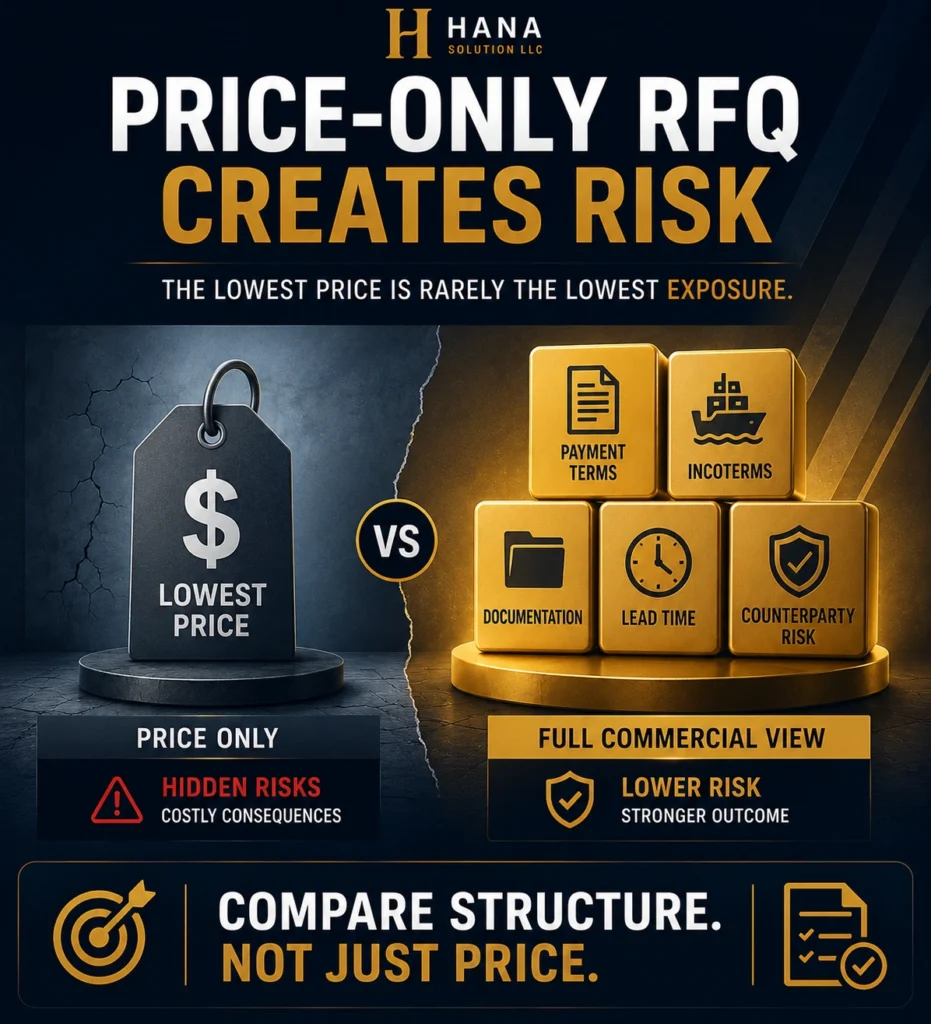
Price-Only RFQ Comparison: The Core Problem
In RFQ governance engagements conducted across multiple sectors and buyer markets, price-only comparison was the most frequently observed structural failure in the supplier selection process. Buyers received three to six quotations, ranked them by unit price, and selected the lowest — treating price as a proxy for overall commercial value. It is not.
A quotation is a commercial document that contains multiple variables beyond price: payment terms, advance payment requirements, lead time commitments, documentation standards, quality guarantees, and counterparty identity. A buyer who evaluates only the price variable is accepting all other variables without review — and those variables determine the actual commercial exposure of the engagement.
The lowest price quotation is frequently the highest risk quotation. The price difference between the lowest and second-lowest response rarely reflects the risk difference embedded in the non-price terms.
The Hidden Variables in Every RFQ Response
Across RFQ governance reviews conducted before commercial engagement, the following variables were consistently found to carry more commercial significance than the price differential between competing responses.
What Structural RFQ Benchmarking Looks Like
Structural RFQ benchmarking evaluates all variables in a quotation response — not price alone. The following framework reflects the benchmarking approach applied in buyer-side RFQ governance engagements.
| Parameter | What to evaluate | Why it matters |
|---|---|---|
| Unit price | Ex-factory or DDP — confirmed basis | Comparable only when Incoterm is identical |
| Payment terms | Advance %, balance trigger, title transfer | Determines buyer financial exposure before delivery |
| Lead time | Production + shipment — confirmed capacity | Reliable only from direct manufacturer |
| MOQ | Minimum per order, per SKU | Trader MOQs are manufacturer MOQs plus margin |
| Documentation | Certificate of origin, compliance docs, test reports | Required for customs and market placement |
| Counterparty status | Manufacturer vs trader — registry confirmed | Determines production control and compliance traceability |
| Certification scope | Certificate applies to specific product — confirmed | Scope mismatch = compliance failure at customs |
Why RFQ Standardisation Must Precede Comparison
Structural comparison is only possible when RFQ responses are structured against identical parameters. An RFQ that does not specify payment term structure, documentation requirements, and Incoterm basis will receive responses that cannot be structurally compared — because each supplier has defined these terms differently.
In RFQ governance engagements where parameters were standardised before issuance, the resulting responses were structurally comparable — payment terms, lead time basis, and documentation commitments were specified consistently across all responses. Where parameters were not standardised, price was the only comparable variable because all other variables were defined differently by each supplier.
RFQ standardisation before issuance is not additional work — it is the work that makes comparison possible. Without it, the buyer is not comparing suppliers. They are comparing each supplier's preferred commercial terms against each other.
Frequently Asked Questions
Price-only RFQ comparison is the practice of evaluating supplier quotations based solely on unit price, without reviewing payment terms, lead time reliability, documentation commitments, or counterparty clarity. It is a problem because price is one variable in a multi-variable commercial document. Selecting a supplier based on price alone means accepting all other variables — including payment exposure, compliance risk, and production control — without review.
An RFQ that enables structural comparison must specify: Incoterm basis, payment term structure, lead time definition, MOQ per SKU, required documentation, certification requirements for the target market, and quality standard commitments. When these parameters are specified in the RFQ, supplier responses can be benchmarked against a consistent framework rather than compared only on price.
A quotation from a trader and a quotation from a manufacturer at the same unit price are not comparable. The trader's price includes a margin on top of the manufacturer's price — which means the manufacturer's actual production cost is lower, and their pricing flexibility is higher. More significantly, the trader's commitments on lead time, quality, and compliance are contingent on a manufacturer they do not control — creating an execution risk layer that the buyer cannot manage or verify.
The governance decision output categorises each supplier response as Retained — meeting all structural parameters and advancing to commercial negotiation — or Not Advanced — failing one or more structural parameters and removed from the shortlist. This decision is made before price negotiation begins, ensuring that commercial negotiation proceeds only with suppliers whose structural profile meets the defined governance standard.
Yes. RFQ Governance & Quotation Analysis is a standalone service covering RFQ standardisation, structural benchmarking, payment exposure review, documentation completeness assessment, and governance decision output. It can be engaged independently or as part of a broader sourcing governance engagement that includes supplier mapping and verification.
Submit a project brief. We standardise your RFQ parameters, benchmark all responses against a structural framework, and deliver a governance decision before negotiation begins.