
Hana Solution LLC – Insights
Why Manufacturing Investment Decisions in Kosovo Start Before the Equipment
Manufacturing investment in Kosovo is frequently evaluated equipment-first — product selected, machinery sourced, facility identified — while the variables that actually determine project viability sit outside that sequence entirely. Institutional capacity, infrastructure reliability, and export market recognition status are rarely checked before capital is committed.
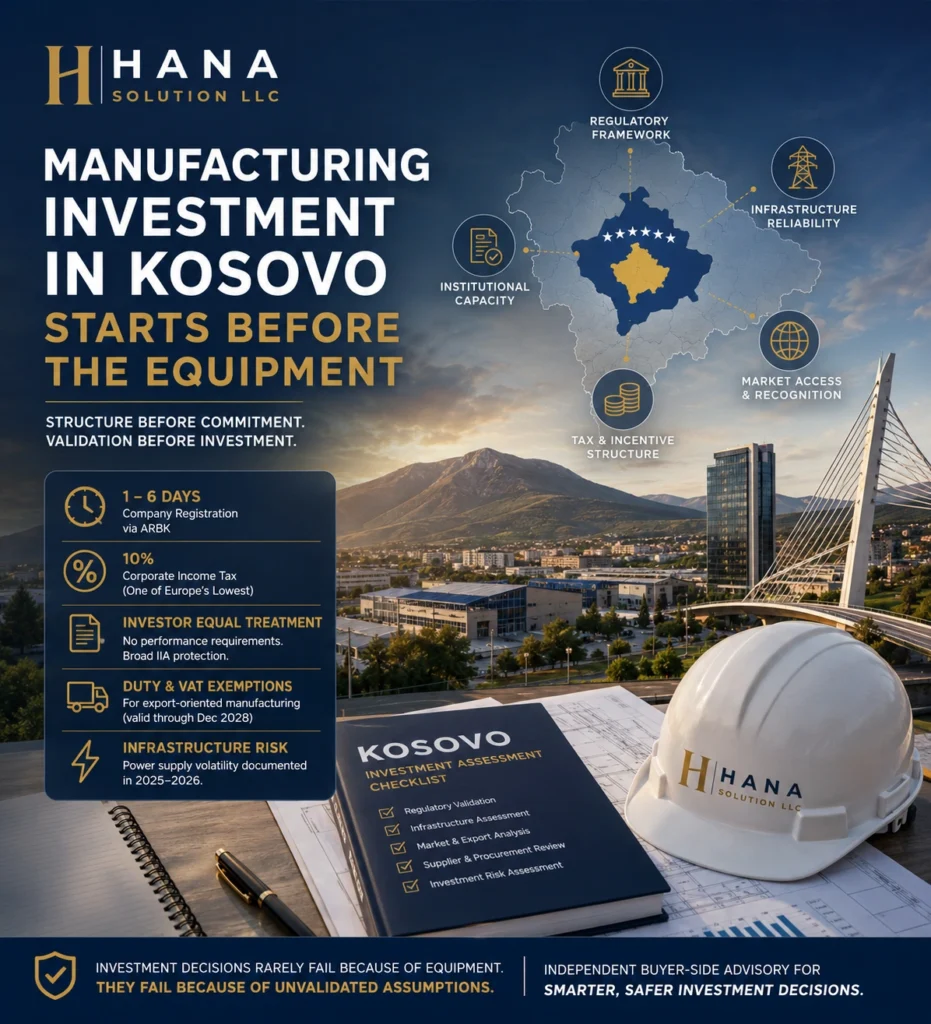
Manufacturing Investment in Kosovo: Why Equipment Is Not the First Decision
Two manufacturing projects can purchase exactly the same production equipment. One reaches commercial production. The other never becomes operational. The difference is rarely the equipment. It is usually the assumptions that were never validated before the purchase order was signed.
Manufacturing investment in Kosovo is frequently evaluated equipment-first — product selected, machinery sourced, facility identified — while the variables that actually determine project viability sit outside that sequence entirely. Institutional capacity, infrastructure reliability, and export market recognition status are rarely checked before capital is committed.
Kosovo's Investment Framework — What the Institutions Actually Cover
Company registration is administered by the Agency for Business Registration (ARBK), operating under the Ministry of Industry, Entrepreneurship and Trade (MIET). Registration typically completes in one to six business days, with the legal certificate issuable in as little as two. Since June 2025, initial company registration has also been available through the e-Kosova electronic platform, alongside the existing in-person process. Corporate income tax is a flat 10 percent — one of the lowest rates in Europe. Standard VAT is 18 percent, with an 8 percent reduced rate applying to specific categories including food and agricultural products. Production inputs and raw materials used to manufacture export goods can be imported free of customs duty and VAT, and under the Law on Economic Recovery, this exemption for export-oriented domestic manufacturing remains in effect through 31 December 2028.
Since September 2024, Kosovo's investment promotion structure has been undergoing a formal reorganisation. The Law on Sustainable Investment dissolved the previous single agency — the Kosovo Investment and Enterprise Support Agency (KIESA) — into two separate bodies: the Agency for Investment and Export (AIE), operating under the Prime Minister's Office as a stated single point of contact for investors, and a separate enterprise-support agency. For projects that qualify for Strategic Investor status under Law No. 05/L-079, the law requires that once status is granted, licence and permit applications must be forwarded to the relevant public institutions within five working days of submission.
Two things are worth separating here. The legal framework is genuinely investor-favourable on paper: equal treatment for foreign and domestic investors, no performance requirements, and bilateral investment protection agreements with a wide range of countries, including Turkey. But successive U.S. Department of State Investment Climate Statements — in 2019 and again in 2025 — have noted the same structural gap: no single entity has been consistently empowered to coordinate investment support end-to-end, and reported agency capacity has lagged the scope of its stated mandate. Neither fact cancels the other out. A favourable legal framework and an under-resourced implementation layer can be true at the same time, and a manufacturing investor needs to plan for both.
Low tax rates and fast registration describe how easy it is to start a company in Kosovo. They do not describe how reliably that company can operate one once production begins.
The Infrastructure Question Most Investors Skip Before Buying Equipment
Production equipment is selected based on output specifications — units per hour, power draw, automation level. What is less commonly checked is whether the facility's power supply can sustain that equipment's operating profile without interruption.
This is not a theoretical concern in Kosovo. The country generates roughly 92 to 94 percent of its electricity from two ageing lignite-fired plants, and the sector has faced acute strain through the winter of 2025 into 2026. Following the formal liberalisation of Kosovo's electricity market in mid-2025 — alongside a 16.1 percent price increase — the Kosovo Chamber of Trade and Industry reported that member businesses experienced frequent, unannounced power cuts. By its own account, two member companies halted production entirely as a direct result, and others considered workforce reductions. In August 2025, the distribution operator disconnected roughly 450 businesses that had not secured supply contracts under the new liberalised system. By January 2026, the transmission system operator reported demand-supply imbalances reaching as high as 26 percent in a single period, triggering load-shedding as what it described as a last-resort stabilisation measure.
None of this means manufacturing in Kosovo is unworkable. It means power supply reliability is a variable that has to be investigated and priced into a project plan before equipment with continuous-run requirements is ordered — not after a production line has already gone down mid-batch.
Procurement decisions made without infrastructure validation transfer operational risk directly into production.
How Kosovo's International Recognition Status Affects a Manufacturing Project
This is a structural detail most investment guides skip, and it has practical consequences for trade documentation and banking. As of 2026, Kosovo is recognised by 117 countries, including the United States, the United Kingdom, Germany, France, and Italy. It is not recognised by Russia, China, Serbia, and five European Union member states — Spain, Slovakia, Romania, Greece, and Cyprus. For a manufacturing project intending to export into the EU, this matters at the level of customs documentation, certificate recognition, and — in specific transaction structures — banking relationships, depending on which EU jurisdictions sit in the trade route. It does not block standard commercial activity, but it is a fact that should be checked against a project's specific export markets, not assumed away.
Why "World Bank Ranking" Citations for Kosovo Are Often Outdated
A specific, recurring error is worth naming directly. Older investment materials frequently cite a "World Bank Ease of Doing Business" rank for Kosovo — commonly a figure in the 40s or 50s. The World Bank discontinued the Ease of Doing Business report in September 2021 following a data-integrity review. It has been replaced by a different methodology, Business Ready (B-READY), which does not publish single composite country rankings in the same format. Any current source quoting Kosovo a specific "Doing Business rank" is citing a discontinued, frozen dataset — not a current assessment.
This matters because investment decisions are sometimes built on exactly this kind of citation, carried forward without anyone checking whether the underlying report still exists.
A fact that was true in a 2020 report is not automatically true in 2026. Verifying that an investment data point is still current is part of due diligence — not a footnote to it.
Supplier Selection Is Not the Same as Investment Validation
A manufacturing project can have the right equipment and a credible supplier identified, and still rest on an investment that was never properly validated. Equipment specification answers what the machine can produce. Supplier evaluation answers whether the counterparty can deliver it. Neither answers whether the underlying institutional, infrastructure, and market assumptions behind the project hold up — and in Kosovo specifically, those three variables are the ones most consistently skipped, because none of them appear on an equipment data sheet or a supplier profile.
How Hana Solution Approaches Manufacturing Investment Assessments
Hana Solution applies the same buyer-side procurement governance framework used across Turkey-origin sourcing engagements to manufacturing investment assessments in Kosovo. The assessment separates what the legal framework promises from what institutional capacity actually delivers, and treats infrastructure and market-recognition risk as factors to be priced in before capital is committed — not discovered afterward.
- Regulatory and institutional verification
- Infrastructure and supply reliability assessment
- Supplier and facility capability review
- Investment assumption validation
- Procurement governance structuring
- Independent buyer-side reporting
Pre-Investment Checklist for Manufacturing Projects in Kosovo
-
1Confirm the current institutional structure
Verify whether a given investment process now sits with the Agency for Investment and Export (AIE) or a different body, given the 2024 reorganisation, rather than relying on older KIESA-only references.
-
2Separate legal framework from implementation capacity
Kosovo's investment law is genuinely favourable; agency execution capacity has been independently flagged as a separate, ongoing constraint by successive U.S. Department of State reports.
-
3Price in power supply risk before ordering equipment
Confirm backup power requirements and supply contract terms for any production line with continuous-run sensitivity, given documented 2025–2026 grid instability.
-
4Check export market recognition status
Confirm whether Kosovo's non-recognition by specific EU member states affects the intended export route's documentation or banking requirements.
-
5Verify that any cited ranking or statistic is still current
Discontinued datasets, such as the former Doing Business rankings, continue to circulate in outdated investment material.
Frequently Asked Questions
Kosovo applies a flat 10 percent corporate income tax rate. Standard VAT is 18 percent, with an 8 percent reduced rate on specific categories including food and agricultural products. Production inputs used for export-oriented manufacturing can be imported free of customs duty and VAT under provisions currently in effect through 31 December 2028.
Registration through the Agency for Business Registration (ARBK), under the Ministry of Industry, Entrepreneurship and Trade, typically completes within one to six business days, with the legal registration certificate itself issuable in as little as two days. This applies equally to foreign and domestic investors, and is also available through the e-Kosova electronic platform since June 2025.
The Law on Sustainable Investment, in force since September 2024, dissolved the previous single investment agency (KIESA) and established the Agency for Investment and Export (AIE) under the Prime Minister's Office, alongside a separate enterprise-support agency. The reorganisation was intended to reduce bureaucratic fragmentation for investors.
Power supply reliability has been a documented, active concern through 2025 and into 2026, following electricity market liberalisation and reported grid imbalances. This does not rule out manufacturing investment, but it is a variable that should be assessed — including backup power and supply contract terms — before equipment with continuous-run requirements is selected.
Hana Solution applies buyer-side procurement governance to manufacturing investment assessments in Kosovo — separating regulatory framework from institutional execution capacity, evaluating infrastructure risk, and verifying that investment data cited in planning materials is current before equipment, facility, or licensing decisions are made.
Submit a project brief. We assess regulatory, institutional, and infrastructure risk before capital is committed. No trading. No commissions. Buyer-side only.