
Low-MOQ Clothing Manufacturers in Turkey: What Private-Label Buyers Should Confirm
A Turkish clothing manufacturer may accept a small order, but the minimum can apply to each style, colour, fabric or production process. Before requesting a quotation, confirm what the stated MOQ covers, whether stock fabric is available and what is included in sampling, labels and packaging.
Last reviewed: November 2026

01 · What Does “Low MOQ” Actually Mean?
MOQ means minimum order quantity, but one clothing order can carry several minimums. The same “low MOQ” claim can refer to the order, each style, each colour or the fabric, so ask for the full breakdown in writing.
| Minimum | What to ask |
|---|---|
| Per order | Can different products be combined in one order? |
| Per style | Is each T-shirt, polo or shorts model counted separately? |
| Per colour | Can the quantity be split across colours? |
| Per size | Can sizes be mixed within the minimum? |
| Per fabric or colour lot | Is the fabric in stock, or must a minimum be knitted, woven or dyed? |
| Per print, label or trim | Do printing, woven labels, zips or packaging have their own minimums? |
A quoted minimum for an order does not automatically mean you can split it across several styles and colours. Find manufacturers by sector: Textile & Apparel · Home textiles
“A low or ‘no MOQ’ offer means a factory will make my design in small quantities.”
A low headline minimum may rest on stock fabric, an existing style or a specific production arrangement. It does not show what applies to your own design, colours and fabric.
What the minimum applies to
A custom colour or fabric can bring the fabric supplier’s own minimum, whatever the sewing unit accepts. Ask whether the quoted minimum is per style, colour or size, and whether it changes with your own fabric. See how to tell a Turkish manufacturer from a trader →
02 · Fabric and Private Label: What Sets the Real Minimum?
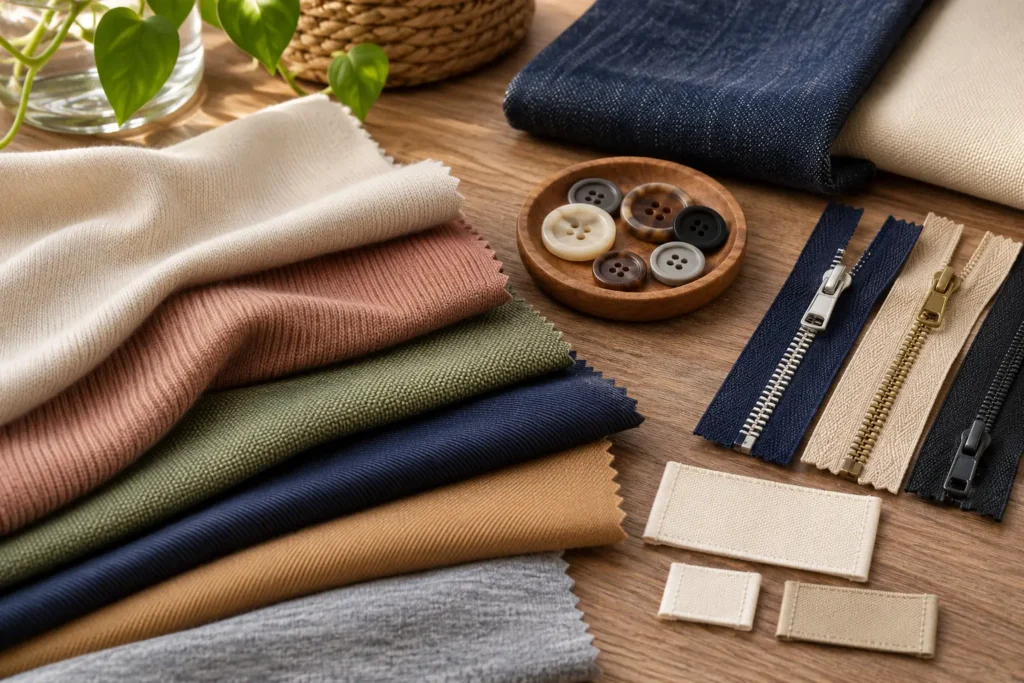
Fabric is often the first decision in a small clothing order. Private label describes whose brand appears on the garment; the product can be an existing style, an adapted style or your own design. Full package and CMT describe how materials and production are divided, and either can be combined with private label.
| Fabric option | Potential advantage | What to confirm |
|---|---|---|
| Stock fabric | May support a smaller first run without a new fabric production run | Composition, weight, colour, available quantity and whether the same fabric can be bought again |
| Custom fabric or dyeing | More control over construction, colour and finish | Fabric minimum, development cost, lead time, test evidence and who pays for unused fabric |
| Buyer-supplied fabric | Keeps a specific material if the manufacturer accepts it; often used in CMT arrangements | Delivery, technical suitability, defects, yield and cutting losses, and who supplies trims, labels, patterns, finishing and packaging |
- Existing style with your branding
- Existing pattern with agreed changes
- Custom development from a tech pack or reference sample
- Number of samples and revisions included
- Pre-production sample approved in writing
- Lead time counted from a named approval
A small order does not include unlimited product development: agree samples, revisions, pattern ownership and costs before work begins. Stock fabric available today is not a promise of repeat availability. Performance claims such as stretch or moisture management need test reports, not a fabric description. On a small first order, also compare the total start-up cost, not only the unit price: samples, pattern work, print or label minimums and freight do not shrink with the quantity. To compare offers line by line, use the supplier quotation comparison checklist →
Product and intended use
Number of styles, and quantity per style and colour
Fabric composition and weight, or “stock fabric acceptable”
Print, embroidery, labels, hangtags and packing
Tech pack, measurements or a reference garment
Destination market, target delivery and target price basis
03 · Who Will Actually Make Your Garments?
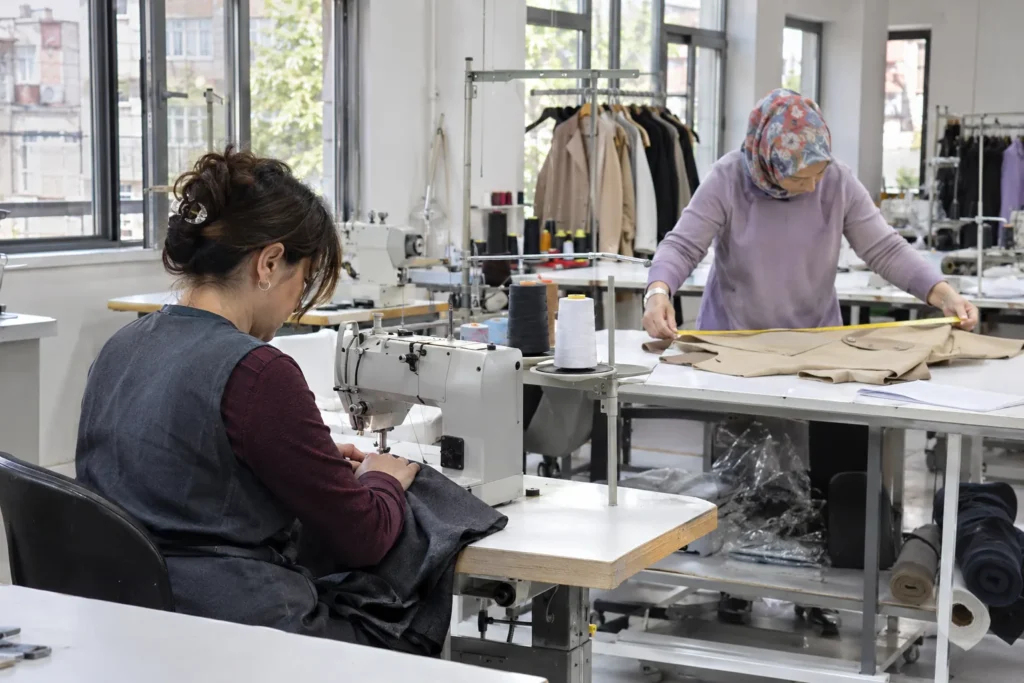
Turkish apparel production often involves more than one company. A seller may sew in-house, use subcontracted workshops for some stages, or buy finished garments from another producer. Each can work; you need to know which applies to your order.
| First contact can show | It cannot establish on its own |
|---|---|
| A showroom, catalogue and sample garments | That the seller sews the garment you will order |
| A factory address on the website | Which site will cut, sew, print and pack your order |
| A certificate logo on the offer | That the certificate names this company and covers your garment |
| A low quoted minimum | That it applies to your fabric, colours and sizes |
1. Which company invoices you, and which site cuts and sews your order?
2. Which stages, such as printing, embroidery, washing or packing, are subcontracted?
3. Is the quoted minimum per style, colour or size, and does it include your own fabric?
4. Which certificate covers the finished garment, and which company is named on it?
Many Turkish producers use specialist workshops for printing, washing or embroidery. Ask which stages are subcontracted and how quality is checked across them.
04 · What We See in Practice
- Four quotations from Turkish ready-made garment suppliers
- All four referred to OEKO-TEX certification
- The choice was about to be made mainly on unit price
- Two certificates covered finished garments
- Two covered only yarn
- Two offers re-quoted on one common basis
A low price only helps when the scope matches. An EU/UK buyer held four garment quotations and was about to choose mainly on unit price. All four referred to OEKO-TEX certification, but two certificates covered only yarn, not the finished garment. Hana Solution LLC separated the certificates and aligned delivery, payment and document terms, so the buyer negotiated with the two suppliers whose certificates matched the garment. The buyer already had the quotations; this was a quotation comparison, not a low-MOQ manufacturer search. Read the case →
05 · Decision: Is Your Clothing Project Ready for Quotes?
Check your own brief before you ask for prices. Record what is fixed, what can change and what still needs an answer from manufacturers.
- When it applies
- Product, quantity per style and colour, basic fabric direction and target market are clear enough for manufacturers to assess
- Next step
- Send the same brief to suitable candidates
- When it applies
- The MOQ basis, fabric availability, development scope or price basis is still unclear
- Next step
- Get written answers before comparing offers
- When it applies
- The quantity, fabric or performance needed cannot yet be matched to a workable production model, or key information is missing
- Next step
- Decide which requirement can change: quantity, colours, fabric, design or timing
This is a preliminary sourcing decision. It does not confirm quality, compliance or delivery. Read: Supplier Qualification Before RFQ →
How Hana Solution LLC helps: we work on the buyer side for brands sourcing clothing from Turkey. Depending on the agreed scope, we review your product and quantities, shortlist manufacturers whose minimums and production model fit, check stated production roles and low-MOQ conditions, and compare quotations on the same technical and commercial basis. Scope, fixed fee and timing are agreed in writing before work begins, with no supplier commissions, no mark-ups and no percentage of your order. No manufacturer yet: Supplier Mapping & Shortlisting → Supplier already found: Supplier Verification → Quotes in hand: RFQ & Quote Comparison →
06 · Common Mistakes With Low-MOQ Clothing Orders
- Taking “no MOQ” at face value. Some no-MOQ offers relate to ready-made or stock garments with branding added; others involve different arrangements. Ask whether the garment is made to your design, who produces it and what costs apply to small quantities.
- Splitting a minimum too thin. Several styles, colours and sizes can leave each variant below what a factory will run.
- Comparing prices across different scopes. A full-package price and a CMT price buy different things, even for the same private-label garment.
- Expecting free development. Agree samples, revisions and pattern ownership before work begins.
- Accepting a certificate logo. Check the holder, certified article and validity. If you require a GOTS- or OCS-certified product, check the applicable scope certificate and ask how the transaction certificate for your order will be issued. See OEKO-TEX scope →
- Leaving lead time undefined. Name the approval that starts the production clock.
Most of these are avoided by writing a clear brief and asking each supplier to confirm the minimum and scope in writing.
Facing a similar step? Choose yours and send a short brief:
Choose Your Next Step
Each service is priced and engaged separately; see the Turkey sourcing services page.
Questions About Low-MOQ Clothing Production in Turkey
Minimums, 50- or 100-piece runs, private label, full package and CMT, tech packs and sample costs.
Related: Supplier Mapping & Shortlisting → RFQ & Quote Comparison → Supplier Verification → How we work →
Related guides: Manufacturer or trader? → How to find manufacturers in Turkey → OEKO-TEX certificate scope →
See it in practice: Case study: 2 of 4 OEKO-TEX Certificates Covered Only Yarn →
This guide explains how buyers can assess low-MOQ clothing production in Turkey. It is not legal advice. Official sources: OEKO-TEX Label Check · GOTS Certified Suppliers Database · Textile Exchange – Find a Certified Company · EU textile labelling · Great Britain textile labelling · MERSIS · Trade Registry Gazette. These sources support supplier and certificate checks; they do not confirm garment quality, fit or delivery.
What is a low MOQ for clothing production in Turkey?
There is no single number for every manufacturer or garment. The minimum depends on the style, colour, fabric, print and production model. Ask for a quantity breakdown specific to your order.
Can I produce 50 or 100 garments per style in Turkey?
Some suppliers advertise production at these quantities, particularly for selected products or stock-fabric options. Whether your project is workable depends on the garment, colour split, fabric, branding and production method. Ask each supplier to confirm the minimum and scope against your actual brief.
Is the MOQ per style or per colour?
It depends on the manufacturer and the project. Ask whether sizes can be mixed and whether colours or styles can be combined within the quoted minimum.
What is the difference between private label, full package and CMT?
Private label describes whose brand appears on the garment; the product may be an existing style, an adapted style or a custom design. Full package and CMT describe how production and materials are divided. In full package, the supplier generally sources the agreed materials and produces the garment. In CMT, the buyer commonly supplies the fabric and sometimes trims, while the supplier performs the agreed cutting, sewing and finishing. Confirm the exact scope in writing.
Do I need a tech pack?
Not always for a first discussion; a reference garment or clear brief can start it. Measurements, materials, construction and branding must be defined before the final sample and bulk order.
Does a low-MOQ quote include samples and labels?
Not necessarily. Ask the supplier to show development, samples, revisions, labels, packaging and delivery costs separately in writing.
Can Hana Solution LLC find low-MOQ clothing manufacturers in Turkey for me?
We review your product, quantities and requirements, then propose a buyer-side manufacturer search if the project fits our scope. We report which candidates meet the brief, which points need clarification and where the market may not support a requirement. Scope, fixed fee and timing are agreed in writing before work begins.

Looking for Low-MOQ Clothing Manufacturers in Turkey?
Share the garment, number of styles, quantity per style and colour, whether stock fabric is acceptable, your development status (tech pack, reference garment or idea), target price and basis if known (EXW Türkiye or delivered) and your destination market. We will review your brief and reply within one business day with any questions or the recommended next step. The scope, fixed fee and timing are confirmed in writing before work begins.
